
The ANZIAM medal is our most prestigious award. At most one award will be made annually, but only to a candidate of sufficient merit. The selection criteria for the award are:
- Outstanding research in Applied and/or Industrial Mathematics, where a significant proportion of the research work has been carried out in Australia and/or New Zealand.
- Distinguished service in the field of Applied Mathematics. Service in ANZIAM related activities will be highly regarded.
- Membership of ANZIAM for at least the five calendar years preceding the year in which the award is made or, in the case of retired members, the five years prior to retirement. Backdating of membership is not acceptable.
The first award was made at the 1995 ANZIAM conference. Between 1995 and 2017, the ANZIAM Medal was awarded at most biennially.
Winners of the ANZIAM Medal
-
1995 Professor Renfrey B. Potts
The Selection Panel for the 1995 ANZIAM Medal proposes that the Medal be awarded to Professor Renfrey Burnard Potts.
CITATION FOR THE ANZIAM MEDAL
We cite the followingoutstanding contributions of Professor Potts in terms of the selection criteria for the medal.
- Research achievements
Professor Potts’s research career involves some main fields
- Ising-type models in mathematical physics
- car-following and road traffic
- operations research, especially networks
- difference equations
- robotics
Professor Potts’s status is high in each of these fields, and they are in some ways so distinct that one comes across people who view him as a leader in one of them, without being aware that he has ever contributed in the others. He has published more than 90 journal and conference papers, spread fairly evenly across the above fields. His most-cited paper (in Proc. Camb. Phil. Soc., 1952) is in the first field, and the “Potts model” still represents a major topic for research by others in that field. But Operations Research is perhaps his most important field, and he was largely responsible for the development of this field in Australia. His work on difference equations is related to, and to a certain extent anticipates, modern research on chaos.
In addition he supervised 21 PhD students, many of whom now occupy positions of importance in the research community. He was elected a Fellow of the Australian Academy of Science in 1975.
- Activities enhancing applied or industrial mathematics, or both
Professor Potts was almost single-handedly responsible for the strong growth of the discipline of applied mathematics at the University of Adelaide, and in particular for its existence as a separate department from 1974. He has also been active in mathematical education matters on the national and international scene, including taking the lead in the organisation of the 1988 Mathematical Olympiad, the 1984 ICME Conference, the Academy of Science “Mathematics at Work” books, and as an early opponent of “New Maths”.
Professor Potts has had a strong influence on industrial applications of mathematics in Australia. This is manifested in the direct industrial application of his research, his consulting work with private and government departments, his organisation work for the Academy of Science, and as Foundation President of the South Australian Computer Society (which was the forerunner of the large and high profile Australian Computer Society).
- Contributions to ANZIAM
Professor Potts played a major role in the activities of the Division of Applied Mathematics of the Australian Mathematical Society (the progenitor of ANZIAM). He was instrumental in its formation in 1973, Chairman in 1978-9, an Executive Member in 1974 and 1986, and an Associate and Assistant Editor of its journal during most of its history. He was an invited speaker at the annual conference of the Division in 1973 and 1976. As always, the Potts lectures were well attended for he is a brilliant lecturer and communicator.
- Recommendation
Professor Potts has played an outstanding role in applied mathematics in Australia for more than 35 years. His achievements have been recognized by his investitute in 1991 as an “Officer of the Order of Australia”. For his splendid achievements that have done so much to shape Industrial and Applied Mathematics in Australia, the Selection Panel recommend that Professor Potts be awarded the inaugural ANZIAM Medal.
-
1997 Professor Ian H. Sloan
The Selection Panel for the 1997 ANZIAM Medal proposes that the Medal be awarded to Professor Ian Hugh Sloan.
CITATION FOR THE ANZIAM MEDAL
We cite the following outstanding achievements of Professor Sloan in relation to the selection criteria for the medal.
- Research achievements
Professor Sloan’s research career has two main emphases – theoretical physics and numerical analysis. He began his research career in theoretical nuclear physics, particularly in the area of few-body collision problems for small systems of particles. His contributions to theoretical physics include some 35 articles in international journals.
In the mid 70s, Professor Sloan transferred his attention to numerical analysis, particularly to the study of integral equations which figures in his theoretical physics research. Since then, he has made extensive contributions to the numerical solution of integral equations of the second kind, the study of weakly singular kernels in second kind integral equations, the convergence and stability of product integration, convergence results in approximation theory, integral equations on semi-infinite intervals, novel methods (`qualocation’) for solving boundary integral equations, the numerical evaluation of high dimensional multiple integrals, and finite elements. His work has resulted in over 100 articles in international journals and an Oxford University Press book with S. Joe entitled “Lattice Methods for Multiple Integration”. This is the first book on this subject.
Professor Sloan’s research has been recognised through the following honours and achievements
- Fellow of Australian Academy of Science (1993)
- representation on editorial panels of many journals (SIAM J Numerical Analysis, Advances in Computational Mathematics, J Integral Equations andApplications, IMA J Numerical Analysis, J Computational and Applied Mathematics, J Austral Math Soc B)
- numerous invitations to international meetings as an invited speaker, prolific winner of ARC grants, including a half million dollar grant from 1988-93 for “Numerical analysis for integrals, integral equations and boundary value problems”
- Activities enhancing applied or industrial mathematics, or both and Contributions to ANZIAM<
Professor Sloan has had a major influence on the development of applied mathematics in Australia in the last two decades. An early major contribution was as Editor of the Journal of the Australian Mathematical Society, Series B from 1978-82. At the time he was appointed, the Journal was in difficulties, and the previous Editor had recommended that the Journal be closed down. In his five years at the helm, Professor Sloan established the Journal on the secure, internationally-recognised basis that continues to this day.
Professor Sloan played a full role in the Division of Applied Mathematics of the Australian Mathematical Society (the progenitor of ANZIAM). He was Director of the 1977 annual meeting and Chair of the Division from 1989-90. He is also on the Council of the Australian Mathematical Society and the Council of the Australian Academy of Science.
From 1991-96, Professor Sloan was Chair of the National Committee for Mathematics of the Australian Academy of Science. He displayed consummate political and networking skills to develop the role of this Committee. As a result of his leadership, the various Australian professional associations in the mathematical sciences now collaborate in better fashion than ever before. He was the driving force in setting up the recent ARC-funded strategic review of the mathematical sciences in Australia.
In 1996, Professor Sloan was appointed to a three year term on the Physical, Mathematical and Chemical Sciences panel of the Australian Research Council.Professor Sloan also played a major role in regional activities, particularly as Head of the School of Mathematics at the University of NSW (one of the largest mathematics departments in Australia) from 1986-90 and 1992-93, and as Chair of the NSW Centre for Parallel Computing.
In all of these activities, Professor Sloan is universally recognised as visionary, articulate, influential and energetic.
- Recommendation
Through his research achievements and work for the benefit of the profession, Professor Sloan has contributed enormously to the development of applied mathematics in Australia for more than 30 years. At home and abroad, he is widely recognised as an outstanding leader of the profession. For these sustained and valuable contributions, the Selection Panel recommends that Professor Sloan be awarded the 1997 ANZIAM Medal.
-
1999 Professor Ernest O. Tuck
The Selection Panel for the 1999 ANZIAM Medal proposes that the Medal be awarded to Professor ERNEST OLIVER TUCK
CITATION FOR THE ANZIAM MEDAL
Ernest Tuck was born in Adelaide, South Australia on June 1st 1939.
At the University of Adelaide he graduated in 1958 with the ordinary B Sc Degree, and in 1960 with the Honours B Sc Degree with First Class Honours in Mathematics.
In 1964 he obtained his Ph D degree at Cambridge University, England.
His major distinctions include:
- the award of the Sir John Gellibrand Scholarship in 1959,
- his election as a Fellow of the Australian Academy of Science in 1988,
- the award of the George Weinblum Lectureship in 1990,
- his election in 1995 as a Fellow of the Australian Academy of Technological Sciences and Engineering,
- and the award of the Australian Academy of Science of the 1999 Thomas Ranken Lyle Medal.
He has held academic positions at:
- Manchester University, England,
- at the David Taylor Model Basin and the California Institute of Technology in the USA,
- and since 1968 at the University of Adelaide, where he is currently Elder Professor of Applied Mathematics.
At Adelaide he has been Chair of the Department of Applied Mathematics for several periods, and has served as Dean of the Faculty of Mathematical and Computer Sciences.
Tuck has a national and international reputation for his research in Applied Mathematics.
He has published over 150 papers covering a wide range of topics in:
- ship hydrodynamics,
- aerodynamics,
- hydraulics,
- bio-fluid dynamics,
- and games theory.
His work is distinguished by its originality and flair, at times its basic simplicity, its computational excellence, and its successful application to real problems.
He has worked with:
- the US and Australian Navy Departments,
- the Shell Oil Company,
- and the Australian Defence Science and Technology Organisation.
As a stimulating and gifted lecturer and supervisor, he has greatly influenced a large number of students and colleagues and has particularly helped to promote Applied Mathematics in Adelaide and throughout Australia.
He has supervised 30 postgraduate students, many of whom have already established successful careers in Australia and overseas.
Ernest Tuck has made a major and unique contribution to the activities of ANZIAM.
- In 1984 he was appointed Editor of Series B (Applied Mathematics) of the Journal of the Australian Mathematical Society.
- On relinquishing the Editorship in 1992, he established a Unit TeXAdel responsible for producing from accepted manuscripts, camera-ready copy for the printing of the AMS journals.
- He has actively supported ANZIAM conferences, attended most, and he and his students have given many presentations.
- He has served on the ANZIAM committee for several years and he has recently completed a two-year term as Chair.
In summary, Ernie Tuck has given outstanding service to the profession of Applied Mathematics through his academic teaching, research and administration and his interaction with end-users.
He is a long-term member of ANZIAM, has served as a committee member and Chair, and has been very active in the organisation of and participation in the annual conferences.
His contribution to ANZIAM activities has been unsurpassed.
-
2001 Associate Professor Charles E.M. Pearce
The Selection Panel for the 2001 ANZIAM Medal proposes that the Medal be awarded to Professor C.E.M. Pearce of the University of Adelaide.
CITATION FOR THE ANZIAM MEDAL
Charles Pearce’s research career has included work in a number of fields of applied mathematics, with applied probability being particularly prominent. He has published more than 120 papers, most in refereed international journals, and has been a principal investigator on ARC-supported projects to a total value of about $750,000. His early work was mostly in queuing theory; his contributions are very well known internationally, and he was a pioneer in studies of generalised input structures and networks of queues. More recent work has ranged over a very broad sample of applied mathematics, including operations research, mathematical biology and mathematical methods, especially involving inequalities. His research output has if anything increased in pace over the years, and he is one of the most prolific of Australian mathematicians.
Dr. Pearce has made sustained and outstanding contributions to ANZIAM. He has been a member of ANZIAM since 1985, and in 1987 he became an Associate Editor of the then Journal of the Australian Mathematical Society, Series B. In 1993 he was appointed Editor of that Journal, and since 2000 has acted as Chair of the Editor’s Committee on the Council of the Australian Mathematical Society. During his editorship, Charles has very successfully developed the scope and readership of the Journal, and has recently overseen its name transition to the “ANZIAM Journal”. Charles has been an active and valuable co-opted member of the Executive of ANZIAM and of the Council of the Australian Mathematical Society during his period as Editor, and has attended almost all ANZIAM and AustMS conferences during that period.
In addition to contributions via ANZIAM, Dr. Pearce has engaged in many activities enhancing applied or industrial mathematics. For example, he as been a Councillor of the Australian Society for Operations Research since 1983 and is presently an Editor of its Bulletin, SA State President and National President. Through his activities for both ANZIAM and ASOR, Charles Pearce has made a singular contribution to Australian applied and industrial mathematics. He is also an Editor of the international journal Mathematical Inequalities and Applications, and of the Australian Mathematical Society’s Lecture Series. Charles is a member of several professional societies, and a regular referee for many international journals.
Within the University of Adelaide, as Associate Professor in the Applied Mathematics Department, Charles has promoted applied and industrial mathematics by serving on departmental, faculty and university-wide committees, and external assessment bodies. He was prominent in the establishment of the Teletraffic Research Centre within the Applied Mathematics Department. Charles has supervised more than 20 PhD students, and 6 MSc students, some of whom have gone on themselves to make important contributions to applied and industrial mathematics in Australia or overseas.
Charles Pearce is an outstanding contributor to our discipline, and more than meets the criteria for this award. It is therefore with great pleasure that the Selection Panel recommends that Associate Professor Charles Pearce be awarded the ANZIAM Medal for 2001.
-
2004 Professor Roger H.J. Grimshaw
The Selection Panel for the 2004 ANZIAM Medal proposes that the Medal be awarded to Professor Roger Grimshaw. We cite the following outstanding contributions by Professor Grimshaw in terms of the selection criteria for the medal.
CITATION FOR THE ANZIAM MEDAL
Roger Grimshaw’s research career is mainly in fluid mechanics, with emphasis on waves. He has published more than 200 papers, most in refereed international journals, plus 3 books, and 15 book chapters. He has been a principal investigator on more than 20 major external grants (including 14 ARC grants in 1990-2001) to a total value of more than the equivalent of A$3 million. His 1964 Cambridge PhD was in sound waves, but soon after then his interest shifted toward fluid mechanics, where he became and has remained one of the world leaders, especially in nonlinear wave theory, with applications in oceanography and geophysics.
Prof. Grimshaw’s academic and professional merit has been recognised by many awards, appointments, and elections to significant bodies. He has been a Fellow of the Australian Academy of Science since 1990. He is on the Editorial Board of more than 10 international journals. He is presently (since 2000) Professor of Mathematical Sciences at Loughborough University, UK, and was previously Professor of Applied Mathematics at Monash University (1994-2000; Head of School 1994-1997), and Professor of Applied Mathematics at the University of NSW (1986-1992). He was born and received his undergraduate education in NZ, and did his PhD at Cambridge University in 1961-1964, followed by academic appointments at the University of Melbourne as Senior Lecturer (1965-1969) and Reader (1970-1985).
Prof. Grimshaw has made very substantial contributions to ANZIAM. He was active in the informal Applied Mathematics Conference series in the early 1970s that led to the formal foundation of the Division of Applied Mathematics of the Australian Mathematical Society in 1975, and played a vigorous and essential role in the discussions leading to its constitution. He was elected to the Chair of the Division in 1985, serving two years as Chair, and two years as Deputy Chair. He remained active in the Division and in its 1994 successor ANZIAM throughout the 1980s and 1990s, attending most annual Applied Mathematics Conferences, and was Director of the 1988 Conference. He was an Associate Editor of the Division’s journal, now called the ANZIAM Journal, in the period 1982-1996. He remains a member of ANZIAM and of the Australian Mathematical Society.
In addition to contributions via ANZIAM, Prof Grimshaw has engaged in many activities enhancing applied mathematics in Australia and internationally. For example, he has served on the Australian National Committee for Theoretical and Applied Mechanics, and has been active internationally in Theoretical and Applied Mechanics via IUTAM as director of symposia and convenor of sessions at ICTAM conferences.
Roger Grimshaw is an outstanding applied mathematician, and more than meets the criteria for this award, both for the internationally acclaimed and respected quality and quantity of his applied mathematical research, and for his invaluable contributions to ANZIAM, especially during its difficult formation and early years. It is therefore with great pleasure that the Selection Panel recommends that Professor Roger Grimshaw be awarded the ANZIAM Medal for 2004.
-
2006 Professor Graeme C. Wake
The Selection Panel for the 2006 ANZIAM Medal proposes that the Medal be awarded to Professor Graeme Wake. We cite the following outstanding contributions by Professor Wake in terms of the selection criteria for the medal.
CITATION FOR THE ANZIAM MEDAL
Graeme Wake’s research career is very broad-ranging, both in areas of application and in its mathematical basis. He has published more than 175 papers, most in refereed international journals. His first paper in 1964 was entitled Calorimetry of oxidation reactions and his third in 1969 was entitled Uniqueness theorem for a system of parabolic differential equations. This movement between real applications and mathematical methods has been a constant theme of his research ever since. Thermal problems, especially involving chemical reactions and combustion, have continued as his major application interest, and parabolic differential equations as a major mathematical method. However, there have been many other interests, especially lately in biological areas and dynamical systems. His work in any one alone of the research areas to which he has contributed would constitute a solid achievement; taken together, it is particularly impressive.
Prof. Wake’s academic and professional merit has been recognised by awards, appointments, and elections to significant bodies. He was elected a Fellow of the Royal Society of New Zealand in 2004, and has been a Fellow of the NZ Mathematical Society since 1999 (and President of that Society twice, first in 1979-80) and a Fellow of the IMA in the UK since 1977. He has supervised more than 22 completed PhD theses, and is Associate Editor of five international journals. His academic career has included Chairs at Massey University, University of Canterbury and University of Auckland, as well as senior visiting appointments in the UK and USA. He is a strong and competent academic leader, carrying the flag for Applied Mathematics with great vigour in NZ and internationally.
Prof. Wake has made very substantial contributions to ANZIAM. He was elected to the Chair of the Division in 1995, serving two years as Chair, and two years as Deputy Chair. In fact Wake was the first New Zealander to be so elected. He was universally recognised as having done an excellent job in his two years in the Chair, and in particular was able to manage efficiently the fact that most of the business of ANZIAM relates to Australia, while maintaining a uniquely NZ contribution. Even prior to his period as Chair, and indeed prior to ANZIAM’s transformation (to which he contributed substantially) from a Division of the Australian Mathematical Society, he was an active supporter of ANZIAM, a regular attender at its conferences, and an Associate Editor of its Journal. More recently, he has been Director of its Mathematics-in-Industry program, and again was been responsible for the first migration of the annual MISG meeting across the Tasman in 2004. He is now a senior figure on the world mathematics-with-industry stage.
Graeme Wake has shown by his enthusiasm, energy and achievement over a long career that he meets the criteria for this award. The Selection Panel recommends that Professor Wake be awarded the ANZIAM Medal for 2006.
-
2008 Professor James M. Hill
CITATION
The Selection Panel for the 2008 ANZIAM Medal proposes that the Medal be awarded to Professor James M. Hill. We cite the following outstanding contributions by Professor Hill in terms of the 3 selection criteria for the medal.
1. Research achievements
Professor Jim Hill is one of Australia’s pre-eminent research applied mathematicians. He was first promoted to Professor at the University of Wollongong in 1988, a year in which he received his D.Sc. from the University of Queensland. Over a long research career starting in 1969, he has published 5 books and more than 200 refereed papers in research journals, a record not ever surpassed by many in Australian and NZ mathematics.
Jim is presently an ARC Professorial Fellow, and is the head of the Nanomechanics Group at the University of Wollongong. This group studies the mechanical behaviour of carbon nanotubes, and heat transfer and electro-rheological effects in nanofluids. Jim has received a total of about $4m in ARC funding for this and many other projects. His other research fields include finite elasticity, heat transfer, diffusion, moving boundary problems, differential equations, and granular materials.2. Activities enhancing applied or industrial mathematics, or both
Professor Hill has over many years successfully mentored more than 60 young people, including honours students, PhD students, post-doctoral appointees and younger colleagues, the majority of whom are still very active mathematicians. He has supervised 14 PhD students and over 20 post-doctoral appointees, most of whom are now working either in academia, government research laboratories, or the finance industry.
In the industrial area, he has collaborated with P. J. O’Connor, a Sydney manufacturer of rubber engineering components, to determine analytical load-deflection relations for rubber bridge bearings and for cylindrical rubber bush mountings. In conjunction with BHP Research, he has developed mathematical models for the colourbond roller coating process, the continuous casting process and the annealing furnace. In 1992 he was made a Companion of the Institution of Engineers, Australia, which is a status equivalent to a Fellow for persons not having an engineering background.3. Contributions to ANZIAM
For a period of two years Jim held the position of Chair of ANZIAM, and has always encouraged and financially supported his students and post-doctoral associates to participate in all ANZIAM activities, especially the annual conferences and the Mathematics in Industry Study Groups. He has also recently served as Vice-President of the Australian Mathematical Society for a period of two years. Jim has been an Associate Editor of the ANZIAM Journal for more than 25 years.
The committee believes that Professor Jim Hill is a very worthy candidate for the ANZIAM Medal, and recommends with enthusiasm that it be awarded to him.
Committee
Prof. E.O. Tuck (Chair)
Prof. C.E.M. Pearce
Prof. G.C. Wake -
2010 Dr Robert Anderssen
Citation
Robert Anderssen’s research career is broad and wide-ranging. He has operated across the ever-expanding spectrum of Applied and Industrial Mathematics, since receiving his first doctorate in 1968 from the University of Adelaide. His work is noted world-wide for its originality and depth. His contributions have had, and are having, a high impact across applied mathematics, industrial mathematics, science, the profession (ANZIAM and the Australian Mathematical Society) and the community generally.
The crucial importance of the research of Dr Anderssen is its utility in a wide and diverse range of applications: from the current work in cell-signalling models of patterns in plants; the extension of rheological interconversion methodology; to the stability analysis of first-kind Volterra integral equations; the ordinary differential equation modelling or gene silencing – in the rapidly growing area of epigenetics; the differentiation of matrix functionals – a core piece of theoretical mathematics; algorithms for determining the regularisation parameter for robust smoothing splines; derivative spectroscopy; resolution enhancement; and dilational Hilbert scales/interpolatory inequalities. Going back to only 1973, the Web of Science has listed more than 950 citations of his work, which underscores the significance of his creative work.
Robert Anderssen is a strong supporter and worker for the profession of Applied and Industrial Mathematics. At both state and national levels, he is a regular contributor to ANZIAM and the Mathematics -in-Industry Study Groups, and he helped ANZIAM, and its fore-runner the Division of Applied Mathematics to establish and sustain a Special Interest Group (SIG) in Computation (CTAC). He has strongly supported the expansion of the ANZIAM umbrella to embrace both countries (Aust/NZ), and he has been active so as to ensure Mathematics has a stronger voice in national and science forums. He served as Chair of the Division of the Australian Mathematical Society (AustMathSoc) and separately as President of the Society.
He is now continuing his research and wider activities productively into “retirement” as a Post Retirement Research Fellow in CSIRO Mathematics, Informatics and Statistics, Canberra, having served CSIRO through to the role of Research Chief Scientist until 2007. His influence on, and nurturing of, emerging young scientists is well-known and many can attest to his encouragement at critical points of their careers. He is always willing to participate in mathematical meetings, and he can be relied upon to give an outstanding and enthusiastic presentation. On many occasions he has acted as judge to select the prize winner for the Best Student Presentation at the NSW/ACT ANZIAM Mini-meeting. He performs this difficult and sensitive task with considerable awareness, sensitivity and flair, such that all participants, and not just the prize winners, are given positive encouragement and their confidence materially uplifted.
Robert Anderssen has lived the life of the committed Applied and Industrial Mathematician, and he has demonstrated through his enthusiasm, energy, and sustained achievement that he well and truly meets the criteria for this award. The selection panel unanimously recommends that Dr Robert Anderssen be awarded the ANZIAM medal for 2010.
On behalf of ANZIAM
- Graeme Wake (Massey University Auckland)
- Jim Hill (University of Wollongong)
- Charles Pearce (University of Adelaide)
-
2012 Professor Robert McKibbin
Preamble:
The ANZIAM Medal is the premier award for Applied and Industrial Mathematics in our region, the first award being made in 1995 to Professor Renfrew Potts and it is awarded biennially. This year the committee comprised myself, Professor Graeme Wake and Dr Bob Anderssen. Unlike many other medals, the ANZIAM medal is a little unusual in that it is not just for research achievement, but is based upon overall wide ranging contributions to the discipline, and the selection criteria specify that the ANZIAM medal be awarded on the basis of a combination of:
- Research achievements,
- Activities enhancing Applied or Industrial Mathematics, or both, and
- Contributions to ANZIAM.
ANZIAM Medal citation for Professor Robert McKibbin
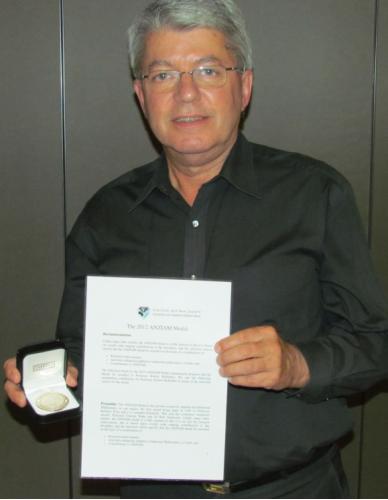
It gives me much pleasure to announce that the ANZIAM Medal for 2012 goes to Professor Robert McKibbin. Robert is Professor of Applied Mathematics at the Institute of Information and Mathematical Sciences, Massey University, on the Auckland campus in New Zealand.
Robert was born in New Zealand and did his first degrees in Mathematics, up to the Masters degree, at the University of Canterbury. After some teaching in Papua New Guinea, he then completed his PhD in 1982 in the area of Geothermal Modelling in the Department of Theoretical and Applied Mechanics (now the Department of Engineering Science) at the University of Auckland, where he subsequently became a Senior Lecturer. Robert moved to Massey University in 1991, first to Palmerston North, and later transferring to Massey University’s expanding Auckland campus in 2001. He was appointed Professor of Applied Mathematics in 1996.Over the past two decades, Robert has been one of the pre-eminent Applied Mathematicians in New Zealand, with a particular focus on geophysical, geothermal and industrial applications. His mathematical work ranges from geothermal fluid dynamics and hydrothermal eruptions, to the modelling of ground subsidence and aluminium smelting cells. He is highly regarded for his early work in the 1980’s in hydrothermal eruptions that appeared in the Journal of Geophysical Research, and presented in a way that made his research accessible to practitioners. His work has attracted significant funding, and national and international recognition through numerous invitations to speak at international Applied Mathematics conferences.
He has made significant impact in the modelling of the distribution of volcanic dust from eruptions, and has many strong Japanese research collaborators. He has visited Japan on many occasions and in 2007 as part of the New Zealand-Japanese Scientist Exchange Program. His work in this area is based on accurately modelling the fundamental physical processes with novel and original uses of the advection-diffusion equation. The same modelling arises from other industrially-based problems, such as pollen distribution and spray drift and its capture by shelter belts. The practical impact of his research can be seen in many of the reports from the Mathematics-in-Industry Study Group meetings. He has also been extremely active in extending the Mathematics-in-Industry Study Group activities to other countries in South East Asia, notably Indonesia and Thailand.

Robert has supervised 23 PhD and MSc students, in many diverse areas of Applied Mathematics, all with a strong Industrial Applied Mathematical focus. He has also supervised a large number of under graduate industrial projects to inspire a whole generation of New Zealand Applied Mathematics students. He is an extremely supportive mentor, and very much a team player in collaborative activities. Throughout Australia and New Zealand, there are many active Applied Mathematicians who attest to have been strongly influenced by Robert.
He has been a leader in ANZIAM for many years and was Chair 2004-6, and his commitment to both ANZIAM and the Royal Society of New Zealand is seen through the large amounts of his time that he devotes to these organisations. His participation in the Mathematics-in-Industry Study Group meetings is one of the central reasons that they have been so successful. He has been the Director of the Centre for Mathematical Modelling and the Centre for Mathematics in Industry at Massey University, for a total of 12 years, and one of the major forces that have steered New Zealand Applied Mathematics towards industrial applications.
There are few other Applied Mathematicians in New Zealand who have shown more devotion and service to the field than has Robert. Through his enthusiasm, energy, and sustained achievement, he has demonstrated a life long commitment to the Applied and Industrial Mathematics profession, to the extent that he well and truly meets the criteria for this award. The selection panel unanimously recommends that Professor Robert McKibbin be awarded the ANZIAM Medal for 2012.Professor James Hill
Professor Graeme Wake
Dr Robert Anderssen
(2012 ANZIAM Medal Selection Committee). -
2014 Professor Kerry Landman
Citation

Professor Kerry Landman is an Applied Mathematician committed to cross-disciplinary research. She graduated with a PhD from the University of Melbourne in 1979, and subsequently has acquired a distinguished publication record with a total of 116 peer-reviewed papers in highly-regarded international journals. Her research reflects a life-time career devoted to the development of Applied Mathematics in Australia, and in particular to the application of mathematical modelling to industrial, environmental, biological and medical areas. The excellence of her research career and her long-standing support for ANZIAM and its aspirations form the basis for the award of the ANZIAM Medal.
Research excellence
Professor Landman has made fundamental and significant contributions to the understanding of physical and biological processes across a
 remarkably broad spectrum of applications. She has successfully exploited a wide variety of mathematical techniques, and has pioneered their use in numerous disparate applications. Her work encompasses:
- Modelling biological cell invasion which has provided a fundamental understanding of the embryonic development of the nervous system in the intestine. She and her collaborators have made major advances to the understanding of Hirschsprung’s Disease. Her work in the mathematical modelling has provided much insight and has greatly clarified how the disease is caused.
- Mathematical study of patterns on growing domains is a current research topic of considerable moment. While previous studies had been limited to slow growth, Kerry has pioneered the study of cell migration patterns on rapidly-growing domains. These results have crucial implications to understanding and mitigating embryonic developmental defects.
- Discrete cellular automata models has been one of her research topics since 2007. Kerry together with Professor Barry Hughes and their group have made significant advances in understanding the average properties of agent-based models through the approximating partial differential equations.
- Industrial applications have continued to motivate her principal research activities in Applied Mathematics. Her work, jointly with Professor White, has made fundamental contributions to predicting the performance of solid-liquid separation processes (gravity thickeners and pressure filters) and to characterizing fundamental material properties of solid-liquid systems. This particular work has made a significant contribution to environmental waste management, water treatment and minerals processing. Her research has developed a generalized approach to the understanding and prediction of solid-liquid separation procedures, and she has developed new numerical techniques to handle the difficult moving interfaces that evolve in flocculated suspensions.
Exemplary leadership in science
In summary, Professor Kerry Landman has established and led research collaborations across engineering, industry and biological fields for over 30 years. She has a proven record of achievement in the advocacy and public promotion of mathematics through partnership building and collaboration. As a role model, she has demonstrated influence across the scientific community.
While an ARC Australian Professorial Fellow 2008-2012, she was also an Invited Speaker at the 2011 International Congress for Industrial and Applied Mathematics (ICIAM) in Vancouver, being the sole invitee from our region. Professor Landman is an exceptional supervisor of higher degree students in the mathematical sciences. To date, she has supervised nine Doctoral students and ten Post-Doctoral appointments, many of whom have gone on to successful careers in academe and industry. Many of her students are women, who she has encouraged and mentored.
She has an exemplary record of leadership in a generation of collaborative research programs; this is particularly demonstrated through her role as the Director of the Mathematics-in-Industry Study Group (MISG) during the period 1993-1997. As Director, she provided strong leadership to the Applied Mathematics community, bridging the interface between the University of Melbourne and the community, and expanding the mathematics profession’s public profile through extensive media coverage. She played a large role in developing MISG into the professional organization that is today recognized nationally and internationally.
Her Curriculum Vitae shows much other service to Applied Mathematics and the ANZIAM organization, including membership of the ANZIAM Journal Editorial Board since 2010. Over her career Professor Kerry Landman has been a constant supporter of ANZIAM, and she is recognized for the excellence of her numerous presentations at the ANZIAM conferences.
For all these contributions, Professor Kerry Landman is to be awarded the ANZIAM Medal for 2014.
-
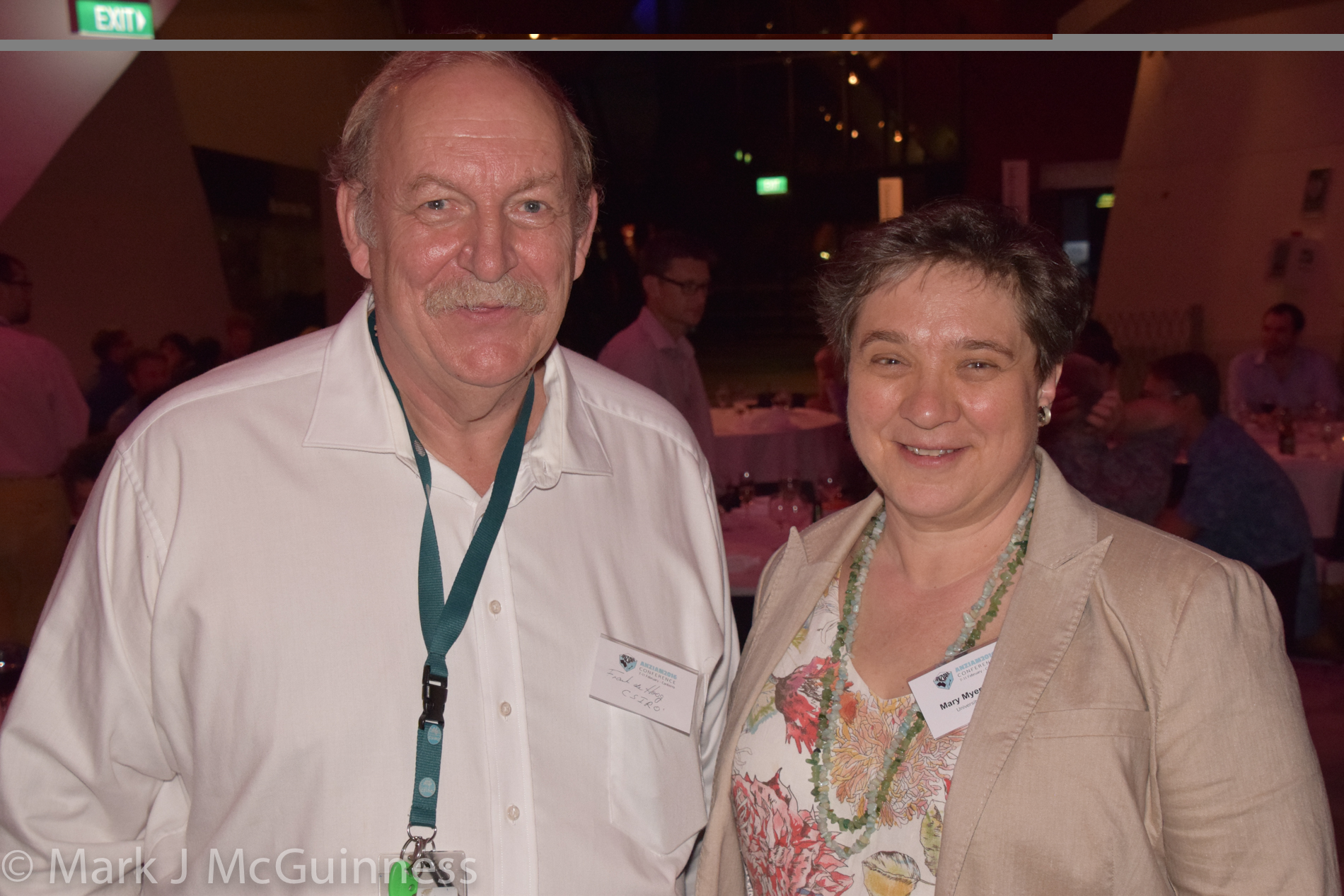
2016 Dr Frank de Hoog
Detailed Citation for Frank Robert de Hoog’s Award of the ANZIAM Medal
(The full citation to be published in the AustMS Gazette)
Frank Robert de Hoog (or simply Frank to colleagues and friends) epitomises a worthy recipient of the ANZIAM medal because his contributions to applied, computational and industrial mathematical research are nationally and internationally famous, while his contributions to ANZIAM have had a significant impact especially in the development of the student support scheme.

Contributions to Applied, Computational and Industrial Mathematics Research
Frank de Hoog commenced his studies at the University of Western Australia in 1966 and graduated with first class honours in Mathematics in 1970. It was clear to his lecturers that he was gifted mathematically. During this period, his interest in applied and computational mathematics was greatly influenced by Professor J. J. Mahoney FAA, Dr Neville Fowkes and Dr Jack Williams who introduced him to applied and computational mathematics. In fact, he started a PhD at the University of Western Australia on the numerical solution of ordinary differential equations under the supervision of Dr Williams. However, with Dr Williams’ return to the UK, Frank accepted a PhD scholarship at the Australian National University to work with Professor M. R. Osborne FAA on the numerical solution of ordinary differential equations. Because of the work that Richard Weiss was pursuing under the supervision of Bob Anderssen, Frank switched his focus to the numerical solution of integral equations. In hindsight, this change proved to be very important because of the success with which he, in collaboration with Richard Weiss, solved a number of important open problems.
As a direct result of the high regard that the research he performed as a PhD student established for him internationally, he was offered an Assistant Professorship in Mathematics at UCLA. With Richard Weiss at CALTEC, their research turned to the very challenging problem of the numerical analysis of singular ordinary differential equation. The resulting publications, because they resolved key issues that others working in the area had failed to resolve, immediately established international reputations for both as numerical analysts, and opened doors to an appointment for Richard Weiss in Vienna and to a return to the ANU for Frank de Hoog. Before accepting his position at CSIRO’s Division of Mathematics and Statistics, he returned to earlier interests in integral equations and commenced his collaboration with his PhD student John Paine and Bob Anderssen on the numerical determination of the eigenvalues of ordinary differential equations. The result that a simple algebraic correction formula could account for the differences between the algebraic estimates and the actual differential eigenvalues was a startling new result, the proof of which involved technically challenging and complex considerations. It has greatly influenced the subsequent design of algorithms for the computation of differential eigenvalues.
It was the significance, depth and breadth of this research which led to Frank being awarded the Australian Mathematical Society’s Medal in 1988.
It was Frank’s move to CSIRO that restimulated his strong interest in applied and industrial mathematics. From that point on, his research has had a very strong applied and industrial mathematical, as well as computational, impact. The success of that research has been recognized by his fairly rapid promotion to a Chief Research Scientist position on the basis of scientific merit, and his recent appointment as CSIRO Fellow. The impressive fact about this research is its phenomenal breadth, ranging over a very broad spectrum of subjects in both applied and computational mathematics, as well as its non-trivial depth and penetrating mathematical insight. There are many highlights in the research that Frank has undertaken during his more than 35 years with the CSIRO. Some, but not all, significant examples include:
(i) Laplace Transform Inversion. For many constant coefficient differential equations which arise in applications, it is relatively simple to determine the Laplace transform of the solution. The numerical inversion of such transforms is a very popular topic in numerical analysis and, thereby, a very challenging area in which to make a contribution that now has a science citation index score of more than 593. In part, this relates to the fact that Frank’s contribution is the basis for standard algorithms in numerical analysis libraries including IMSL.
(ii) Smoothing Spline Optimization. The major limitation of the early methods for data smoothing with splines was the complexity of the computation of the regularization using cross-validation. In this research, it was shown how to reduce the complexity from an order n-squared activity to an order n deliberation. It is now the basis for all standard algorithms for smoothing spline fitting to observational data.
(iii) Fast Methods for Toeplitz Matrices. Various authors have proposed ways to exploit the special structure of a Toeplitz matrix in order to derive fast algorithms. It was a very competitive subject that required deep mathematical understanding and insight to identify an alternative strategy which improved on the earlier alternatives. Though other methods were proposed, it was the first stable numerical method for positive definite Toeplitz matrices.
(iv) Mineral Separation. In designing an industrial device, it is not only a matter of engineering but of matching the engineering to the operational parameters of the device. Dr de Hoog developed a mathematical model for the Kelsey Centrifugal Jig of Geologics which allowed such matching to be performed. As a result of this collaboration, these jigs are now used around the world to perform mineral separation that was not possible in the past. These jigs are responsible for the recovery of minerals with a value in excess of half a billion dollars a year.
(v) Sheet Metal Rolling. The efficient production of sheet metal is a highly competitive situation. The faster the rolling can be performed, the higher the profits. However, the faster the rolling the more sophisticated must be the algorithms controlling the operation of the rolling. The work that Dr de Hoog and colleagues have accomplished has given BHP a competitive edge internationally.
(vi) Mode Coupling in the Vibration of Beams and Shells. The mode coupling that occurs in beams and shells is quite complex, and the earlier publications that aimed to explain this phenomenon were complex and cumbersome. The importance of this work is that it identified the key issues involved in a way that yielded a clear simple explanation.
(vii) Conditioning and Dichotomy of Boundary Value Problems. This research established for the first time that there are uncoupled boundary conditions that have similar conditioning to the most general situations. It thereby laid a theoretical framework for the formulation of robust algorithms for two-point boundary value problems.
Contributions to Industrial Mathematics Study Groups
In addition to the above contributions, it is important to acknowledge that Frank played a key role, along with others, in the successful establishment of the Mathematics-in-Industry Study Group Meetings, which are now an important part of the R&D image of ANZIAM. The first Study Group Meeting was organized by the then CSIRO Division of Mathematics and Statistics, with Noel Barton and Frank playing lead roles along with strong support from Kerry Landman and Terry Speed. The Study Group’s successful implementation would not have been achieved with the speed and impact that it has if it were not for the dedicated and insightful commitment of Frank, Noel, Kerry and Terry, as well as others.
In many ways, one of Frank’s great personal characteristics, which is the basis for his highly successful collaborative research endeavours, is his understanding, fair and unselfish approach to colleagues. An example is his work on the winding of coils, which arose initially through the Mathematics-in-Industry Study Group framework. In collaboration with CSIRO and industrial colleagues, he developed and applied theory which established explicitly the winding stress required to achieve specified residual stresses in the wound coils. As an immediate consequence of such endeavours, the damage due to excess stress was minimized while the stability of the wound coil was maximized. These results have become the basis for the processing of coils in both the aluminium (Comalco) and steel industries (BHP/Blue Scope), and contributed directly to the cost-efficiency with which aluminium and steel sheets are now rolled and coiled.
Contributions to ANZIAM
Frank has been a regular attendee since 1976 invariably giving a talk. He was a key organizer for the meeting in Merimbula in 1984.
As an extension of his strong support for students in CSIRO, in terms of student support schemes and internship programs, Frank garnered financial support for ANZIAM from CSIRO on the understanding that the funds would be exclusively used to support student participation at ANZIAM. This has turned into the CSIRO-ANZIAM Student Support Scheme and has become a feature of AustMS conferences as well as those of ANZIAM.
The Selection Committee unanimously agreed that, for all these contributions, Frank de Hoog be awarded the ANZIAM Medal for 2016.
Dr Robert Anderssen
Professor Robert McKibbin
Professor Kerry Landman
-
2018 Emeritus Professor Phil. G. Howlett
Professor Phil Howlett has made sustained and outstanding contributions to both the theory and applications of mathematics, particularly in the development of control theoretic methods in the transport industry. In addition, he has been an effective and passionate advocate of ANZIAM over a long period and has held a number of key positions including ANZIAM Chair, Director of the Mathematics in Industry Study Group (MISG) and chair of the ANZIAM Student Support Scheme. Also, he has trained and mentored a cadre of young capable applied mathematicians who are terrific ambassadors, both in industry and the research community, worldwide, for the kind of mathematical thinking that embodies the spirit of ANZIAM.
The ANZIAM Medal is our society’s most prestigious medal and recognises research achievement, wide-ranging activities enhancing the discipline of applied and industrial mathematics, and contributions to ANZIAM. Phil’s outstanding contributions in these three areas make him a most worthy recipient of the ANZIAM medal.
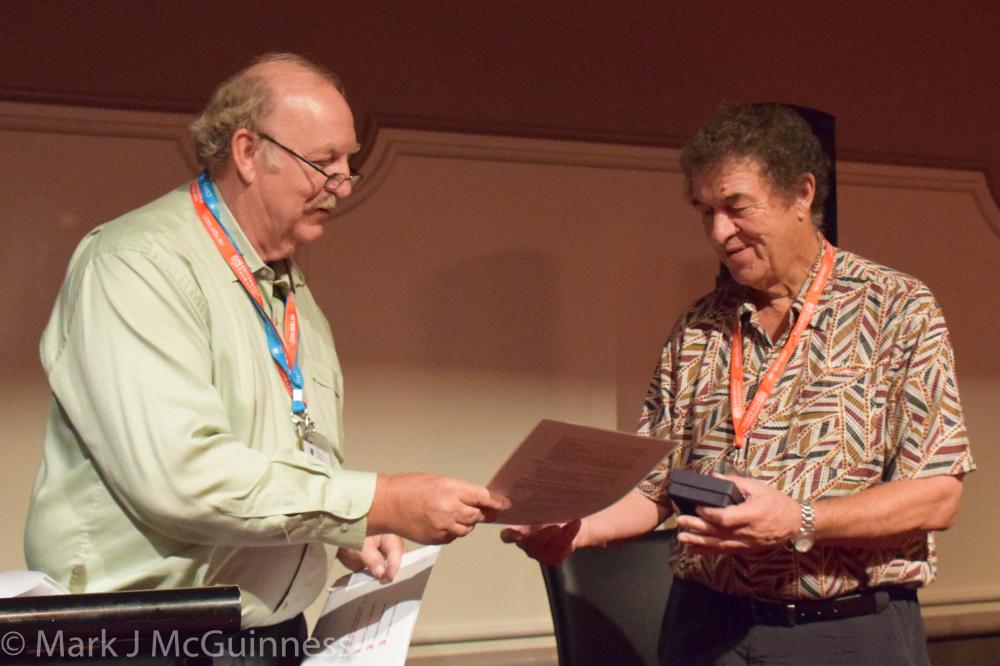
Frank de Hoog (left) and Phil Howlett (right) (Photo Credit: Mark McGuinness)
Contributions to Applied and Industrial Mathematics Research
Phil graduated with honours in Mathematics from the University of Adelaide in 1965 and then obtained a position as tutor with the South Australian Institute of Technology (SAIT, now University of South Australia). While a tutor, Phil embarked on research on approximation theory under the supervision of Jim Michael at the University of Adelaide and was awarded a PhD in 1971. In 1979 he was a Visiting Fellow at the Control Theory Centre at the University of Warwick where he worked on his initial publication on control theory. This was the first of his many contributions to this area.
In 1982 Ian Milroy formed the Transport Control Group at the SAIT and Phil developed rigorous mathematical justification for the heuristic strategies used by Metromiser, the control system for short journeys that had been developed by the group. At the same time he produced the first theoretical confirmation that speed-holding should be used if the journey time is relatively large. This work had immediate impact for future work on long-haul strategies by the group. In 1990 the Transport Control Group was renamed the Scheduling and Control Group. Phil led this Group from 1992 to 2011. Under Phil’s leadership, and by virtue of his long-standing collaboration with Peter Pudney, the achievements of this group include:
- Development of a complete mathematical theory for the calculation of optimal train-driving strategies for trains under discrete control
- Major contributions to the theory of optimal train-driving strategies under continuous control
- Development of a mathematical theory for optimal driving strategies for solar-powered racing cars
- Development of rail technology software Freightmiser and Energymiser in collaboration with rail industries
In addition to national competitive grant awards, the work by the Scheduling and Control Group has been recognised by the following awards:
- Control strategy team for Aurora 101, winner of the World Solar Challenge (1999).
- Winner, Australia Technology Award, Technology Development from the Government Sector, University of South Australia, with Siemens and ICT for Development of Metromiser Technology (2000).
- Winner, Australasian Railway Association Rail Industry Awards for Excellence; for the Freightmiser Program for TMG International (2004).
- TTG Transportation Technology – National Export Award: Environmental Solutions Category (2014).
- TTG Transportation Technology – Supplier Export Achievement Award: Australasian Railway Association (2015).
- TTG Transportation Technology – Innovation & Technology Achievement Award: Australasian Railway Association (2015).
- Australian Society for Operations Research: Ren Potts medal for outstanding contributions to OR in Australia (2015).
- Société Nationale des Chemins de fer Français (SNCF): winner “Enterprise of the Year”, awarded by Directors of Energy Departments in France, for deployment of the Energymiser (Opti-conduite) train driver advice system (DAS) as a smart phone app for 2000 TGV train drivers in France. The DAS software was developed by the Scheduling and Control Group in collaboration with TTG Transportation Technology during 1994-2017 and has been deployed around the world (2017).
In addition to his work associated with control theory, Phil has also made important contributions to the following areas:
- Theoretical analysis of the fundamental equations for the inversion of matrix and operator pencils in collaboration with various colleagues including Amie Albrecht, Konstantin Avrachenkov, Jerzy Filar and Charles Pearce.
- Water storage and rainfall modelling in collaboration with various colleagues including Jonathan Borwein, Charles Pearce and Julia Piantadosi.
- Operator approximation and estimation of random signals in collaboration with Anatoli Torokhti and Charles Pearce.
Contributions to Applied and Industrial Mathematics
Phil is an outstanding supporter of mathematics in general and applied and industrial mathematics in particular. He has successfully supervised 14 PhD scholars, participated in numerous direct interactions with industry and facilitated industrial problem-solving through the University of South Australia and the Mathematics in Industry Study Group. A partial list of the leadership positions is:
- 1994-2003: Assistant Editor, Proceedings of the Australian Mathematics in Industry Study Group.
- 1998-2004: Director, Centre for Industrial and Applied Mathematics, University of South Australia.
- 2000-2002: Director, Australian Mathematics in Industry Study Group.
- 2003-2003: Deputy Director, Australian Mathematics in Industry Study Group.
Contributions to ANZIAM
Phil has been and continues to be a passionate advocate for ANZIAM and has devoted a considerable amount of energy and time in contributing to its success. His contributions include:
- 1998-99, 2006-07: Executive Committee Member, ANZIAM.
- 2007, 2010: Deputy Chair, ANZIAM.
- 2008-2009: Chair, ANZIAM.
- 2010-2018: Chair CSIRO/ANZIAM Student Support Scheme.
The ANZIAM Medal selection panel unanimously recommends that Professor Phil Howlett be awarded the ANZIAM Medal for 2018.
On behalf of ANZIAM:
Dr Frank de Hoog
Professor Kerry Landman
Professor Robert McKibbin -
2019 Professor Peter Taylor
Professor Peter Taylor is an outstanding applied mathematician internationally known for his contributions to the theory and applications of mathematics, particularly in the area of applied probability. He has developed modelling, analytical and computational techniques for mathematical structures that are commonly used in the analysis of real-world stochastic systems. Peter Taylor has provided valuable leadership to the mathematics community both nationally as President of the Australian Mathematical Society and internationally through his active roles as editor and reviewer for several respected international journals. Peter Taylor was Chair of ANZIAM and he played a key part in the design and implementation of the ANZIAM/CSIRO Student Support Scheme that has become an exemplar for other similar schemes elsewhere.
The ANZIAM medal is our society’s most prestigious award and recognises research achievement, wide-ranging activities enhancing the discipline of applied and industrial mathematics and contributions to ANZIAM. Peter Taylor has made an outstanding contribution in these three areas and is a most worthy recipient of the ANZIAM medal.
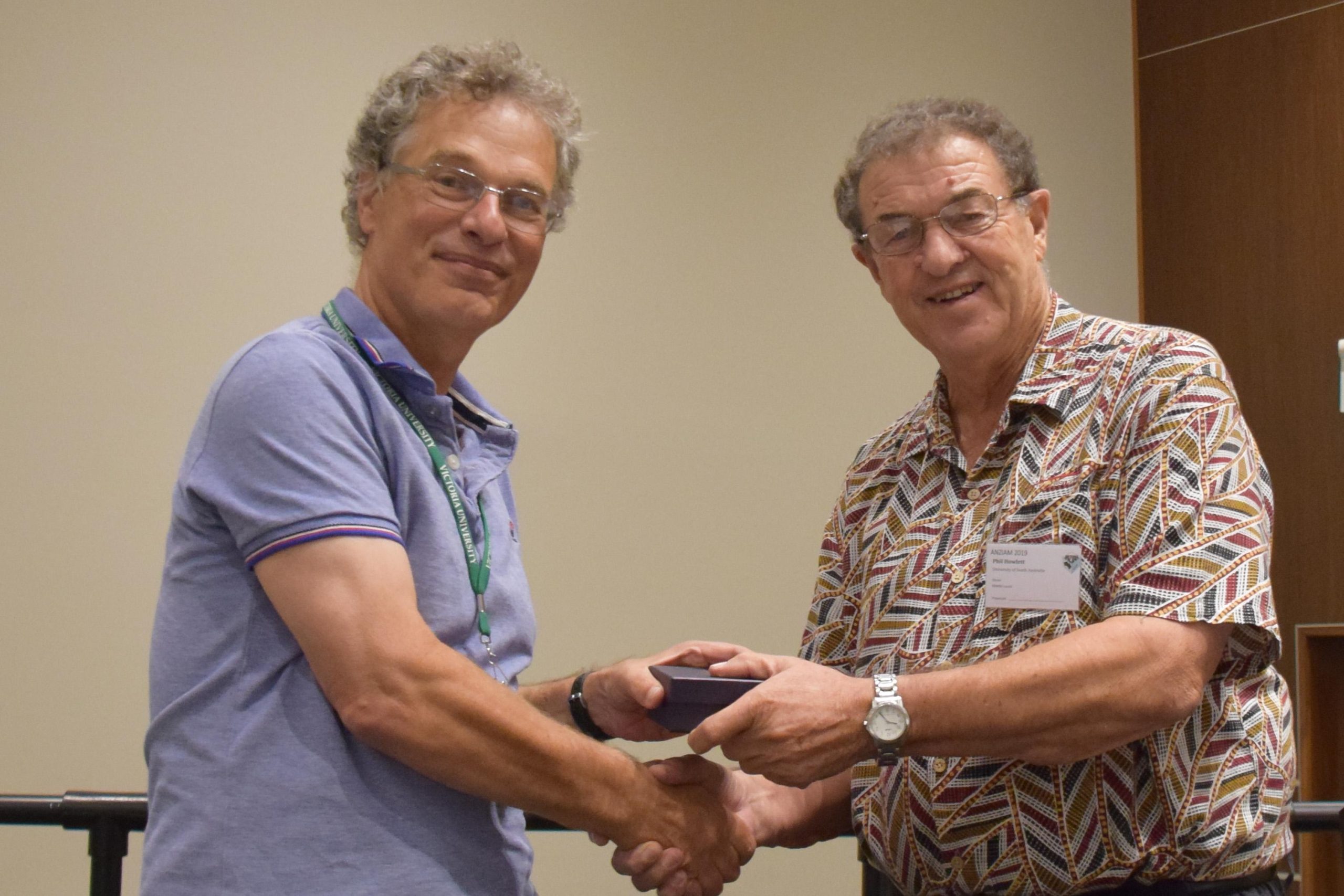
Peter Taylor (left) and Phil Howlett (right) (Photo Credit: Mark McGuinness)
Research Achievements
Peter Taylor was awarded a PhD in 1987 from the University of Adelaide for his work on applied probability under the supervision of Bill Henderson and Charles Pearce. This early work demonstrated both mathematical intuition and rigour. His understanding of the ubiquitous nature of stochastic behaviour in applications was enhanced greatly through his affiliation with the University of Adelaide’s statistical consulting group and the Teletraffic Research Centre (of which Peter was Director for four years), as well as his own consulting work. As a result, Peter’s research interests are extremely broad as is reflected in his current projects which include mechanism design in economic systems, modelling extreme rainfall events, bushfire re-ignition probabilities, the spread of epidemics, nonparametric deconvolution, customer credit card behaviour, biosensor experiments and Bitcoin.
Peter has also made important advances in the study of queueing networks with batch arrivals where his early work with colleagues Bill Henderson and Charles Pearce has been cited by numerous authors. His early work dealt with the related concepts of insensitivity and product-form queueing networks and, with various co-authors, he proved the existence of product-form invariant measures in a number of different multidimensional stochastic models. Two recent highlights are his work with Robert Maillardet on queues with advanced reservations and his work with David Stanford and Ilze Ziedins on accumulating priority queues, which promises to have significant application in healthcare systems.
In 1992, Peter started working with V. Ramaswami on quasi-birth-and-death processes. This collaboration also sparked an interest in matrix-analytic methods and Peter has worked in this area ever since. His 1996 paper with PhD student Les Bright was the first to show how to extend matrix-analytic methods to level-dependent quasi-birth-and-death processes (QBDs) and his 2004 paper with Dirk Kroese and Werner Scheinhardt observed that strange and counter-intuitive behaviour can occur in QBD models that have infinitely-many phases. This paper triggered a number of papers from a variety of authors examining matrix-analytic models with infinite phase spaces, to the extent that their properties are now well-understood. As of 2018, Peter has written 30 research papers in the area of matrix-analytic methods, many with his long-term colleague Guy Latouche. Peter is an internationally-recognised expert in this area, having three times been a Program Co-Chair of the International Workshop on Matrix-Analytic Methods, and having been invited to give extended tutorials on matrix-analytic methods in a number of forums.
With Nigel Bean and Frank Kelly, Peter studied Braess’s paradox, in which addition of resources to a network can result in diminished service for all and, with Greg Harmer and Derek Abbott, he provided the first mathematical analysis of Parrondo’s games, in which a certain type of mixture of two losing games can be shown to be winning.
Activities Enhancing Applied or Industrial Mathematics
In addition to his formal positions in ANZIAM and AustMS, Peter Taylor has shown exemplary leadership in the wider applied and industrial mathematics community. He is currently Director of the ARC Centre of Excellence for Mathematical and Statistical Frontiers (ACEMS) and an Australian Research Council Laureate Fellow. He has been the Editor-in-Chief of one international journal and is on the Editorial Board of three others. From the beginning of 2019 he will become Editor-in-Chief of Advances in Applied Probability and the Journal of Applied Probability, two of the most prestigious applied probability journals in the world. He has been on awards committees for INFORMS, including chairing the Nicholson Prize Committee, which awards the prize for the best student paper in operations research and management science worldwide and the Applied Probability Section Awards Committee, which awards the Erlang Prize as well as the best paper award in applied probability, again worldwide.
Peter has supervised 26 PhD students, one research masters and 44 honours/coursework masters students to completion, with a number of others in the pipeline. Many of these students have gone on to excellent careers in government, industry or academia.
As Director of the University of Adelaide’s Teletraffic Research Centre (TRC) in the late 1990s, Peter was responsible for performance models used by the TRC’s major client, Telstra. The mathematical models behind this work spilled over into Peter’s research, resulting in papers on many types of telecommunications modelling.
Contributions to ANZIAM
Peter Taylor has been an active member of the ANZIAM community since he first attended the Applied Maths Conference at Merimbula in 1984. He has held the positions of Chair of ANZIAM, President of the Australian Mathematical Society, Secretary of the Applied Maths Conference, Deputy Convenor of the Engineering Mathematics Conference, Chair of the ANZIAM Invited Speakers Committee (twice), Chair of the E.O. Tuck Medal Committee and many other ANZIAM committee roles.
One of Peter’s key achievements as Chair of ANZIAM was to help establish the ANZIAM/CSIRO Student Support Scheme (SSS), which is used to support student attendance at the annual ANZIAM meeting and the meetings of the ANZIAM special interest groups. Peter was responsible for drawing up the principles of the SSS and was the first Chair of the panel that makes the funding awards.
The ANZIAM Medal selection panel unanimously recommends that Professor Peter Taylor be awarded the ANZIAM Medal for 2019.
On behalf of ANZIAM:
Dr Frank de Hoog
Professor Kerry Landman
Professor Phil Howlett -
2020 Professor Lawrence Forbes
Summary
Professor Lawrence (Larry) Forbes has made an outstanding contribution over many years to applied and industrial mathematics with special contributions to the theory and numerical computation of fluid flows and the design of magnetic resonance imaging (MRI) coils. Larry has been an exemplary contributor to ANZIAM—as Chair of ANZIAM and Convenor of three successful ANZIAM conferences—and as an inspirational presenter for the many postgraduate students who attend the annual ANZIAM Conference. More generally he has made a long-standing commitment to applied mathematics as Associate Editor for the ANZIAM Journal and the Journal of Engineering Mathematics and as Head of School at the University of Tasmania. His influence in the applied mathematics community has spread far and wide through his supervision of a large number of talented postgraduate students—an integral part of the next generation of applied mathematicians—and through his untiring efforts to model the complexities of the real world using the power of mathematics.
The ANZIAM medal is our society’s most prestigious medal and recognises research achievement, wide-ranging activities enhancing the discipline of applied and industrial mathematics, and contributions to ANZIAM. Larry’s superb credentials in these three areas make him a most deserving recipient of the ANZIAM medal.
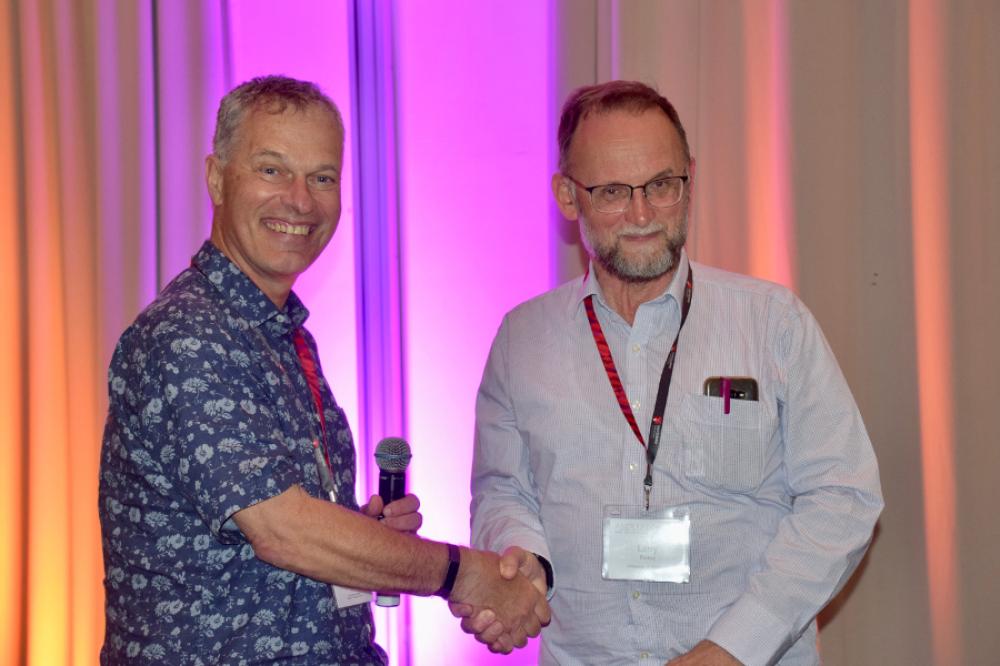
(Photo Credit: Mark McGuinness)
Research Achievements
Larry obtained his PhD in 1981 from the University of Adelaide under the supervision of Len Schwartz and Ernie Tuck. After short stints as a researcher at the University of Adelaide and at the Materials Research Laboratories in Melbourne, Larry moved to the USA as a visiting researcher at the University of Iowa before he was appointed to a two-year term in 1983–1984 as Assistant Professor in the Department of Mathematics at Kansas State University in Manhattan, Kansas. Larry moved back to Australia in 1985 to accept a position as Lecturer in the Mathematics Department at the University of Queensland. He quickly established himself as a charismatic force in the Australian applied mathematics community and worked his way up to a well-deserved appointment as Reader (Associate Professor) in 1995. After five years in this position he moved to his current position as Professor of Mathematics at the University of Tasmania.
Larry first came to international attention through his early publications in the Journal of Fluid Mechanics (JFM). His jointly authored paper with Len Schwartz on Free-surface flow over a semicircular obstruction in JFM is regarded as a cornerstone in the analysis of flow past an obstacle. The analysis and numerical computation of fluid flexural-gravity waves in his two-part complementary papers in JFM —Surface waves of large amplitude beneath a plastic sheet. Part 1. High-order series solution in 1986 and Surface waves of large amplitude beneath a plastic sheet. Part 2. Galerkin solution in 1988—has been described in the literature as pioneering. Larry’s interest in fluid flow has been sustained by a long-term collaboration with Graeme Hocking that has produced an ongoing stream of joint publications which began in 1990 and continues to this day. In 2018 Professor Forbes was joint winner of the Mahony–Neumann–Room prize from Aust MS for his 2014 article titled On turbulence modelling and the transition from laminar to turbulent flow in the ANZIAM Journal.
A major project led by Larry Forbes and Stuart Crozier to investigate fundamental problems in the design of magnetic resonance imaging technology ultimately led to the granting of three US patents to Larry and his co-workers. This work was supported by four successive Australian Research Council (ARC) Discovery Grants from 1996–2012 with total funding of more than $2.5 million and the resulting publications have influenced a large body of subsequent research.
Professor Forbes has earned a major international reputation in applied mathematics for his work on the modelling and numerical solution of problems in mechanics, electromagnetism and chemistry. His numerical algorithms are said to be both ingenious and reliable. Larry’s research interests include ship hydrodynamics, shock waves in gases, outflows from underwater explosions or stars, modelling of disease spread and the behaviour of complex chemical reaction systems. His prodigious output on a wide range of topics is a truly impressive achievement.
Contributions to Applied and Industrial Mathematics
Larry Forbes has been an important contributor to applied mathematics in a variety of roles. He has supervised 16 PhD students, many of whom have gone on to high-profile careers in applied mathematics. They include Professor Scott McCue (QUT), Professor Harvinder Sidhu (UNSW), Associate Professor Shaun Belward (James Cook U), Dr Adrian Koerber (U Adelaide), Dr Michael Chen (U Adelaide), Dr Michael Brideson (U Tasmania), Dr Jane Sexton (Geoscience Australia), Dr Nick Beeton (CSIRO, Tasmania) and recent graduate Dr David Horsley (NASA, USA).
Professor Forbes was Head of the School of Mathematics and Physics at the University of Tasmania for the period 2001–2008. His service to the Australian mathematics community includes a three-year term on the ARC College of Experts. On the international front—in addition to his editorial duties with the Journal of Engineering Mathematics—Larry has refereed grant applications for the Natural Sciences and Engineering Research Council of Canada; the Foundation for Research, Science and Technology of New Zealand; and the Danish Technical Research Council.
Contributions to ANZIAM
Larry Forbes has been, and continues to be, a major contributor to ANZIAM. Aside from his roles as Associate Editor and prolific contributor to the ANZIAM Journal he has been a constant source of inspiration to the many postgraduate students who attend the annual ANZIAM Conference. On three separate occasions Larry has been voted by the students as best presenter at the Conference—a unique achievement—and consequently is the winner of three coveted Cherry Ripe prizes. Larry has also been Convenor of three ANZIAM conferences—another unique contribution. He was Chair of ANZIAM in 2014–2015 and Deputy Chair in 2013 and 2016. He has served more than his fair share of time on the ANZIAM Executive Committee—initially as representative for Queensland but more significantly as representative for Tasmania where, for many years, he was a lone voice. Larry has indeed made a great contribution to ANZIAM.
The selection panel unanimously recommends that Professor Lawrence K Forbes be awarded the ANZIAM Medal for 2020.
On behalf of ANZIAM:
Frank de Hoog (CSIRO);
Phil Howlett (Chair, UniSA);
Vivien Kirk (U Auckland);
Kerry Landman (U Melbourne);
Peter Taylor (U Melbourne). -
2021 Professor Nalini Joshi
Citation for Nalini Joshi
The ANZIAM medal is our society’s most prestigious medal, recognising research achievement, wide-ranging activities enhancing the discipline of applied and industrial mathematics, and contributions to ANZIAM. Nalini Joshi’s sustained contributions in these three areas over a long time make her a most deserving recipient of the ANZIAM medal.

Photo credit: Annie Fenwicke
Nalini is a world leader in the theory and applications of differential equations that form the basis of understanding the effects of random behaviour in fields as diverse as particle physics, quantum mechanics, large prime-number distributions, and wireless communications. She has made unparalleled contributions to applied mathematics in leadership, gender equity, and promotion of mathematics and she has been a consistent and active member of ANZIAM.
Research Achievements
Nalini received her PhD from Princeton in 1987 under the supervision of Martin Kruskal. After periods at ANU, The University of New South Wales and the University of Adelaide, she moved to The University of Sydney in 2002, where she now holds the position of Payne-Scott Professor and Chair of Applied Mathematics.
Classical mathematical modelling typically relies on linear models, but much of the world is not linear; examples include water waves in the ocean and the fluctuations of infected cells in the bloodstream. Prediction of such nonlinear systems is necessary for understanding and controlling our world, but the difficulty of prediction is compounded by singularities,
where functions become immeasurable. There is a dearth of existing tools for describing such nonlinear singular systems.
Nalini has pioneered innovative methodologies for describing these, with a particular focus on integrable systems such as the Painlevé equations. Her deep understanding of nonlinear systems has enabled her to develop simple, precise definitions of functions, yielding
descriptions that extend to the whole domain of existence. In particular, she has shown how to relate behaviour before and after a critical transition-point in applications such as quantum tunnelling, spontaneous magnetisation in metals, and water waves with surface tension. Her new methodologies have uncovered hidden information across multiple fields and sparked significant new research programmes across the globe.
Nalini has written over one hundred peer-reviewed papers together with authored and edited monographs. Her outstanding contributions to mathematics have earned her numerous accolades, including Fellowship of the Australian Academy of Sciences in 2008, the London Mathematical Society’s prestigious Hardy Fellowship in 2015, a Bragg Membership of the Royal Institution of Australia in 2019, the 2019 NSW Premier’s Prize for Excellence in Mathematics, Chemistry, Physics and Geosciences and, most recently, the 2020 Szekeres Medal of the Australian Mathematical Society.
Contributions to the Discipline
In 2012, Nalini was awarded an Australian Research Council (ARC) Laureate Fellowship, which is the most prestigious fellowship that can be funded by the ARC in any discipline. In addition, she was named as the ARC Georgina Sweet Laureate Fellow for that year, with extra funding for activities to promote and support women in research. Nalini used her Georgina Sweet Fellowship to initiate and support activities such as the Women in Mathematics Lunches at the annual ANZIAM conferences. The value of such events, raising awareness, providing support and networking opportunities, and strengthening a sense of community, cannot be underestimated.
Nalini was due to start a Leverhulme Visiting Professorship in the UK in 2020 and has often been invited as principal speaker by prominent overseas mathematical associations. She is a member of the editorial boards of four international journals, has served on the ARC Selection Advisory Committee and been Co-Chair of the ARC Future Fellowships panel.
Nalini is a Vice-President of the International Mathematical Union as well as serving on national and international panels. She was the first female professor of mathematics, and the first woman to be Head of The School of Mathematical Sciences at The University of Sydney and President of the Australian Mathematical Society.
Nalini has worked tirelessly to promote mathematics, including applied mathematics, to the wider scientific community and general public. She was instrumental in the development of the Decadal Plan for Mathematical Sciences. She has been a panellist on the ABC’s Q&A and is frequently interviewed on mathematics education both online and on the radio. In 2016, she was appointed an officer of the Order of Australia “for distinguished service to mathematical science and tertiary education as an academic, author and researcher, to professional societies, and as a role model and mentor of young mathematicians” and in 2018, she was awarded the Eureka prize for Outstanding Mentor of Young Researchers.
Nalini is especially famous for creating new ways to encourage, support and retain women in STEM careers. Her work on diversity, including the creation of the Science in Australia Gender Equity (SAGE) initiative, has resulted in influential actions and impact across the nation.
Service to ANZIAM
In addition to her numerous high-profile engagements, Nalini has been a strong supporter of ANZIAM and a regular participant of its annual meetings. Her role in initiating and supporting the Women in Mathematics Lunches at the annual ANZIAM conferences has already been mentioned above. She has also, served on the Executive Committee of ANZIAM and the JH Michell Medal Selection Committee.
In summary, Nalini combines a distinguished research record and numerous prestigious awards with an outstanding contribution to the leadership of our discipline. She is a most deserving winner of the 2021 ANZIAM Medal.
-
2022 Emeritus Professor Phil Broadbridge
Citation for Professor Emeritus Phil Broadbridge, FAustMS
The ANZIAM Medal is the Highest Award made by ANZIAM, and it is now awarded annually to exceptional individuals who have shown outstanding commitments to Research, to advancing the Discipline of Applied Mathematics, and to the ANZIAM Community.
It is an honour to award the 2022 ANZIAM Medal to Emeritus Professor Phil Broadbridge, of LaTrobe University. Phil has made outstanding and innovative contributions to Research, pioneering novel methods for finding exact solutions to difficult nonlinear partial differential equations that arise in a wide variety of important applications. He has demonstrated sustained leadership in Applied Mathematics at the International level, forging new links with colleagues in Asia, leading and growing the Australian Mathematical Sciences Institute (AMSI) and accepting editorial roles in a variety of prestigious international Journals. Phil has also been a keen and passionate supporter of ANZIAM. He served as ANZIAM Chair and Deputy Chair, and introduced some new initiatives in that leadership role. He is an Associate Editor for the ANZIAM Journal. He has served as Conference Director for a February ANZIAM Conference, and has also taught AMSI subjects to Honours and Higher-Degree students.
Phil continues to be a friend, supporter and mentor to many in the ANZIAM Society, and is a most worthy recipient of the 2022 ANZIAM Medal.

Professor Emeritus Phil Broadbridge
Research Achievements
Phil Broadbridge has written two books, published over 140 scientific papers, and contributed more than 30 magazine and newspaper articles. He has wide ranging research interests, with publications in theoretical hydrology, metal surface evolution, heat conduction and Stefan free boundary problems, quantum mechanics of unstable systems, cosmology, symmetry methods for nonlinear partial differential equations, mathematical biology, financial mathematics and combustion.
Phil’s most highly cited contribution (over 400 citations) is in the field of hydrological modelling, where he proposed an exactly solvable nonlinear model for unsaturated flow. The Broadbridge and White model is used internationally as a reliable predictor of “time to ponding”. Phil is also recognised for significant contributions to the area of symmetry analysis and is well regarded by other international leaders in this field. His work often provides insightful solutions to nonlinear boundary value problems, typically using nonclassical symmetry analysis, and has on at least four occasions provided useful exact solutions to long-standing unsolved physical problems (including calcium fertilisation waves, grain boundary groove formation and Arrhenius reaction-diffusion). Under Phil’s leadership, an MISG problem on bubbling of wet gummed wine labels resulted in a joint publication in SIAM review, with an image of a wine label appearing on the journal cover.
Phil has been awarded nearly $9m in research and development projects in Australia, Japan and the US (including $1m from the ARC and $5.6m from industry).
Activities enhancing Industrial and Applied Mathematics
Phil took on the heavy responsibility as Director of AMSI during 2006-2009, during which time the Institute flourished. AMSI became the major advocate for mathematics in Australia, ensuring that the discipline has a strong voice at all national and policy-making levels. Phil was instrumental in securing large government grants and industry sponsors to set up the first round of AMSI Internships, to run a national project on teaching mathematics to engineers, and to review APRA’s ratings system of financial institutions. He was presented with the 2008 Fast Thinking/ Open Universities National Innovation Award in the category of science innovation on behalf of AMSI.
Phil has shown tremendous leadership in establishing formal links with international research groups. He formalised a relationship with SIAM and later instigated relationships with JSIAM and developed the LaTrobe University branch of the Kyushu University Institute of Maths for Industry (IMI) in Japan. These links have provided an opportunity for Australian mathematicians to engage with other researchers in Asia. Phil was awarded a distinguished service award from Kyushu University in 2019, and he was also co-director of the joint ANZIAM-ZPAMS conference held in Hangzhou, China in November 2016.
As a full professor since 1991, Phil has made significant contributions as Head of School at Wollongong, Delaware, and LaTrobe. In all these places, the discipline of mathematics has thrived under his leadership. Phil has supervised 13 PhD students to completion (including 6 women), many of whom now work in academia, both in Australia and overseas. He has been a strong advocate for women mathematicians, receiving the Women in Science and Engineering award on behalf of the Mathematics department at the University of Delaware, for the development of future women faculty during his time there.
Phil is on the editorial board of 11 international journals, including acting as the subject editor for the prestigious Proceedings of the Royal Society of London Series A.
Contributions to ANZIAM
Phil has been an ardent supporter and participant in ANZIAM activities since the early 1980s. He served as Chair of ANZIAM (2012-2014), developing the MISG Memorandum of Understanding, playing a key role in the inclusion of the ECR Workshop in ANZIAM meetings, and overseeing changes to ANZIAM publishing agreements. As a member of the AustMS Committee on Division and Interest Group Finances, he bolstered the financial stability of ANZIAM and improved its relationship with AustMS and AMPAI. He was director of the 1999 ANZIAM conference and co-organised the 2003 ICIAM meeting. Phil has been a member of the
ANZIAM Journal editorial board since 2008 and has participated in numerous MISG groups, acting as a problem moderator on many occasions.Phil has an extremely positive outlook and is always supportive of early career researchers and women in mathematics. He gives freely of his time and ideas and seldom seeks the limelight for this inventiveness.
-
2023 Emeritus Professor Tony Roberts
Citation for Tony Roberts
The ANZIAM Medal Committee recommends that Emeritus Professor A.J. (Tony) Roberts from the University of Adelaide be awarded the 2023 ANZIAM Medal, for his international research leadership, his unending efforts to promote and enhance applied mathematics, and his major contributions to ANZIAM, especially his initiation and guidance of the Electronic Supplement of the ANZIAM Journal.
Tony’s research in modelling the emergent dynamics of complex multiscale dynamical systems is an influential and enduring contribution to Applied Mathematics. Researchers around the world continue to apply concepts and techniques Tony initiated in the past 4 decades of research, based on the description of centre-manifolds to provide low-dimensional modelling for deterministic and stochastic systems and for continuum and discrete models. Recent innovations include rigorous techniques for models with multiple-scales, specifically for models in large thin domains with slowly varying dynamics. He has provided free, fast and flexible computer-algebra algorithms (implemented in the REDUCE computer algebra system), shown how normal form transforms provide slow and fast modes in stochastic systems, and contributed to “equation-free” modelling for computation that provides evolution of complicated microscopic systems at a macroscopic scale.
Professor Emeritus Tony Roberts
Tony actively promotes and supports applied mathematics. In addition to outreach and local academic roles as Head and Associate Dean, he has contributed to applied mathematics in Australia in an enormous number of roles, including as a member of the Council of the AustMS since 1993, and a member of the ARC College of Experts. He has also written 4 books to make mathematics accessible to practical modellers, engineers and scientists.
In Tony’s long record of service, particular attention should be given to his extraordinary contributions to ANZIAM. Not only has Tony directed, coordinated or served on the committee for 3 ANZIAM meetings, he also founded the Electronic Supplement of the ANZIAM J in 1997, and has run it ever since. When it started, there were almost no other online mathematics journals. Under Tony’s stewardship, this Electronic Supplement remains one of the few journals that publishes movies and interactive graphics, and implements protection against wanton copying and plagiarism. He instigated, trialled, and manages the Open Journal System for most articles submitted to the AustMS and pioneered the free electronic publication of all back issues of AustMS journals. Tony is also co-editor of many EMAC, CTAC and MISG proceedings, and supported others in their editing of these proceedings. Through these roles, and in a series of articles in the Gazette of the AustMS, he has encouraged and informed the community to adopt the highest standard of typesetting and writing.
For all these reasons, we unanimously recommend that Professor Tony Roberts be awarded the 2023 ANZIAM Medal. Congratulations Tony!
-
2024 Professor Hinke Osinga
Citation for Professor Hinke Osinga

Professor Hinke Osinga is an internationally renowned researcher in the analysis, characterisation and computation of invariant manifolds of chaotic dynamical systems. Her scientific publications, numbering well above 100, have over 3800 citations recorded on ResearchGate.
Her methods are uniquely supported both by robust convergence proofs and by open source software enabling them to be used by research groups worldwide. Professor Osinga’s research includes the development and investigation of the geometric ingredients of a new type of high-dimensional chaos, called wild chaos. She has pioneered new methods for demonstrating the existence of wild chaos and for visualising and understanding how it is created or destroyed. Professor Osinga’s remarkable achievements have been recognised worldwide, by an array of awards and fellowships. This includes: being elected Fellow of SIAM, the largest applied mathematics society in the world; the Research Award of the New Zealand Mathematical Society; the London Mathematical Society/New Zealand Mathematical Society Aitken Lectureship; and the Moyal Medal, awarded annually by Macquarie University. Professor Osinga was the first female mathematician to be made a Fellow of the Royal Society of New Zealand.
She has a total of over $6M of income on individual grants, as well as being a principal investigator for the Dodd-Walls Centre of Research Excellence. 20 past and present PhD students have benefited from her supervision.
Professor Osinga is a natural leader within our community, and is currently chair of the New Zealand branch of ANZIAM. She has previously served on the Executive Committee, is a member of the editorial board of the ANZIAM journal, was on the scientific committee for the 2020 ANZIAM meeting, and has chaired or been a member of many prize committees within the Australia-New Zealand mathematics community. She has organised Women in Science events in Auckland, spoken at events for undergraduates, and is a mentor for many junior female mathematicians.
She has been an associate editor on nine applied mathematics journals, including some of the top journals in the field. She was involved with founding the online magazine DSWeb, and has been involved with committee work for international organisations such as SIAM and the International Congress of Mathematicians.
Her beautiful crocheted version of the Lorenz manifold has drawn substantial international media attention around the world since 2004: she appeared on Channel 4 News in the UK, Channel One TV News in Russia and CBC Radio in Canada, as well as in numerous print media outlets in the USA, UK, Germany, The Netherlands and Australia. Despite these many aspects of her work achievements, Professor Osinga freely gives of her time to speak not only in scientific conferences but also in many community and school education engagements.
-
2025 Professor Andrew Bassom
Citation for Prof Andrew Bassom

Image courtesy of Peter W. Allen
Andrew Bassom plays a leading role within ANZIAM, most notably as a a continuing Co-Chief Editor of the Journal from 2010. He was also instrumental in organising two ANZIAM Conferences, the Pillow Trust, and instigating the flourishing Tasmanian branch. Andrew also enthuses high-school students to study mathematics, while regularly setting Year 12 Specialised Maths exam for them since 2005. At the national level, Andrew was a member of the 2018 ERA panel, has sat on the NZ Marsden Fund panel, member of the Committee for Mechanical and Engineering Sciences, is appointed to the ARC College of Experts since 2023, and manages to be President of the South Tasmanian Whale Rescue Group.
Andrew Bassom’s research significantly advances knowledge over a broad swathe of areas, distinguished by over 200 refereed publications in top international journals. Just three example areas are the following. With collaborators he explored the Painleve ODEs to innovatively classify various families of exact solutions and developed new theories to explain some of their properties. Andrew also vortices in oceanography and meteorology, developed theories that discovered winding-up properties and diffusion characteristics in classical vortices which are explained in a sequence of high-cited papers. The stability of oscillating fluid layers was a classic outstanding problem and Andrew and Peter Blennerhassett, via Floquet theory, developed how to establish and characterise its instability. In other research Andrew has led collaborative, multi-disciplinary teams in applications from the ventilation of premature babies, to the design of open-pit mines, and Antarctic geophysics, and included resolving problems in beer-making. His technical mastery of methods and techniques in applied mathematics has been instrumental in developing advances on many fronts.
-
2026 Professor Mary Myerscough
Citation for Prof Mary Myerscough

Professor Mary Myerscough is internationally recognised for her expertise in the application, modelling, and analysis of non-linear dynamical systems, with the goal to gain a deep conceptual understanding of the qualitative and quantitative dynamics of biological systems. Throughout her career, Mary has sought to produce new mathematical models with impact and practical importance in the life sciences, securely founded in experimental and observational truth. Her commitment to mentoring and career development, combined with her exemplary scientific insight, has opened up new systems-based ways of thinking about scientific problems. It has allowed her and her team of collaborators and students to gain a fundamental understanding of extremely complex, high-dimensional systems.
Particularly significant is her ground-breaking research on the population dynamics of honey-bee colonies. Mary developed a modelling framework through which she could explain, in combination with empirical studies, how individual stress responses of honey bees interact with social dynamics to cause colony failure. This research had an immediate and direct impact when it was used by the EU as part of its case for banning neonicotinoid pesticides. Mary’s observation that ‘fools rush in where angels fear to tread’ is a characteristically modest turn of phrase, which fails to mention that it takes bravery and innate talent to tackle and make progress in a hard area that had been overlooked for modelling, like atherosclerosis. Her award-winning research contributes to a deeper understanding of the fundamental biological mechanisms behind the progression of atherosclerosis. She was able to quantify processes that are essential to atherosclerotic plaque growth, and estimate a physiological set of parameters that provides well-founded predictions of the development of early atherosclerotic plaques.
Mary’s leadership has been bold and inspiring, producing important breakthroughs that are continuing to drive understanding. She has had significant grant funding success, including six ARC Discovery grants, a University of Sydney Thompson Fellowship and a grant from the Human Frontiers Science Program. Mary also has a long record of exceptional national and international service. Her persistence and perseverance, not in the least while being Chair of the ANZIAM Executive (2016–2018), has led to a national conversation within ANZIAM about our community’s engage- ment with the Australian Research Council’s College of Experts, leading to new nominations and better representation for the whole ANZIAM community. Mary has always believed that Australian Mathematical Biology could, should, and indeed, must be a player on the world stage. She was the first Australian or New Zealand member of the board, and Secretary of the Society of Mathematical Biology, paving the way for others. She was instrumental in getting the first SMB meeting to be held in Australia (in 2018), which significantly increased the international profile of Mathematical Biology in Australia, and has led to deeper engagement with overseas researchers.
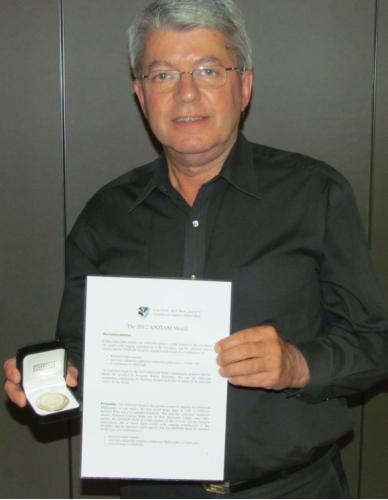

Call for nominations for the 2027 ANZIAM Medal
Nominations for the award can be made by any member of ANZIAM other than the nominee or members of the Selection committee. A nomination portfolio should consist of four parts in the following order:
(i) a statement detailing the impact that any career interruptions have had on the candidate’s opportunity to carry out research;
(ii) a brief C.V. of the nominee that includes the nominee’s list of publications;
(iii) a resumé of the significance of the nominee’s research; and
(iv) a resumé of the significance of the nominee’s service contribution.
Each of parts (i), (iii) and (iv) should be no more than one-page in length.
Nominations should be sent to the ANZIAM Secretary <anziam.secretary@gmail.com> by Friday 16 October.
Updated: