
In honour of the late Ernest Oliver Tuck, FAustMS, FTSE and FAA, ANZIAM has instituted a mid-career award for outstanding research and distinguished service to the field of Applied Mathematics. At most one award will be made annually, but only to a candidate of sufficient merit. No person can receive more than one such award and previous winners of the ANZIAM medal are ineligible. The selection criteria for the award are:
- Outstanding research, relative to opportunity, in Applied and/or Industrial Mathematics, where a significant proportion of the research work has been carried out in Australia and/or New Zealand.
- Distinguished service in the field of Applied Mathematics. Service in ANZIAM related activities will be highly regarded.
- On 1 January in the year in which the award is made, the recipient will have normally had their PhD conferred more than ten and less than twenty years ago (see note 3. below).
- Membership of ANZIAM for at least the five calendar years preceding the year in which the award is made. Backdating of membership is not acceptable.
Between 2013 and 2017, the EO Tuck Medal was awarded at most biennially.
Notes:
- In criterion 1 the research portfolio will be assessed relative to opportunity. Any significant teaching and administrative responsibilities will be considered when assessing the volume of a candidate’s research output and contribution.
- ANZIAM considers it highly desirable that its members advance the profession into the future. The selection panel can consider the potential of the candidate to the discipline (for example, via their ability to be awarded prestigious research fellowships).
- Any exceptional circumstances should be forwarded to the Executive Committee to assess eligibility; they will normally consider the types of career interruptions allowed by the ARC in their research fellowship guidelines.
Winners of the EO Tuck Medal
-
2013 Professor Shaun C. Hendy and Associate Professor Geoffry N. Mercer
Citation for Shaun Cameron Hendy
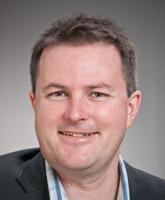
Shaun Hendy has made remarkable contributions to applied mathematics and varied contributions to his profession, in particular to ANZIAM, as well as communicating the excitement of science to many communities. An innovative thinker and commentator who is widely read by policy makers, his research prowess is already indicated by the positions he holds: Professor of Computational Physics in Victoria University of Wellington’s School of Chemical and Physical Sciences and Industry and Outreach Fellow at Callaghan Innovation – . He also served as Deputy Director of the MacDiarmid Institute for Advanced Materials and Nanotechnology from 2008-12.
Elected as a Fellow of the Royal Society of NZ in 2012, Professor Hendy has published many peer-reviewed and well-cited papers and a book, and is in demand for invited talks and postgraduate student supervision. He has managed over NZ$20M of research contracts, is a consultant to the New Zealand Ministry of Education, and has a regular speaking slot on a National Radio program. He has ongoing collaborations with Stanford, Tennessee, UC Berkeley, Flinders, Sydney, Dresden, Lyon, Lublin Universities and Imperial College.
Shaun has pioneered the transformational research area of mathematical modelling in nanotechnology in New Zealand. There are very few groups worldwide involved in mathematical work in nanotechnology; Professor Hendy is undoubtedly a research leader in this field, and has demonstrated considerable initiative. Many aspects of nanotechnology require mathematical and numerical methods for their description. The insights gathered from his research cover the whole research spectrum, from highly-theoretical results, relating for example to the discovery of new phase phenomena at the nano-scale, to very practical patents relating to novel intellectual property that is relevant to nano-device manufacture.
Professor Hendy, analogously with the late Professor Tuck, has made significant contributions to the theory of fluids. Shaun’s major research discoveries include identifying new solid-liquid phase behavior, such as superheating, that can occur in nanoparticles, and the classification of novel recoil behaviour of nanoparticles. Their discovery by Shaun attests to his scholarship, especially given the very applied and industrially-motivated aims of his research programmes.
More recently, in a pioneering study, Professor Hendy has used the international patent databases, and Google Earth, to show how innovation develops in space and time. He has developed methods which allow NZ innovation to be benchmarked internationally and contributes to IBM’s Innovation Index for NZ. Industrial Research Ltd (now Callaghan Innovation) appointed Hendy as their inaugural Industrial and Outreach Fellow, and provided additional resources for his research into innovation.
Shaun Hendy is a remarkable scientific thinker, commentator and communicator. He uses all forms of modern communication to bring his message to a wide variety of audiences: blogging relentlessly with his A Measure of Science on SciBlogs, and communicating through radio, public talks, print media and blogging. He is widely read by policy makers in the innovation sector in New Zealand, and his blog has become a leading forum for discussion of the links between science, innovation and economic growth. The wider community has embraced the power of his messages, delivered in his unassuming style. Shaun won the 2012 NZ Prime Minister’s Science Media Communication Prize for being an effective communicator. The 2012 Callaghan Medal for outstanding contribution to science communication was awarded to Shaun for his remarkable work in raising public awareness of science and its role in increasing economic prosperity. The late Sir Paul Callaghan, FRS, and previously New Zealander of the Year, wrote that Shaun “is emerging as one of New Zealand’s great science leaders and communicators. I see him as achieving anything I have achieved here and more.”
Professor Shaun Hendy, as was the late Professor Tuck, is a strong contributor to ANZIAM, being Chair of the New Zealand Branch between 2008-10, and Secretary in 2011. As Chair of the NZ Branch, he introduced electronic voting, and he initiated changing the NZ Branch to an Incorporated Society, a lengthy but important process, which was only completed in 2012. These changes represent the most significant modernisation of the NZ Branch since its formation.
Shaun is recognized as a leading scientist for his energy, scholarship, leadership, high connectivity and high standing in our region and in the international science community. The selection panel unanimously recommends that Professor Shaun Cameron Hendy be awarded an ANZIAM 2013 EO Tuck Medal.
On behalf of ANZIAM
Robert Anderssen (CMIS Canberra)
Jim Hill (University of Adelaide)
Kerry Landman (University of Melbourne)
Robert McKibbin (Massey University)Citation for Geoffry Norman Mercer
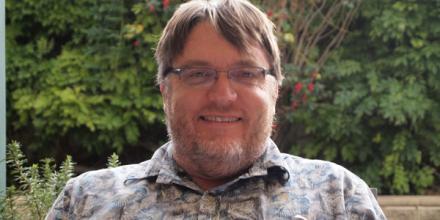
Geoffry Mercer has made an outstanding contribution to applied mathematics research across a wide range of applications, and has a very distinguished record of service to the field of applied mathematics, in particular ANZIAM and MISG. His expertise, talent and energy in multidisciplinary science has infused all aspects of his career, in particular, his teaching and communication of research results, his supervision of PhD students and his community leadership.
As a mid-career researcher, Dr. Mercer’s research record is most impressive. He has published approximately 100 journal articles and has been awarded $2.5 million in external grant funding, including ARC and NHMRC grants. Many of Dr. Mercer’s papers have been published in leading international journals including Proc. Roy. Soc. Ser. A; SIAM J. of Appl. Math.; IMA J. Appl. Math.; PLoS one; Vaccine and Epidemiology. The breadth of Dr. Mercer’s research contributions is striking: combustion and heat transfer, bushfire modelling, flow through porous media, dispersion and hydrodynamics and currently epidemiology and population health.
Dr. Mercer is the leader of the Infectious Disease Epidemiology and Modelling group at the National Centre of Epidemiology and Population Health (NCEPH) and a member of NCEPH’s management team. He is responsible for setting the research agenda of a very diverse set of researchers ranging from applied mathematicians, biostatisticians, epidemiologists, medical and allied health trained professionals as well as assisting in their career development. He is lead researcher on numerous large national and international inter-disciplinary projects on issues of vital importance to our regional population health; e.g. determination of source attribution of Salmonella, developing a new pandemic plan, modelling tuberculosis in the Torres Strait, seasonal and pandemic influenza and dengue fever.
After completing his PhD at the University of Adelaide in 1993, Dr. Mercer built a rewarding and successful long-term collaboration with his colleagues at the Australian Defence Force Academy; in particular, Dr. Steven Barry, Assoc. Prof. Harvinder Sidhu and Assoc. Prof. Rodney Weber on combustion, dispersion and many real world problems arising from deliberations at various Mathematics in Industry Study Group (MISG).
Dr. Mercer has made an outstanding service contribution especially to ANZIAM and MISG. Most recently, he was Secretary of ANZIAM (2008-12), a key role involving the oversight and arranging of many society activities, and providing continuous support and liaison to the Chair and Treasurer. His advice, sound judgment, knowledge of ANZIAM history and procedure were invaluable to our professional body. In addition, he has contributed to a wide range of other ANZIAM activities, such as being Founding Chair of the ANZIAM special interest group in Mathematical Biology, chair and member of the ANZIAM ACT branch and member of various conference organizing committees.
He has also provided outstanding contributions to the MISG, as project coordinator on five occasions, as a member of various MISG organizing committees, and as a participant. The MISG projects he worked on have been very successful, leading to ongoing interactions with industry and to successful ARC linkage grants.
His service contribution has also involved the successful supervision of five PhD students and the current supervision of four PhD students. Students value the rich knowledge and experience that Dr. Mercer brings to their development.
These examples demonstrate that Dr. Mercer has played a pivotal and influential role in the support of applied and industrial mathematics in Australia and ANZIAM. In addition, he uses the multi-disciplinary nature of his research to effectively promote the discipline of Applied Mathematics at a national and international level.
Dr. Mercer is a committed applied and industrial mathematician and has demonstrated through his enthusiasm, energy and sustained achievements that he well and truly meets the criteria for this mid-career award. The selection panel unanimously recommends that Dr. Geoffry Norman Mercer be awarded an ANZIAM 2013 EO Tuck Medal.
On behalf of ANZIAM
Robert Anderssen (CMIS Canberra)
Jim Hill (University of Adelaide)
Kerry Landman (University of Melbourne)
Robert McKibbin (Massey University) -
2015 Associate Professor Troy W. Farrell
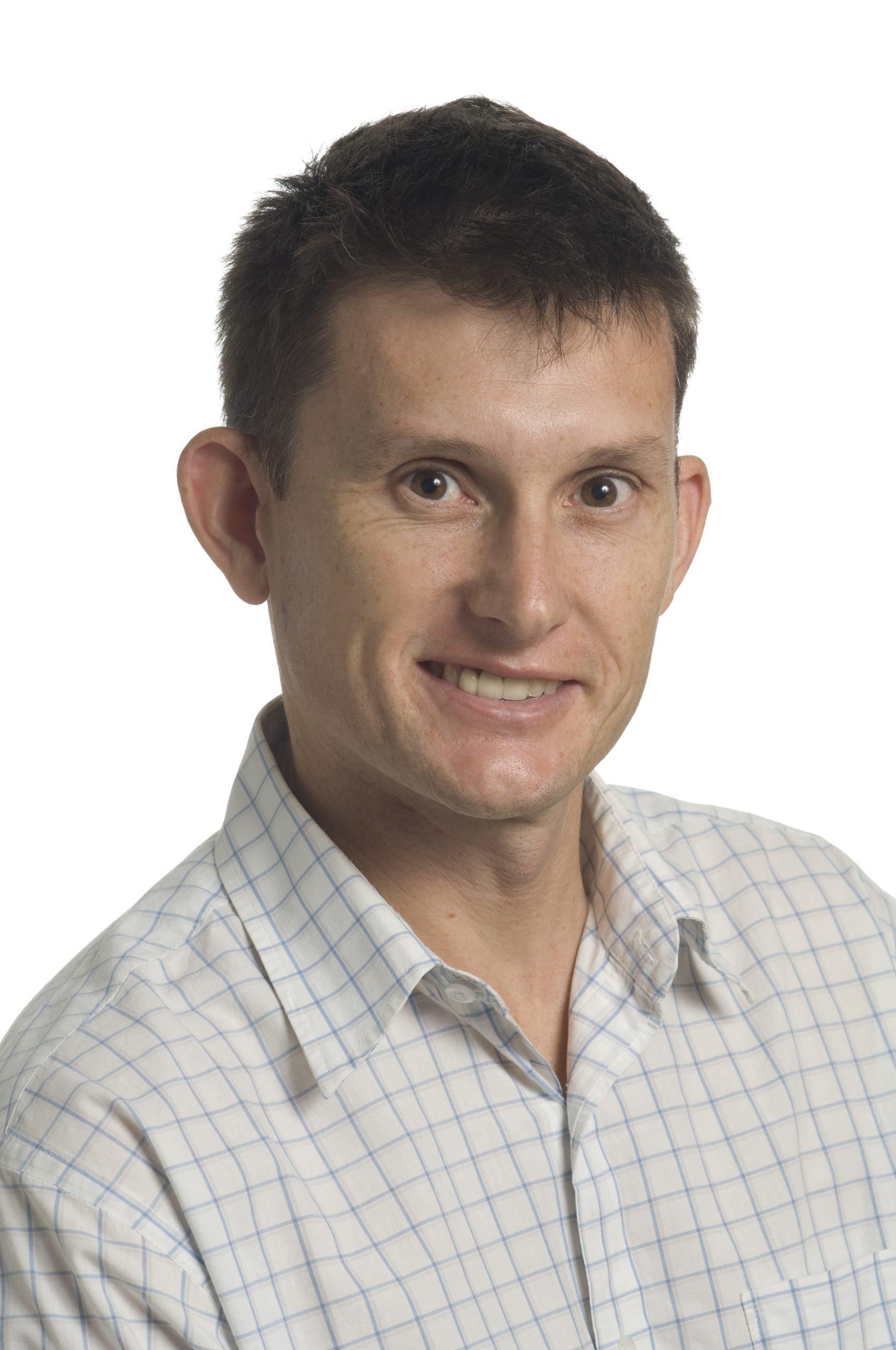
Associate Professor Troy Farrell, from Queensland University of Technology, is an outstanding industrially focussed applied mathematician. He has been highly successful in addressing challenging and important problems that arise in industrial contexts. His work has simultaneously helped to develop the profession of applied mathematics and has achieved high impact for the industries his research has targetted, generating widespread economic benefits. In so doing, he has set an excellent example for the next generation of researchers. For these achievements, he is an ideal recipient of the E.O. Tuck Medal.
Since graduating with a PhD in 1999, Troy Farrell has produced more than 25 peer-reviewed journal articles and conference papers, a book chapter, 12 technical reports as well as many that are confidential and hence unpublished. He has been awarded nearly $1 million in grants and $400k in contracts, and has been involved with the supervision of 3 postdocs, 13 PhD and 16 Honours or Masters students. Troy is a highly regarded and award-winning university teacher and supervisor, and has also been recognised for his contributions to QUT’s external engagement. He has been a visiting academic at the University of Southampton and at KTH in Stockholm.
Troy has used his in-depth knowledge of applied mathematics and physical chemistry to develop sophisticated models of chemical systems that are of great industrial significance. Some recent applications include batteries, dye-sensitised solar cells, drying of colloidal droplets, the oxidation of biomass stockpiles, and understanding the composition and recovery of coal seam gas being produced in Queensland. His work is mainly undertaken in collaboration with industrial partners, for whom his technical ability would not be applicable without supporting attributes including his work ethic, interpersonal skills, and willingness to undertake confidential research, some of which is suppressed from publication.
Troy is a recognised world expert on the electrochemistry of batteries. A specific highlight is his development of a comprehensive, multi-scale, computational model for primary alkaline battery discharge. The model includes realistic features such as charge transport in the electrolyte and at all physical interfaces in the cell, as well as simulation of the phases and structure of the micro-porous cathode. Troy has also successfully investigated many other features of batteries, including measurement of active material utilisation in primary alkaline battery cathodes, singular perturbation analysis for utilisation of active material in electrochemically active nanoporous particles, and the precipitation of ZnO in separator compartments of primary alkaline batteries.
His recent work on lithium ion batteries has gained international attention. The novelty and impact of this work has led to Troy being invited to give plenary lectures in the Oxford Centre for Collaborative and Applied Mathematics (OCCAM) at Oxford University, and in the Institute for Pure and Applied Mathematics (IPAM) at UCLA.
Dye-sensitised solar cells are another important area where his technical skills have been successfully applied. He has developed a model that accounts for charge transport in the semiconductor and electrolyte phases of the cell, as well as photoelectrochemical production of charge at the semiconductor/dye/electrolyte interface in the anode of the cell. Troy has also been the Principal Investigator in an ARC Linkage Grant on oxidation in biomass stockpiles. Another active research project was with the Australian Institute of Nuclear Science and Engineering on drying of colloidal nanoparticle sol droplets.
Troy’s service to the Australian and New Zealand applied mathematics community is also noteworthy. He has done an excellent job as Director of the MISG over the last 3 years. He has a passion for communicating the relevance and effectiveness of mathematics to stakeholders in all parts of the community, as well as facilitating connections between early career researchers and industry.
Other roles of note include being Treasurer for QANZIAM since 2008, and Treasurer for ANZIAM 2009 in Caloundra. He has played a significant role with the QUT Node Leadership of the ATN Industry Doctoral Training Centre in Mathematics and Statistics, a federally funded national centre supported strongly by industry. He is also an important member of the QUT Mathematical Sciences School Executive, holding the position of Director of Industry and Engagement. He is an Associate Editor of ANZIAM J(E) and undertakes reviewing duties for many journals.
The selection panel unanimously recommends that Associate Professor Troy Farrell be awarded the ANZIAM E.O. Tuck Medal for 2015.
On behalf of ANZIAM:
Robert Anderssen (DPAS, CSIRO, Canberra)
Kerry Landman (University of Melbourne)
Robert McKibbin (Massey University) -
2017 Professor Kate A. Smith-Miles
Professor Kate Smith-Miles, from Monash University, is an outstanding applied mathematician internationally known for the interdisciplinary focus of her research. She has developed a broad toolkit of mathematical techniques, and as well as the language and communication skills necessary to collaborate with researchers and industry partners, on problems from fields as diverse as manufacturing design, epidemiology, neural prosthetics, computer vision, finance, and stem cell modelling. The quest for societal impact drives her research agenda and her research leadership. She is an outstanding recipient of the E. O. Tuck Medal.
After graduating with a PhD twenty years ago, she was rapidly promoted from lecturer through to professor in just ten years. She has produced over 240 refereed scientific publications, has been awarded over $15 million in research grants (including 6 ARC Linkage grants) and has 22 PhD completions.
Kate has developed powerful new methods for solving combinatorial optimisation problems, and proposed novel multilinear algebra and tensor analysis techniques to achieve world-leading results in the field of image processing. She has constructed novel formulations of practical industrial optimisation problems, so they can be solved using traditional methods, as well as developing new techniques; she has advanced the use of machine learning methods coupled with optimisation to support intelligent optimisation methods that are responsive to dynamic conditions. These contributions were recognised with the award of the Australian Mathematical Sciences Medal in 2010 for outstanding research contributions to the mathematical sciences.
In 2014, she was awarded an Australian Research Council Laureate Fellowship, with an additional Georgina Sweet Award, a total of $2.83m, to support her groundbreaking work in developing new methodologies to support an improved science of algorithms. Here she uses a combination of linear algebra, optimisation, machine learning, and statistical inference to create powerful visualisations of the strengths and weaknesses of algorithms. She has proposed novel techniques for generating new test instances with controllable characteristics that are provably more diverse, challenging and insightful than standard benchmark test instances. Her methodologies are being applied to algorithms from fields as diverse as combinatorial optimisation, machine learning, time series forecasting, continuous optimisation, mixed integer programming, and software testing. The importance of these ideas to the many research communities that rely on algorithm testing is evidenced by the 20 fully-funded keynote and plenary addresses she has been asked to give in recent years to a variety of audiences from mathematics, computer science, engineering, and other fields. Her world-leading research has formed a critical component of several large- scale UK and European projects for which she serves on their international advisory boards. Kate’s ability to have an impact across many fields stems from her interdisciplinary background, which gives her the perspective to recognise the need for a new science of algorithms that cuts across any field that develops and tests algorithms.
In her role as Head of the School of Mathematical Sciences at Monash University (2009-2014), she brought a strong sense of appreciation at the highest levels of the university that the mathematical sciences are empowering to many disciplines. This led to Monash University supporting Kate’s initiative called MAXIMA (Monash Academy for Cross & Interdisciplinary Mathematical Applications), which blends teaching, research, consulting and community engagement. MAXIMA currently provides training opportunities for 19 interdisciplinary PhD students, and a further 23 interdisciplinary PhD topics have been proposed, awaiting student recruitment.
Beyond Monash University, Kate has made strong service contributions to the discipline of mathematics through membership of various AMSI committees, as well as membership of the AMSI Board. In addition she is chair of the advisory board for the $22m Choose Maths program, funded by BHP Billiton Foundation. She is also on the international advisory board for MATRIX, and is a member of the Prime Minister’s Knowledge Nation 100, which contributes to the implementation of the Australian Government’s National Innovation and Science Agenda. She is a new member of the ARC College of Experts (2017-2019). As a long-term partner in the CSIRO Mathematicians in Schools program, she has also made contributions to outreach, developing teaching materials that have been shared with other mathematicians to support their engagement with their schools.
Kate’s commitment and proven track record of successful service to the discipline of mathematics has been acknowledged with her being asked to commence a 2 year term as President of the Australian Mathematical Society, which commenced in December 2016.
The selection panel unanimously recommends that Professor Kate Smith-Miles be awarded the ANZIAM E.O. Tuck Medal for 2017.
On behalf of ANZIAM:
Kerry Landman (University of Melbourne)
Robert McKibbin (Massey University)
Peter Taylor (University of Melbourne) -
2018 Professor Yvonne M. Stokes
Professor Yvonne Stokes, from The University of Adelaide, is an exceptionally gifted applied mathematician who has made fundamental contributions to industrial and applied mathematics.
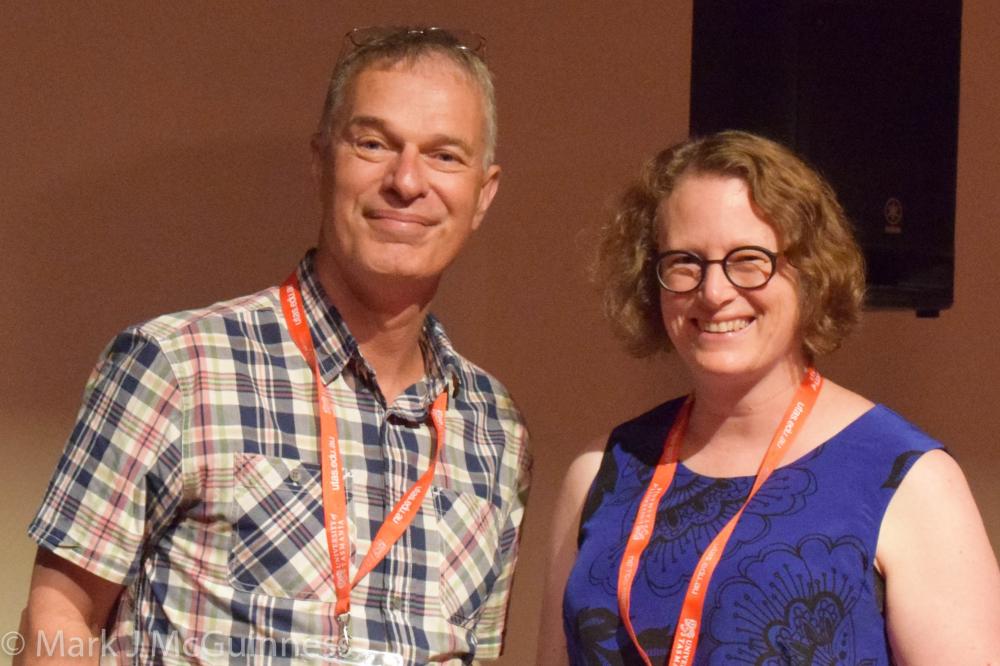
Peter Taylor and Yvonne Stokes (Photo Credit: Mark McGuinness)
Yvonne’s research is focussed on two main areas: viscous fluid mechanics and mathematical biology. The former topic has been the subject of her work since her PhD, which she received in April 1999. Her collaboration with the Institute of Photonics and Advanced Sensing on the modelling of the fabrication of micro-structured optical fibres has been truly world-leading. This is evidenced by a US Patent together with a series of papers of stunning originality. Yvonne has developed a strong research record in suspension flows, focusing on curved geometries. Simultaneously she has applied her considerable abilities to various biological problems including the simulation of the growth of plant roots and the calcium signalling and travelling wave response to oocyte fertilisation.
Over the years, Yvonne has written a number of high-impact papers in highly-regarded journals such as the Journal of Fluid Mechanics and Physics of Fluids. Her work is well-cited. She has been very successful in obtaining Category 1 funding, having been awarded two ARC Discovery grants as lead Chief Investigator, two Linkage projects and a Future Fellowship, which runs through to 2020. Yvonne has developed and consolidated fruitful international collaborations with world-renowned researchers, such as Professor Andrea Bertozzi and Professor Darren Crowdy, which have become a central pillar in her research portfolio. She has been especially productive in the last five years with about twenty papers in top quality journals while supervising five PhD students, four of whom have already completed. In addition in 2007 she was awarded the J.H. Michell Medal.
Yvonne has built up an outstanding service record both within her home university and the wider mathematical community.
In December 2016, she was elected Chair of the Women in Mathematical Sciences Special Interest Group (WIMSIG) of the Australian Mathematical Society, a position she took up early in 2017. This leadership role builds on a long record of outstanding leadership in the promotion of women in mathematics at high school level: highlighting of STEM opportunities for women, promoting the Marta Sved scholarship, organising of the annual Women and Mathematics workshop to promote the study of university mathematics to students in Year 12, and initiating the South Australian GEM (Girls Enjoy Maths) day under the auspices of AMSI and BHP Billiton.
In addition, Yvonne is an exceptional mentor to young mathematicians, as evidenced by the careers of former students.
Yvonne has also demonstrated exemplary service to applied and industrial mathematics. She has been a member of the Australian Academy of Sciences National Committee for Mechanical Sciences since 2012. Over 2005-2006 and 2014-2015 she served on the Executive Committee of ANZIAM and from 2015-2017 was a member of the selection committee for the J.H. Michell medal including one period as Chair. She was the Director of the ANZIAM conference held in February 2017 in Hahndorf that was a highly successful and enjoyable event. She also has been very active in the South Australian branch of ANZIAM.
In other service achievements, Yvonne has been a moderator at three Mathematics in Industry Study Groups, as well as being a valued participant over many years. Yvonne taught an extensional flows subject at the AMSI summer school at Monash in 2018.
To summarise, Yvonne is an outstanding applied mathematician known for the very high quality of her research and service. She has been recognised by the award of the Future Fellowship, her numerous grants and a steady stream of PhD graduates. She possesses an exceptional service record, including substantial work for ANZIAM and AustMS.
The selection panel unanimously recommends that Professor Yvonne Stokes be awarded the ANZIAM E.O. Tuck Medal for 2018.
On behalf of ANZIAM:
Shaun Hendy (University of Auckland)
Kerry Landman (University of Melbourne)
Peter Taylor (University of Melbourne) -
2019 Professor Scott W. McCue
Professor Scott McCue, from Queensland University of Technology, is an outstanding applied mathematician with expertise across a broad range of research areas, and is an inspirational and committed leader in the ANZIAM community.
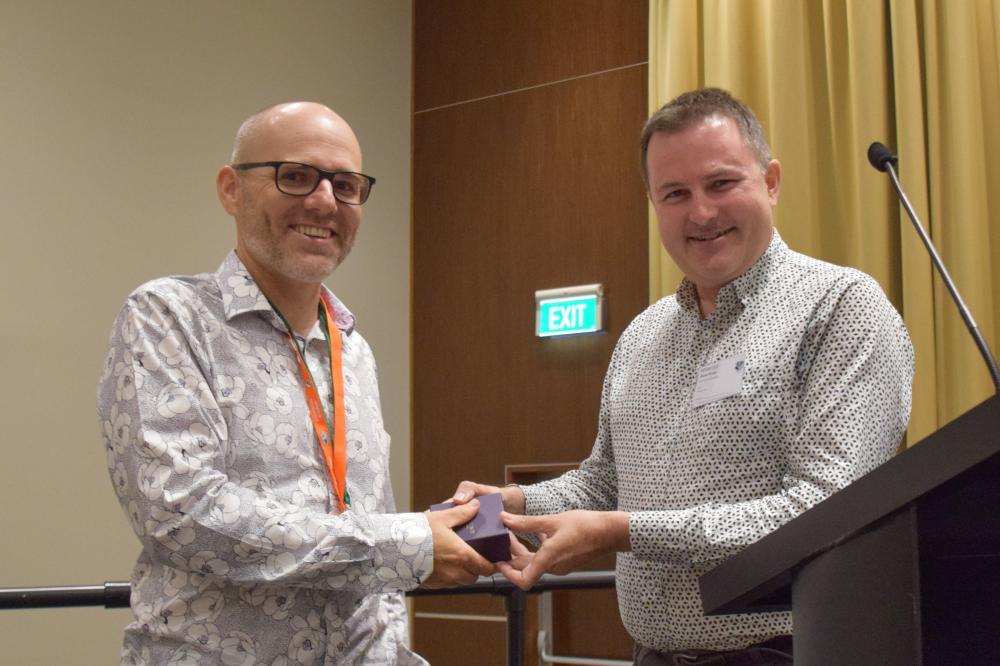
Scott McCue and Shaun Hendy (Photo Credit: Mark McGuinness)
In particular, Scott’s research has a focus on developing and applying theoretical and computational techniques to problems in interfacial dynamics and mathematical biology, but he has also made broader contributions to industrial mathematics. Scott has led numerous funded research projects, and has received over $2.8 million funding for ARC Discovery and Linkage Projects, including $740K from his industry partners.
Scott’s primary expertise is in the area of interfacial dynamics, which concerns developing and analysing mathematical models for complex processes that involve moving interfaces. Scott has applied conformal mapping, integral transforms and boundary integral methods to study surface gravity wave problems, specialising in both linear and nonlinear settings. He has published numerous papers in this area, including five in the prestigious Journal of Fluid Mechanics. In recent years, Scott’s research group at QUT has also. developed new extremely efficient computational methods and applied these techniques to study unusual features of highly nonlinear ship wave patterns.
Scott’s research in interfacial dynamics also covers nonlinear moving boundary problems in Hele-Shaw and Darcy flow, focussing on selection problems, viscous fingering, pattern formation, self-similarity and singularity structure. A closely related subject of Scott’s research is in the area of Stefan problems, for which Scott is well known for his asymptotic analysis of `hole-closing’ problems.
Scott’s second research area is mathematical biology, in particular developing and analysing reaction diffusion models and random walk processes for collective cell motion, with applications to wound healing and cancer biology. The impact of this work is both in applied mathematics itself and for end users in biology. The highlights of Scott’s work in this area include new insights into nonlinear degenerate diffusion for cell migration and mechanochemical models for tissue growth.
The third area of Scott’s research is industrial mathematics, which involves applying a suite of mathematical modelling techniques to solve practical problems of direct relevance to industry partners. Scott leads a large project, funded by two ARC Linkage grants, which is constructing a suite of mathematical models to investigate spray droplet interactions at the single leaf, whole plant and crop level. The mathematical components of this project have led Scott and his group to new discoveries in the fields of thin film flows over curved surfaces and droplet impaction on hydrophobic surfaces.
Scott has made an exceptional contribution to the teaching and supervision of students and emerging researchers. He has supervised 7 post-doctoral fellows and 14 PhD students to completion, as well as supervising an additional 46 undergraduate, summer, Honours or Masters projects. In terms of opportunity, Scott has held a traditional academic position since 2005 with a full teaching load. In recent years, he has taken on significant leadership roles at QUT including being the Discipline Leader for Applied and Computational Mathematics, ERA Director for the Science and Engineering Faculty and HDR Director for the School of Mathematical Sciences.
Scott has been an important leader in the ANZIAM community. He served two 2-year terms (2006-7 and 2010-11) on the ANZIAM Executive. He has attended 20 ANZIAM conferences and has served as a member of the TM Cherry Prize Committee on four occasions. He was Secretary of the ANZIAM Conference in Caloundra in 2009, and in 2015 was co-Director for the annual ANZIAM Conference in Surface Paradise. As a Director, Scott led the organisation of this successful conference and developed the well-received scientific program. Scott demonstrated leadership in the ANZIAM community by playing a major role in the invited speakers committee, acting as MC for the conference dinner and awards ceremony, and facilitating the Women in Mathematics Lunch.
Scott is the Chair of the Michell Medal Committee in 2018, after serving as Incoming Chair in 2017. Scott is an ongoing Trustee in the AF Pillow Applied Mathematics Trust, a role that involves reviewing Trust. activities and ranking the applications for the AF Pillow Applied Mathematics PhD top-up Scholarship. Since February 2008 Scott has been on the Editorial Board of the ANZIAM Journal, handling 85 articles in both the printed journal and the electronic supplement.
Scott was Chair of QANZIAM for the four years 2006-09. In this role, Scott represented QANZIAM in the ANZIAM community, formulating and reporting on QANZIAM activities, and successfully advocating for a significant increase in annual funding. Scott has organised four annual QANZIAM conferences. Under Scott’s leadership, the QANZIAM Executive put in place strategies to further engage with students, for example by waiving student registration fees and by funding a student prize for the most outstanding student presentation.
The selection panel unanimously recommends that Professor Scott McCue be awarded the ANZIAM E.O. Tuck Medal for 2019.
On behalf of ANZIAM:
Troy Farrell (QUT)
Shaun Hendy (University of Auckland)
Yvonne Stokes (University of Adelaide)
Peter Taylor (University of Melbourne) -
2020 Professor Matthew Simpson
Professor Matthew Simpson, from Queensland University of Technology, is an outstanding applied mathematician and a committed leader in the ANZIAM community.
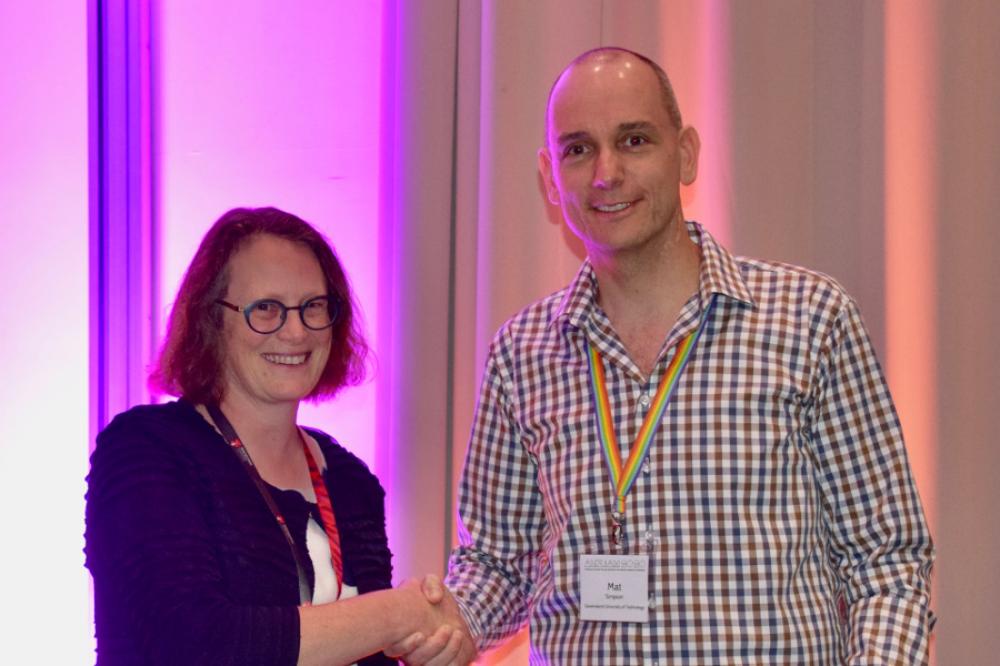
(Photo credit: Mark McGuinness)
Matthew’s research uses computational and analytical methods for solving mathematical models of biological and physical systems. Since graduating his PhD in 2004 from the University of Western Australia, Matthew has established a very strong record of research. He has produced more than 150 refereed journal articles, the majority of which are in the leading journals in their field. He has been awarded $2M in external funding, including 4 ARC Discovery Grants, 3 as lead Chief Investigator, an ARC Future Fellowship, an ARC Postdoctoral Research Fellowship. In addition to the ARC, Matthew has received funding from the Marsden Fund (New Zealand), the Royal Society (United Kingdom) and the USA Aerospace Research Program.
Matthew’s PhD research involved designing and analysing novel computational algorithms to solve mathematical models that predict how fresh and saline fluids mix in coastal aquifers. Supported by a Small Grant from the Australian Research Council (ARC), this work led to publications in Water Resources Research, Advances in Water Resources, Journal of Hydrology and Groundwater that have since received almost 500 citations.
In his postdoctoral career Matthew led projects that used mathematical models to design and interpret experiments on the spatial organization of cell function within an invading population of biological cells. Publications in Developmental Biology, Journal of Theoretical Biology and Development, Growth and Differentiation have been cited more than 300 times. Matthew collaborated with colleagues from the University of Melbourne to develop new theoretical tools to describe multiscale data from cell biology experiments. Publications in Physical Review E and Physica A have been cited more than 330 times.
Matthew’s more recent work involves the development and application of mathematical tools for describing collective migration of populations of adhesive biological cells and the development and use of mathematical models to study a range of biomedical phenomena including: melanoma invasion into intact, three-dimensional human skin tissues; burn injuries in living three-dimensional tissues; and optimal control of leukemia treatment. He has also led projects on the analysis of stochastic models of cell migration which have resulted in the derivation of new continuum-limit descriptions of these models.
Matthew continually fosters new projects and collaborations. In 2018 he worked with medical researchers at the University of Queensland to develop continuum and discrete mathematical models of cell migration that describe experiments performed with a new individual florescent cell labelling and imaging technique called FUCCI. This new technology is revolutionising experimental cell biology research and Matthew and his group are the first to develop mathematical models of this emerging technology. This work has been published in prestigious journals, such as Biophysical Journal and the Journal of the Royal Society Interface and Matthew was invited to write a popular science article about FUCCI modelling, which was published on the front cover of SIAM News in 2019.
The national and international research community has recognised Matthew’s research achievements by inviting him to make several plenary presentations, including: Australian Society for Medical Research; ANZIAM; Australasian Wound and Tissue Repair Society; Kyushu University Mathematics-for-Industry Forum; Swinburne Archimedes Lecture; and SIAM Life Sciences. Matthew was awarded the JH Michell Medal in 2012.
Matthew’s service to the Australian and New Zealand applied mathematics community is also noteworthy. He has made significant contributions to the teaching and supervision of students (7 PhD and 2 MPhil students completed) and emerging researchers (4 postdoctoral research fellows). He is currently an Associate Editor of the Journal of Engineering Mathematics and the ANZIAM Journal. In 2018 Matthew chaired the scientific committee for the annual meeting of the international Society for Mathematical Biology (SMB) in Sydney. In 2017 Matthew was appointed to an International Advisory Panel to conduct a mid-term review of Te Pūnaha Matatini, a Centre for Research Excellence funded by the New Zealand Government’s Tertiary Education Commission.
Matthew was elected to the ARC College of Experts from 2016 to 2018 and is currently the Deputy Director of the Australian Mathematical Sciences Institute (AMSI) where he chairs the AMSI Research and Higher Education Committee and jointly coordinates the Vacation Research Program. In 2015 he Co-directed the highly successful 51st meeting of ANZIAM on the Gold Coast and he has contributed to many ANZIAM committees including those for the Thomas Cherry Prize, the JH Michell Medal and the development of the ANZIAM Code of Conduct. He is a past Queensland representative on the national ANZIAM Executive Committee.
The selection panel unanimously recommends that Professor Matthew Simpson be awarded the ANZIAM E.O. Tuck Medal for 2020.
On behalf of ANZIAM:
Troy Farrell (QUT)
Shaun Hendy (University of Auckland)
Yvonne Stokes (University of Adelaide) -
2021 Professor Michael Plank
Professor Michael Plank, University of Canterbury, New Zealand, has a record of outstanding research in, and distinguished service to, applied mathematics. He is a committed leader in the ANZIAM community.
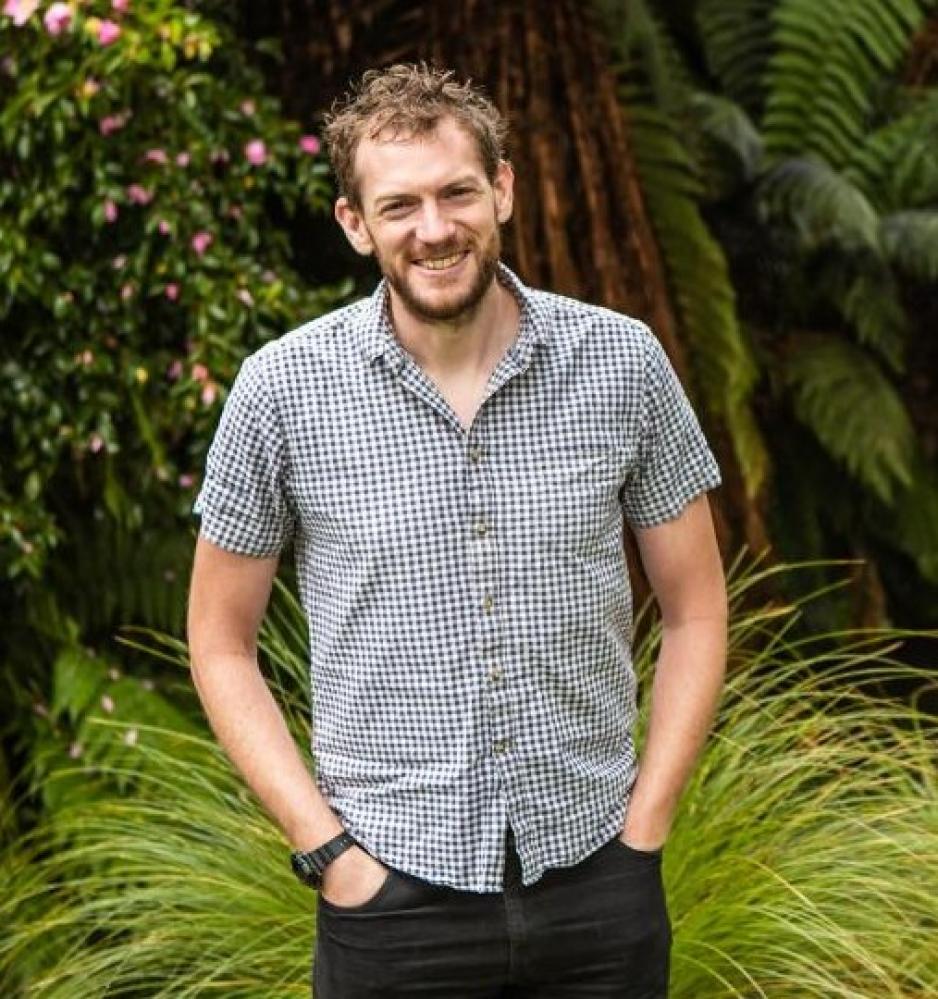
Professor Michael Plank
Mike is an expert in mathematical modelling of complex biological and social systems at multiple scales from intracellular signalling and collective cell behaviour through to large ecosystem dynamics. His research is transdisciplinary and application‐driven, employing mechanistic and stochastic mathematical modelling to give insight into underlying mechanisms. His publications are a blend of novel methods and results in applied mathematics, and application‐focused models that have impact in other disciplines and outside academia.
Mike has 103 papers published in diverse top-ranking multidisciplinary journals including Nature, Proceedings of the National Academy of Sciences USA, Physical Review E, Ecology Letters, Journal of the Royal Society Interface, International Council for the Exploration of the Seas (ICES) Journal of Marine Science, Neurocomputing, and more. His review paper on random walks in the Journal of the Royal Society Interface is the go‐to paper for researchers using random walks to model biological processes and has almost 1,200 citations (Google Scholar). His paper in Nature coupled a nonlinear differential equation model with random matrix theory to provide a new explanation for why complex ecosystems exist in reality, despite a long-standing theory that high-dimensional ecosystem models cannot be stable. Invitations to speak include at the International Conference on Mathematical Sciences and Technology in Malaysia, workshops at the Banff International Research Station and UC Berkeley’s Gump Research Station, the Asia‐Pacific Forum “Math for Industry”, and ANZIAM conferences. Furthermore, Mike has been successful in securing significant competitive external research funding. He is a Principal Investigator and one of four research theme leaders at Te Pūnaha Matatini (Centre for Complex Systems), one of 10 New Zealand Centres of Research Excellence that have been refunded for 2021‐28, and has been a Principal Investigator on two Marsden grants and a Partner Investigator on two ARC Discovery Projects.
Mike’s research has significant impact in industry and government, both in New Zealand (NZ) and internationally. He is a member of the NZ Prime Minister’s Chief Science Advisor expert panel “Towards a vision for fisheries in New Zealand in 2040”. His ongoing research on balanced fishing has been cited in reports by the Food and Agriculture Organisation of the United Nations and the International Union for the Conservation of Nature, and discussed in a forum at the European Union Parliament. His research on social networks of at‐risk children has been influential in the NZ Ministry for Children and led to an invitation to present at the International Congress on the Prevention of Child Abuse and Neglect in 2019.
Mike also co‐leads the team modelling Covid‐19 in NZ and advising the government on its policy and operational response. In March 2020, he led the development of a stochastic, age-structured branching process model, driven by data on Covid-19 cases imported into NZ by international travellers. This model quickly became, and remains, one of the main tools for modelling the spread and control of Covid‐19 in NZ. Mike’s team was seconded by the National Crisis Management Centre, regularly briefs Cabinet in advance of decisions about changes in Covid-19 Alert Levels and policy settings on testing, contact tracing and border quarantine strategies, and provides weekly real‐time reporting to Health Board planners on current and projected infection rates and healthcare requirements. His work on Covid-19 has also begun to yield research publications. In July 2020, the Prime Minister personally wrote to Mike to thank him for his contribution to New Zealand’s ongoing efforts to eliminate Covid‐19. Furthermore, Mike is an invited member of the Pandemic Response Subgroup of the Global Partnership on Artificial Intelligence, an international group of experts promoting the responsible use of algorithms and data to inform public health responses.
Mike has long been a leading member of the New Zealand branch of ANZIAM and is the current President. He also serves the ANZIAM community more broadly. He has represented ANZIAM on the Board of the International Council of Industrial and Applied Mathematics (ICIAM) since 2016. He has been an Associate Editor for the ANZIAM Journal since 2010 and has sat on ANZIAM’s Executive Committee since 2014. He has served on ANZIAM invited speakers committees, the TM Cherry Prize committee, and spoken at an ANZIAM Early Career Workshop. He is presently on the steering group for an ANZIAM‐led bid to host the 2027 ICIAM Congress in Auckland. Mike was one of two co‐convenors of ANZIAM 2019 in Nelson, NZ, for which he led the development and implementation of a Code of Conduct which has since been adopted for subsequent ANZIAM conferences and events. Mike was also involved in development of the Code of Conduct for the ANZIAM Society and the Terms of Reference for the ANZIAM Nominations Committee which aims to ensure a diverse pool of high‐quality nominations for ANZIAM awards and their evaluation in a transparent and unbiased manner.
Mike also promotes the profession of Applied Mathematics through outreach activities such as public lectures, school enrichment talks and activities on mathematical modelling. Through the Covid-19 pandemic he has appeared in the print and broadcast media numerous times. He has served on NZ’s Marsden and Performance-Based Research Fund panels, has been a member of the Mathematics‐in‐Industry NZ (MINZ) Reference Group since its establishment in 2016 and is on the Organising Committee for MINZ 2021.
Mike also contributes to the development of the next generation of applied mathematicians. He has supervised 5 postdoctoral fellows and 15 PhD and 2 Masters students in a range of application areas, often with collaborators in industry. Many have gone on to jobs in academia, Crown Research Institutes, government or private sector organisations both in NZ and around the world. He has also acted as external examiner of many HDR theses.
Professor Michael Plank is a very worthy winner of the ANZIAM E.O. Tuck Medal for 2021.
On behalf of ANZIAM:
Yvonne Stokes (University of Adelaide),
Troy Farrell (QUT),
Kate Smith-Miles (University of Melbourne),
Hinke Osinga (University of Auckland),
Gary Froyland (University of New South Wales). -
2022 Professor James McCaw
Citation for James McCaw
Professor James McCaw, University of Melbourne, has a record of outstanding research in, and distinguished service to, applied mathematics. Furthermore, he has demonstrated his leadership in both the ANZIAM community and society more broadly, as an applied mathematician making fundamentally important contributions, and raising the profile of mathematics.
From a mathematical perspective, James’ research covers dynamical systems, stochastic processes, numerical and computational simulation, and Bayesian data analysis. James engages in deeply cross-disciplinary research into the development of novel mathematical and statistical models in biology, with a focus on their application to understanding infectious diseases. His research expertise primarily focuses on host-pathogen interactions and epidemiological transmission dynamics. The impact of his work has been significant, particularly in recent years, where his expertise has been highly sought after by public health authorities, translating fundamental insights on infection derived from mathematical and statistical modelling into policy relevant advice and decision support.

Professor James McCaw
James has published over 100 peer-reviewed journal papers, in addition to numerous other research outputs in the form of reports to government agencies detailing findings from model-based investigations and recommendations for response strategies to emergent disease threats. Most notably, his 2007 Mathematical Biosciences paper with Professor Jodie McVernon formed the foundation for much subsequent research, including the model used to inform the Commonwealth about SARS-CoV-2 and trigger the Australian response in the first week of February 2020. From January 2020, James has been an invited expert member of the Australian Health Protection Principal Committee, directly advising the Commonwealth and jurisdictions on response options for the COVID-19 pandemic. He was also a member of the Communicable Diseases Network of Australia COVID-19 Surveillance Working Group, contributing to Australia’s National Surveillance Plan. The epidemic assessment work that James has led for COVID-19 in Australia has become part of the national terminology and framing. He introduced the notion of `transmission potential’ and co-wrote elements of Australia’s National Surveillance Plan for COVID-19 that define these measures as key instruments for evaluation of the epidemic and Australia’s response. His team’s findings are reported weekly to the Australian government.
James’ exceptional research and impact has been recognised through receipt of the University of Melbourne Award for Excellence in Engagement in 2021. Furthermore, James was awarded the 2016 Australian Museum Eureka Prize in Infectious Diseases (for collaborative work on malaria infection and drug action), an Australian Institute of Policy and Sciences’ Victorian Young Tall Poppy Award in 2012, and the inaugural Public Health Association of Australia’s Aileen Plant Memorial Prize in Infectious Diseases Epidemiology in 2009 (for research on allocation of antiviral drugs for pandemic response). His research in epidemic forecasting was recognized with the 2018 CivSec National Innovation Award for Civil Security and a category award in the same year for Innovation in Disaster Relief, Emergency Management and Humanitarian Services. He was invited to join the World Health Organisation’s Influenza Incidence Analytics Group, formed in 2019 and expanded and refocussed as part of the global COVID-19 response. His teams’ contributions to this emerging field were presented through a ‘perspective’ piece published in the top-tier journal PLoS Medicine in January 2020.
Pre-COVID, and linked to his Young Tall Poppy Award, James delivered numerous talks and workshop sessions to secondary school students on the role of mathematics in understanding how diseases spread and how we can better manage them. In 2017, he worked with AMSI to develop a long-format introduction to disease modelling for secondary school students (see here). James has been a regular commentator in the national and international media on COVID-19, appearing on TV (The Drum, 7.30, 60 Minutes, Seven News) and radio (ABC, 3AW) and through commentary, analysis and interviews in the print media. He has written regularly for the past decade for The Conversation, Pursuit and other long format speciality publications such as Cosmos Magazine.
In addition to these numerous service contributions to society more broadly, James has consistently made strong and valuable contributions to the academic community. He is an Editor for Epidemics, the leading speciality journal for infectious diseases modelling, and serves on the editorial boards of the journals eLife, Infectious Disease Modelling and BMC Theoretical Biology and Medical Modelling.
Over the last decade James has been a strong contributor to ANZIAM. He was a founding member (2012) and chair (2015–18) of the Mathematical Biology Special Interest Group of ANZIAM. He served on the executive of ANZIAM while he was Chair of the Mathematical Biology Special Interest Group. Furthermore, James was Deputy Chair of the 2021 ANZIAM Conference Organising Committee. He was the original Director of the Conference; establishing the committee, venue, and undertaking early planning when he stepped down due to COVID-19 commitments.
At the University of Melbourne James was Associate Dean (Research) for the Faculty of Science from January 2020 to June 2021. In his relatively short time in the role, he had substantial impact, including initiatives to support early career researchers whose career progression has been affected by COVID-19. He continues to advocate for the importance of discovery-based research, and support the development of ECRs and broader diversity and inclusion. James has also served as Assistant Dean for Graduate Programs where he carried a major role in supporting graduate students. As a mentor himself, James has supervised 6 research fellows, 7 PhD students and 22 Masters students across the disciplines of Mathematics and Statistics, Bioinformatics, Epidemiology and Public Health.
James is clearly an exceptional “well-rounded” academic, with an impressive balance between high quality and impactful research, outstanding teaching and mentoring, and service within ANZIAM as well as responsive service to the community through his government policy work and media communications.
For these reasons, the selection committee believes that Professor James McCaw is a very worthy winner of the ANZIAM E.O. Tuck Medal for 2022.
-
2023 Associate Professor Luke Bennetts
Citation for Luke Bennetts
Associate Professor Luke Bennetts, from the University of Adelaide, is both a distinguished applied mathematician with an outstanding track record of high-quality research and an enthusiastic supporter of the discipline and ANZIAM. He is a natural leader who is leaving a deep and lasting legacy by mentoring young people, servicing the academic community and promoting applied mathematics to society as a whole.

A/Prof Luke Bennetts
Luke’s mathematical research focusses on wave propagation, mostly water waves and their interaction with solid bodies. He is an expert on the mathematics of wave-structure interactions, dispersive waves and wave scattering, applying a mix of classical applied mathematics and novel computational methods to study fundamental mathematical models based on partial differential equations. On the other hand, Luke is heavily involved in application-driven research, for example modelling the dynamics of the marginal ice zone, including propagation of storm waves through the sea-ice-covered ocean, wave-induced ice breakup, and the resulting dynamics of the ice cover. For this very applied work, Luke combines his theoretical insight with experimental results from the laboratory and analysis of field observations.
Luke has co-authored roughly 75 peer reviewed articles in international journals, including a dozen in the prestigious Journal of Fluid Mechanics and many others in top applied mathematics outlets such as SIAM Journal on Applied Mathematics and Proceedings of the Royal Society A. Luke’s applied research is published in highly regarded scientific journals including Geophysical Research Letters, Nature and Nature Communications. As an example of the influence of this work, Luke and collaborators from Norway developed the first model of coupled wave propagation and sea ice breakup, which has been adopted by many other research groups, and integrated into numerical wave and sea ice models used for operational and climate studies. The two articles describing the model have received over 300 citations combined. In another example, Luke led combined mathematical and physical modelling of the highly nonlinear phenomenon of wave overwash of ice floes, for which the three foundational articles have received over 200 citations.
Luke has been phenomenally successful in attracting external funding for his research. He is currently an ARC Future Fellow undertaking a project to integrate rifts and swell in the mathematics of ice shelf disintegration, and was previously an ARC DECRA Fellow where he assimilated ocean wave interactions with sea ice into climate models. He is currently first Chief Investigator on an ARC Discovery Project for empowering next-generation sea-ice models with wave-ice mathematics. Further, Luke is currently leading the sea ice modelling component of Australia’s next generation ocean-sea ice model, as part of the Consortium for Ocean-Sea Ice Modelling in Australia community. The modelling is the main work package of an ARC Linkage Project, which involves end-users at CSIRO, the Bureau of Meteorology, and the Australian Antarctic Division. Moreover, Luke is a Chief Investigator on the East Antarctic Marginal Ice Zone Project, which will be based around a multi-month voyage in 2023 on Australia’s new icebreaker.
In terms of service, Luke has been a dedicated supporter of ANZIAM and the community of mathematical sciences. He has been a regular at ANZIAM conferences since 2010 and has presented in the ANZIAM session at AustMS conferences. He has served as an AustMS Early Career Representative for four years and as an organiser of two AustMS Early Career Workshops. He was an AustMS representative at Science Meets Parliament 2021, and on the Neumann Prize Committee for the best student talk at the AustMS 2021 conference. He is on the committee of the ANZIAM South Australia branch and is currently on the ANZIAM Executive Committee.
Significantly, Luke has helped establish and lead the Australasian Wave Science community KOZWaves, which runs a highly successful biennial conference. Luke hosted KOZWaves 2015 at the University of Adelaide and obtained funding support from the US Office of Naval Research. He has been the Chair of the KOZWaves Executive Committee since it was set up in 2015. Luke is the principal organiser of a six-month research programme to be held at the Isaac Newton Institute of Mathematical Sciences in Cambridge in 2023. He was the managing guest editor of a theme issue of the Philosophical Transactions of the Royal Society A, which was published in 2022. He was the lead organiser of the Australian Academy of Science conference on Multiscale Dynamics of the Southern Ocean in 2021 and was an organiser of two AMSI–AustMS supported conferences in 2022.
In terms of public engagement, Luke writes articles and give talks to disseminate his research to the broader science community. He has given have public lectures for the National Science Week, as part of the Tonsley Innovation Hub, and at the South Australian Museum. Further, he has written three articles for The Conversation to communicate his research fields to a broader audience. Importantly, Luke has been an energetic and thoughtful mentor for many research students and postdocs over the years, leaving an enduring footprint on young researchers in our community.
Luke has been recognised elsewhere for his excellent record of research and service. Apart from his ARC DECRA and Future Fellowships, Luke was previously a SA Tall Poppy Winner in 2016. He has held a Humboldt Experienced Researcher Fellowship, a Simons Fellowship as part of a Newton Institute programme at Cambridge and was joint winner of the AustMS Gavin Brown Best Paper Prize. In 2016 in was awarded the Christopher Heyde Medal by the Australian Academy of Science to recognise outstanding research in the mathematical sciences by researchers up to 10 years post PhD. And notably, in 2020 Luke was awarded the Australian Mathematical Society Medal for distinguished research in the mathematical sciences, a medal that is awarded once each year for mathematicians that are less than 15 years out of their PhD.
The selection panel enthusiastically recommends that Luke Bennetts be awarded ANZIAM’s EO Tuck Medal for 2023.
-
2024 Professor Alex James
Citation for Professor Alex James
Professor Alex James of the University of Canterbury has a record of outstanding research and distinguished service in the field of applied mathematics.
Alex has made an exceptional range of research contributions in mathematical modelling, with over 65 journal articles spanning theoretical and applied areas. Her applied research includes significant contributions to problems of national importance, including translocation of West Coast snail species, weed invasion of farmland, the Mycoplasma bovis epidemic, the academic pay gap, and the Covid-19 response. She has also published highly cited papers on theoretical problems, for example on Lévy walks and complex ecological systems, in prestigious journals including Nature, Royal Society journals, and Ecology Letters.
Alex has led a powerful suite of research findings on gender inequity in academia in New Zealand and beyond. This work began with a 2020 paper finding that male researchers have nearly double the odds of being a Professor or Associate Professor compared with female researchers of similar age and research score. Several of her papers explore possible causes and solutions for the gender pay gap. These papers are unique in the field, in that they explore women’s lived experiences in a quantitative way. For example, her 2023 paper explores double-binds and double-whammies facing women in academia, examples of no-win situations that detrimentally affect women’s career progression. Alex’s 2022 article investigates the ‘levers of change’ that universities could pull to improve equity outcomes, while her recent article in Royal Society Open Science models ethnicity and intersectional effects on equity in employment outcomes.
From early 2020, Alex played a leading role as part of New Zealand’s national Covid-19 modelling team, setting aside her research plans to do a science pivot. Her collective work on biomathematics and gender equity, internationally recognised in its own right, had to take a back seat to science that lay at the core of the public interest. She worked in real time with government advisors and policymakers on matters of crucial national importance. Her involvement in developing mathematical models, analysing data, and communicating the results was a significant contribution to New Zealand’s world-leading response to Covid-19. In addition to working in this consultative role for the New Zealand Government, her team developed novel and innovative approaches to epidemic modelling.
Alex has an impressive range of recent publications in highly-ranked journals. These include papers about predicting water levels in wetlands under climate change, modelling balanced harvesting in fisheries, the optimal brood size in populations, and modelling endangered languages with a focus on te reo Māori.
Alex has shown national leadership in leveraging and expanding the network of Te Pūnaha Matatini, New Zealand’s Centre of Research Excellence in complex systems, to pull together impactful research on many fronts. Her work on the “DT model” for masting is at the heart of the Department of Conservation’s multimillion dollar “Battle for our Birds” campaign, and is also used by the National Institute of Water and Atmospheric Research for management decisions.
Alex has attracted several million dollars in research funding, including four fully funded PhD scholarships, 10 years worth of postdoctoral funding and 14 summer scholarships, from sources including Te Pūnaha Matatini, National Science Challenges, and numerous Crown Research Institutes and Government Departments. Alex has supervised over 50 student projects, including 10 PhDs and four Masters students. She has co-authored 19 journal papers with students from a range of disciplines including creative arts, linguistics, Māori and Indigenous studies, as well as students in Mathematics and Statistics. She has supervised nine postdoctoral fellows and mentored junior scientists at the University of Canterbury and Manaaki Whenua. She was a plenary speaker at the Australian Mathematical Society conference in 2016 and at the Society for Mathematical Biology conference in 2018.
Alex’s service activities have a strong equity focus. She has contributed at the national level to gender equity, showing initiative and courage by scrutinizing and reporting on sensitive and complex issues. Her gender equity work has been used by the Tertiary Education Commission in their recent review of New Zealand’s research assessment framework, and by the University of Canterbury in their promotions review. She has been profiled by the New Zealand Herald and Radio New Zealand. Her gender-equity work has been covered by Times Higher Education and Guardian Education, and her linguistics work by the ABC and BBC.
Alex contributed considerably to the public discussion of the science behind New Zealand’s Covid-19 response. She has been highly active in the media, contributing media interviews and communicating the science behind the health advice and decision-making to the public. She also provided comment to international news outlets and co-authored three articles in The Conversation, which together have received over 750,000 reads. With global trust in science at a low ebb, Alex’s science communication has shown New Zealand and the world the value of trusting in good science.
The title of Alex’s professorial lecture – Changing the World, one Data-point at a Time – embodies her service-oriented work ethic and commitment to improving the evidence base for impactful decisions from the local to the global stage. Currently, Alex is contributing to the mathematical evidence base for efforts to improve equity in student achievement. This type of service is just one example of her selflessness in giving her time and expertise in the service of a more just world for all.
Overall, Alex’s academic and professional activities demonstrate an exceptional degree of promoting engagement of mathematics with the wider world and beyond the traditional boundaries of the discipline. She brings a mathematical lens to areas where this has not traditionally been done and has the courage to work on controversial yet crucial questions. She has the vision to use the power of mathematics and data science to challenge the status quo and illuminate a brighter future.
For these reasons, the selection committee believes that Professor Alex James is a very worthy winner of the 2024 E.O. Tuck Medal.
-
2025 Professor Jennifer Flegg
Citation for Prof Jennifer Flegg
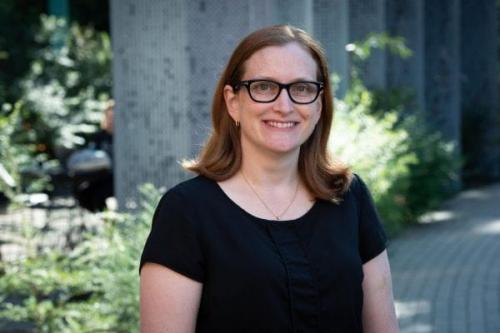
Prof Jennifer Flegg is an outstanding applied mathematician. Her work brings expertise in applied mathematics and advanced computational statistics to critical areas of the biological and medical sciences. Prof Flegg currently holds an Australian Research Council (ARC) Future Fellowship, has previously held a Discovery Early Career Researcher Award (DECRA) and has received multiple other major competitive grants from both the ARC and National Health and Medical Research Council (NHMRC). She is the University of Melbourne Node Leader for the ARC Centre of Excellence for the Mathematical Analysis of Cellular Systems (2023—2029).
As of late 2024, Jennifer has published 77 journal papers which together have attracted more than 6,000 citations. A 2014 paper on the Spread of Artemisinin Resistance in Plasmodium Falciparum Malaria, published in the New England Journal of Medicine, on its own, has been cited more than 2500 times. She has a Google Scholar h-index of 30. The strength of her research has been recognised through awards of several prestigious medals including the ANZIAM JH Michell Medal (2020) for outstanding new researchers, the Australian Academy of Science Christopher Heyde Medal (2020) to recognise distinguished research in the applied mathematical sciences by researchers up to 10 years post PhD and the Society for Mathematical Biology Leah Edelstein-Keshet Prize (2020) for exceptional contributions to mathematical biology and exhibiting a continuously high level of scientific endeavour and leadership.
Jennifer’s work has had important global impact. She developed the first predictive spa- tiotemporal mathematical models of the spread of resistance to the drugs used to treat malaria. Using Bayesian model-based geostatistics, her models have predicted drug resis- tance in space and time over Africa and the Mekong region using data that is sparsely available in these regions. This approach overcomes the barrier of gaps in information regarding antimalarial drug resistance by taking a set of discrete observations of resis- tance in space-time and generating continuous predictive maps, where each location in space-time has an associated predicted resistance level, with quantifiable uncertainty. The World Health Organization (WHO) has used these models to update its policies on where and when certain drugs should be used. Her work in this field has been published in high quality, interdisciplinary journals including PNAS, Lancet Infectious Diseases, PLOS Computational Biology and the New England Journal of Medicine. She is involved in leading change in drug policy for malaria as a core part of the Mitigating Antimalarial Resistance Consortium in South-East Africa.
Jennifer has also made significant advances in developing mathematical models which pro- vide biological insight into tissue dynamics that allow assessment of treatment therapies. Working closely with clinicians (at the Wesley Hospital, Brisbane and the Alfred Hospital, Melbourne), she has used coupled partial differential equation models (typically mixed parabolic-hyperbolic systems) of complex cellular interactions to gain biological insight into the treatment of chronic wounds including oxygen therapy for diabetic wounds and compression therapy for venous leg ulcers. This insight is achieved with numerical ap- proximations to the model (typically with finite volume methods) and analytic methods (typically asymptotic analysis). Using her models, Jennifer has derived conditions which allow the stimulation of healing in chronic wounds that would otherwise remain unhealed. She has published this work in top mathematical biology journals including PLOS Computational Biology, Proceedings of the Royal Society B and Bulletin Mathematical Biology.
Prof Flegg has been invited as a plenary speaker at major Australian and International conferences, including ANZIAM 2020, AustMS 2021. Computational Techniques and Ap- plications Conference (CTAC) 2022, Society for Mathematical Biology (SMB) 2018, 2021, and the Society for Industrial and Applied Mathematics (SIAM) 2022. She has held edito- rial positions with top journals in applied mathematics and mathematical biology includ- ing SIAM Journal on Applied Mathematics, PLOS Computational Biology and Bulletin of Mathematical Biology. She was Editor-in-Chief of the quarterly SMB Newsletter from 2017-2019 and was elected to the Board of Directors for the SMB (2024—2028).
Jennifer has been heavily involved in the Women in Mathematics Special Interest Group (WIMSIG) and has contributed to numerous mentoring programs in mathematics includ- ing the WIMSIG mentoring program, STEM Professionals in Schools , ChooseMaths and Sisters in Science.
With these accomplishments as a researcher, leader and mentor, Jennifer Flegg is a worthy recipient of the EO Tuck Medal for 2025.
-
2026 Professor Ngamta (Natalie) Thamwattana
Citation for Professor Ngamta (Natalie) Thamwattana
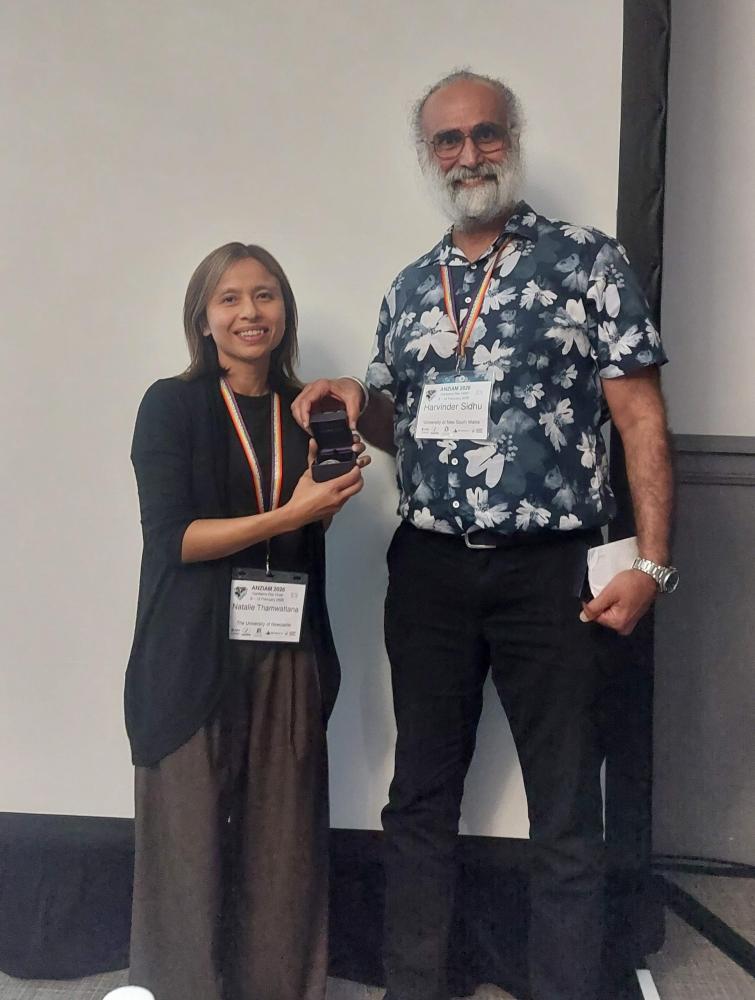
Professor Ngamta (Natalie) Thamwattana is an exceptionally gifted applied mathematician who, for the past 25 years, has made outstanding contributions to Applied and Industrial Mathematics through her research, teaching, PhD supervision, mentorship, and service to the mathematics community. Her influence is felt nationally and internationally, and she is widely recognised as a leader in her field.
Natalie’s research employs advanced mathematical modelling and mechanics to address a wide range of problems in engineering and science, from the behaviour of highly frictional granular materials to complex nanoscale phenomena. Early in her career, she derived exact analytical solutions for granular‑flow problems that had previously only been treated numerically, marking a major advancement in the field. Her work in nanoscience has been similarly pioneering: by modelling the mechanics of interacting atomic and molecular structures, she has produced powerful analytical results with international impact. Her modelling expertise spans engineering, chemistry, biology, and medicine, and has led directly to industrial innovations—including improved design and longevity of permeable reactive barriers used in groundwater remediation.
Professor Thamwattana has an outstanding publication record, with over 100 refereed journal articles in leading international journals, as well as a comprehensive textbook, “Modelling and Mechanics of Carbon‑based Nanostructured Materials”. She has attracted more than $3.4 million in competitive research funding as lead or chief investigator on multiple Australian Research Council Discovery and Linkage Projects, reflecting the high esteem in which her research program is held. At the University of Newcastle, she has served as Director of the Priority Research Centre for Computer‑Assisted Research Mathematics and its Applications (CARMA) and currently leads the Applied and Industrial Mathematics (AIM) Research Group, fostering a vibrant research culture and supporting early‑career academics.
A dedicated supervisor and mentor, Professor Thamwattana has supervised 12 PhD students to successful completion, with several more currently under her guidance. Many of her former students now hold research or academic positions in Australia and overseas. She is also deeply committed to outreach, regularly organising programs that inspire high school students to pursue advanced mathematics and promoting diversity and participation in STEM.
Beyond her research and educational contributions, Professor Thamwattana has demonstrated exceptional leadership and service to the mathematical sciences. She served as Chair of ANZIAM in 2022–2023 and as Vice‑President of the Australian Mathematical Society during the same period. As ANZIAM Chair, she oversaw the establishment of the organisation’s Code of Conduct, the creation of the ANZIAM investment scheme and Outstanding Service Award, and initiated the modernisation of ANZIAM’s website and logo, among several other key milestones. She directed the 2025 ANZIAM Annual Conference and co‑directed the Mathematics in Industry Study Group (MISG) from 2020–2022, strengthening ties between academia and industry.
Her national service is extensive: she has been a member of the ARC College of Experts (2021–2026), served on governing and advisory boards for MATRIX and AMSI, and played key leadership roles within the Australian Mathematical Society’s Women in Mathematics Special Interest Group (WIMSIG). Through these roles, she has been a passionate and influential advocate for equity, diversity, and the advancement of early‑career researchers.
Professor Thamwattana’s excellence has been recognised with numerous honours. In 2014 she received the prestigious ANZIAM J.H. Michell Medal and, in the same year, the University of Wollongong Vice‑Chancellor’s Emerging Researcher Award. She has since been featured in the 2019 Australian Women of Mathematics Exhibition and received the 2020 Faculty Award for Excellence in Industry Engagement for her work with MISG. She has been invited to deliver plenary and keynote lectures at major national and international conferences, and has served on editorial boards and conference committees throughout her career, further cementing her standing in the applied mathematics community.
In summary, Professor Ngamta (Natalie) Thamwattana has an exemplary record as a researcher, leader, and mentor. Her innovative research has advanced multiple fields and delivered tangible industrial benefits; her leadership has strengthened the mathematical sciences community; and her mentorship has fostered the next generation of applied mathematicians. The selection committee is delighted to recognise Professor Thamwattana as a most worthy recipient of the EO Tuck Medal for 2026.
Call for nominations for the 2027 EO Tuck Medal
Nominations for the award can be made by any member of ANZIAM other than the nominee or members of the Selection committee. A nomination should consist of four parts in the following order:
(i) a statement detailing the impact that any career interruptions have had on the candidate’s opportunity to carry out research;
(ii) a brief C.V. of the nominee that includes the nominee’s list of publications;
(iii) a resumé of the significance of the nominee’s research; and
(iv) a resumé of the significance of the nominee’s service contribution.
Parts (i), (iii) and (iv) should be no more than one-page in length.
Nominations should be sent to the ANZIAM Secretary <anziam.secretary@gmail.com> by Friday 16 October.
Updated: