
EMAC 2017
The conference was held at the Science Centre on the University of Auckland’s city campus, from 29th November – 1st December, 2017.
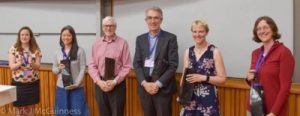
Dr Alys Clark (co-organiser) with plenary speakers: Caroline Yoon, Graham Weir, Michael Forbes, Philippa Martin, and Louise Olsen-Kettle (Photo credit: Mark McGuiness for all EMAC 2017 photos.)
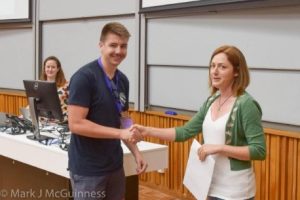
Top Student Talk Awarded to Michael Gravatt by EMAC Chair Bronwyn Hajek.
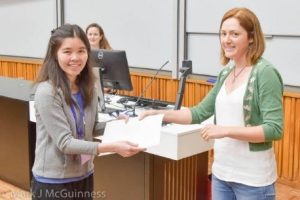
Highly Commended Student: Win Min Tun.
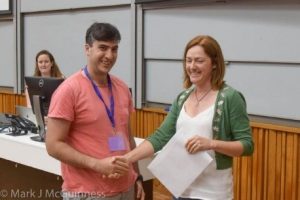 Highly Commended Student: James Cavallo.
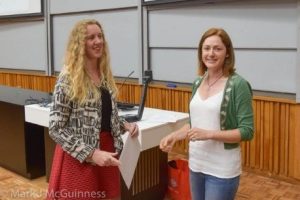
Highly Commended Student: Alison Schroeder.
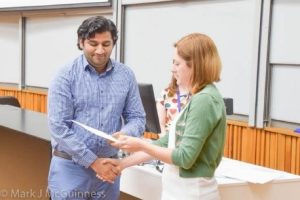 Highly Commended Student: Faheem Zaidi.
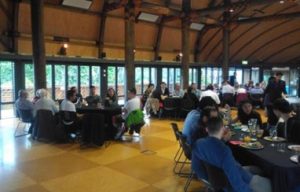
Conference dinner at the Fale Pasifika.
EMAC 2015
The conference was held at the City West Campus of UniSA in Adelaide, from 6th – 9th December, 2015.

Bill Blyth with the winner of the William Finlay Blyth Prize, Dilan Pathirana (Griffith University) and with David Harman (Griffith University) and Muhammad Ilyas (University of Newcastle) who both received honourable mentions.

A Very Short History of the Engineering Mathematics Group (EMG)
by Bill Blyth and Mark Nelson
-
- Part One: 1992 to 2001 by Mark Nelson
The following link to content within Part One.
- A history of the engineering
mathematics group - The Engineering Mathematics and Applications Conference (EMAC) Series:
conference reports.- Inaugural Engineering
Mathematics and Applications Symposium: Mathematics and
Engineering (1992) - Engineering Mathematics Group
Symposium (1993) - The 1st Australian Biennial
Engineering Mathematics and Applications Conference: The
Role of Mathematics in Modern Engineering
(AEMC 1994) - The 2nd Biennial Australian
Engineering Mathematics Conference.
Engineering Mathematics: Research, Education and
Industry Linkage. (AEMC 1996) - The 3rd Biennial Engineering
Mathematics and Applications Conference (EMAC 1998) - The 4th Biennial Engineering
Mathematics and Applications Conference (EMAC 2000)
- Inaugural Engineering
- The executive committee of the
EMG (1992-2001). - The Engineering Mathematics and Applications (EMAC) Conference Series
(1992-2001): conference tables. - Abbreviations.
- Acknowledgements.
- Footnotes.
- Missing Paper-Work.
- Bibliography.
Part Two: 2002 to 2019
The following currently links to content within the main
article.
- The 5th Engineering Mathematics and
Applications Conference (EMAC 2002) - The 6th Engineering Mathematics and
Applications Conference (EMAC 2003) - The 7th Engineering Mathematics and
Applications Conference (EMAC 2005) - The 8th Engineering Mathematics and
Applications Conference (EMAC 2007) - The 9th Engineering Mathematics and
Applications Conference (EMAC 2009) - The 10th Engineering Mathematics and Applications
Conference (EMAC 2011) - The 11th Engineering Mathematics and Applications
Conference (EMAC 2013) - The 12th Engineering Mathematics and Applications
Conference (EMAC 2015) - The 13th Engineering Mathematics and Applications
Conference (EMAC 2017) - The 14th Engineering Mathematics and Applications
Conference (EMAC 2019) - The executive committee of the EMG.
- The Engineering Mathematics and Applications (EMAC) Conference Series:
conference tables.- Conference details
- Conference Committee
- Biennial EMG awards
- William Finlay Blyth Prize for best student presentation .
- Best student presentation using Maple.
- Student Prize Committee
- Student Maple Prize Committee
- Editors of the EMAC proceedings
(and links to proceedings). - Invited Speakers Committee
- Invited speakers.
- Registration Fees
- Length of presentations
- Other Conference Committees
- Analysis of delegates.
- Obituary Notices
- Abbreviations.
- Acknowledgements.
- Footnotes.
- Missing Paper-Work.
- Bibliography.
The 5th Engineering Mathematics and Applications Conference
(2002)
The 5th Engineering and Mathematics Applications Conference
(EMAC2002, 29th September – 2nd October) was ran at
the Queensland University of Technology. Like its predecessors
it was organised under the auspices of the
EMG and IE Aust.
The conference was directed by
Dr Mike Pemberton (UQ). There were six plenary
presentations (all by men) and 38 non-plenary talks,
10 of which were given by students.
(Noel Barton became the second person to be an invited speaker at two
conferences: AEMC 1994
and EMAC 2002.)
There were twenty sessions across
the three days of the conference, including a CEANET seminar session
for the conference silver sponsor. Papers were thirty minutes in
length; twenty for the presentation, five for questions and five for
changeover.
There were 61 registered delegates (including invited speakers): 47 from
Australia, 12 international delegates and one delegate of unspecified origin.
The international delegates were from six countries: 5 Nigeria, 2 England,
2 Japan, 1 Iran, 1 Papua New Guinea and 1 Scotland.
The delegates came from 33 institutions (!). The institutions with the most
delegates were: QUT (8), UQ (6),
and the Cooperative Research Centre for Mining Technology & Equipment (CMTE)(5).
From the perspective of 2018 it is fascinating that the contact details
included the hotel at which delegates were staying at (where known)
but not an e-mail address.
(The main conference hotel was the Hotel George Williams, Brisbane,
with rooms available at a rate of $83 per night.)
The refereed proceedings of the conference were provided to delegates at the time of
registration. It was noted in the conference proceedings that
The full versions of all papers appearing in this volume have met the full
DETYA review process unless otherwise indicated
(Pemberton, 2002).
There was an evident page limit of six pages for contributed papers. The length of the
paper by the plenary speakers ranged from six to ten pages. The conference proceedings
contained 38 papers: 5 by the plenary speakers and 33 contributed papers.
The papers from the invited speakers preceded the contributed papers.
The latter were arranged in alphabetical order.
The welcome reception was one of the most fancy I (MIN)
can remember at any conference, though at this late date (January 2013)
I am not so sure what made it so fancy… though I have a vague impression
that the canapes were both rather splendid and in high supply due to the
low number of delegates (29th January 2019).
The conference had technical tours to both
QUT
(Aerospace Avionics, Infomechatronics Facilities,
Medical Engineering Biomechanics Robot Testing Equipment and
Visualisation Laboratory) and UQ
(Microgravity, Scramjet and UQ Racing).
An unusual feature of the conference was a dress code (`smart casual’) for
both the conference and the conference dinner. It is not clear who had the
task of enforcing this!
Biennial EMG Awards
were awarded at the first four EMACs
(1994-2000) and an IEAust Award
was presented at the third
and fourth EMACs (1998 & 2000). No awards were made
at EMAC 2002.
Bill Blyth (2019) wrote that
The awards seem not to have been considered by either the EMG
.
Executive Committee or by the chair of the conference organising
committee
Mark’s speculation on the matter is that
Dr J. Steiner had been on the organising committee for the first four
EMACs.
Furthermore, EMAC 2002 was the first EMAC that Dr Steiner did not attend
Perhaps his absence from both the organising committee and the conference
resulted in a hole in the collective memory?
Whatever the reason, the EMAC awards were quickly forgotten…
This was the first EMAC to be run by professional conference organisers, namely
ICMS Pty Ltd. Due to unusually low attendance (only 61 registered delegates)
and contracts based on higher numbers of attendees, the conference suffered
a large loss. (This was noted at the EMG 2005 AGM).
Since IE Aust had financially underwritten the EMAC series,
they were called upon by ANZIAM to cover the losses.
This resulted in IE Aust ceasing its support for future
EMAC conferences: EMAC 2002 was the last to be
organised under the auspices of the EMG and
(to a use a well-worn phrase).
IE Aust
The precise details are unknown since the new Chair of the EMG
Executive Committee, elected at the AGM at EMAC 2002, was neither involved nor
informed of many of the details
(Byth, 2019).
This led to the strict advice for future EMAC directors
that they must not enter into contracts with costs (such as conference
management costs, conference dinners etc) based on estimated numbers: costs
must be based on actual numbers of participants.
(This instruction was very carefully followed by the organisers of
EMAC 2011).
Personal reminisces
This was the first EMAC that MIN attended!
The 6th Engineering Mathematics and Applications
Conference (2003)
The 6th Engineering Mathematics and Applications Conference
(EMAC2003, 9–11 July 2003)
was ran as an embedded meeting of the 5th International
Congress on Industrial and Applied Mathematics (7–11 July 2003, Sydney).
The embedded meeting ran for two hours on the Wednesday and
then two full days (Thursday and Friday).
The EMAC director had no influence over the ICIAM registration fees nor any
direct access to ICIAM funds. However, the ICIAM conference funded
an EMAC welcome function. (I assume that this was the cocktail party
organised by Deane Eveson
(Department of Mathematics, UTS) held on 10th July
featuring
two lovely jazz musicians, a wonderful singer and a keyboard
(Wood, 2003b)).
player
The ICIAM conference sessions were split between the Sydney Convention
and Exhibition Centre and the nearby Haymarket Campus of
UTS.
The EMAC (and CTAC) sessions were held at UTS.
EMAC 2003 had no invited speakers.
It attracted 100 registered delegates with 63 presentations, from 60 speakers,
spread over
15 sessions in three parallel streams (Wood, 2003b).
(MIN.
According to the program there were 54 speakers, with nine individuals
giving two talks. 18.06.19).
There were 54 speakers (there were no invited speakers): 47 from Australia,
and 7 international delegates. The international delegates were from seven
countries:
China, Denmark, England, Papua New Guinea, Russia, South Africa, and Sweden.
The delegates came from 29 institutions. The institutions with the most
delegates were: UOW (8), UTS & UNSW (5), and QUT (4).
However, the UNSW figure does not distinguish between
UNSW (Sydney) and UNSW (Canberra).
The diverse program reflects the interests and applications of engineering.
We start with the nano scale and expand to telecommunications at the
astro scale. There is a strong modelling component and many
applications in manufacturing, fluids and finite elements are represented.
Engineering applications include solar cells, construction and bioreactors.
On Friday there is an engineering education stream.
(Wood, 2003b).
Short reports on nine of the sessions
(`CFD’, `Data Mining’, `Engineering applications – Fluids’,
`Engineering applications – Machines’,
`Engineering applications – Steel’, `Engineering education’,
`FEM and Thin Flow’, `From nano to macro’, `Stability of fluids’)
appear in (Wood, 2003).
The sessions `From nano to macro’ covered an amazing range of length scales
from nanotechnology through to wavelet analysis of galaxies!
The two engineering education sessions (`curriculum’ and
`technology’) contained ten talks and featured a
lively debate
(Wood, 2003).
Several presentations were given by people working
on engineering mathematics curriculum and investigating
the state of engineering mathematics at their universities
(Wood, 2003). As a result of these presentations
It was proposed that Australian mathematicians and
engineers form a working group to develop a core curriculum in mathematics
for engineering, in consultation with Engineers Australia
(Wood, 2003). It was also noted that
There was also lively debate about the use of technology in
engineering mathematics
(Wood, 2003)).
Finally, it was noted
that
“The standard of the presentations and papers was high – several of
the `old hands’ could do well to emulate the new researchers.”
(Wood, 2003)
A comment that is as true today (2011) as it was then!
This was the final EMAC where the (refereed) conference proceedings were
published in a book with distribution at the conference. As the editors
had pdf files of all the papers for the print version
they also produced a CD version of the proceedings
(Bill Blyth, email 3rd April 2012). As there were no invited speakers,
the papers were arranged in alphabetical order of first author. It was
noted in the preface of the proceedings that
“the full version of all papers appearing in this volume have been
peer reviewed by two referees“. The papers were limited to
six sides in length.
Copies of the proceedings could be ordered from the
UTS coop booking shop
(Wood, 2003b).
Gary FitzGerald produced a website advertising EMAC 2003.
At the AGM
The EMG business meeting was held on Friday 11th July.
The decision on the location of the next conference was
(Wood, 2003b).
deferred pending negotiations with AAEE. There was interest from the
Engineering Department at the University of Tasmania to host the 2005
conference
EMAC 2005
would eventually be held at RMIT. The University of Tasmania
hosted EMAC 2007.
Personal reminisces
This was the second EMAC that MIN attended! It has been my practice to
write notes on conference presentations that I attend. I’ve lost my notes
for EMAC 2003 (assuming that I made them), so no personal reminisces
as nothing springs to mind (26.06.2019).
The 7th Engineering Mathematics and Applications Conference (2005)
Prior to the conference
EMAC 2005 followed the successful practice of EMAC 2000 by inviting an
engineer, Associate Professor Liuping Wang from the
School of Electrical & Computer Engineering at RMIT, to be co-chair of the
EMAC committee
Associate Professor Wang’s presence on the
committee assisted it to engage with the engineering community.
The EMAC 2005 committee requested that ANZIAM sponsor EMAC with a
grant of $2000
(Blyth 2005, January).
I believe that special interest groups of ANZIAM receive
non-refundable funding when they are set up. It is therefore
unusual for ANZIAM to provide subsequent funding to a special interest group.
It will be interesting to find out if ANZIAM provided the requested
funding!
The conference committee decided that a book of abstracts would be
distributed to conference delegates. The conference proceedings would
be published in a special issue of a refereed journal after
the conference. This two-tiered arrangement followed the lead of CTAC 2005
(Blyth 2005, January). Following discussion
with Professor Tony Roberts (editor of the ANZIAM J (E)) it
was decided to publish the conference proceedings in that journal.
The Conference
The 7th Engineering Mathematics and Applications Conference,
(EMAC 2005) was held at RMIT University
from 25th to 28th September 2005. (This was the third time that the
conference was held at RMIT – a record that stands as of 2019!).
It was organised under the auspices of the
EMG — no longer the IE Aust.
It was the first EMAC to be organised in an odd year (discounting EMAC 2003
which was part of ICIAM 2003).
The conference was opened by Professor Dennis Gibson AO
(Chancellor, RMIT University). Professor Gibson’s PhD was in
magnetohydrodynamics and earlier in his career he had served as a
Head of the Department of Mathematics, Science and Computing
at Northumbria University from 1977 to 1981. (In his opening address
he noted that he had taught mathematics
for twenty years prior to entering university administration).
The conference was directed by
Associate Professor Bill Blyth.
(Bill became the second person to direct two EMACs
(EMAC 2000 & 2005). Or the
first if we decide to discount Joseph Steiner on the grounds that the
Inaugural Engineering Mathematics and Applications Symposium
(1992) is not
part of the EMAC series. As of today (19th June 2019) no-one else has
chaired EMAC twice!).
There were four plenary speakers (all by men):
one from Australia,
one from England
one from New Zealand
and one from the USA. There was one plenary presentation on Monday morning.
two on Tuesday morning, and one on Wednesday morning.
(The plenary speakers were identified as keynote presentations in the
program book).
There were twenty-nine sessions of contributed talks. These
were predominantly organised into three parallel
sessions, with a smaller use of four parallel sessions.
The conference contained 96 non-plenary presentations, 32 by students.
Neither the program nor the list of abstracts distinguished between
student and non-student presentations.
The plenary presentations were forty-five minutes long
whilst the contributed talks were twenty minutes in length. These
lengths included time for questions.
There were 96 registered delegates (including invited speakers): 74 from
Australia, 20 international delegates and two delegates of unspecified origin.
The international delegates were from twelve countries: 3 Fiji, 3 Thailand,
3 USA, 2 China, 2 Japan, 1 England, 1 Germany, 1 Korea, 1 New Zealand,
1 Oman, 1 Russia, and 1 Sweden.
institutional details! The conference book does not list any sponsors.
The delegates came from 40 institutions, including four from unknown
institutions. The institutions with the most delegates were:
RMIT (35),
UNSW at ADFA (5), and
UOW (4). An honourable mention is
given to the University of the South Pacific which sent three delegates.
According to my calculations 88 of the 95 delegates
(92.6%) gave a presentation. Is that an EMAC record?
In addition to the technical program the conference organised:
a welcome reception on Sunday 25th September at the Oxford Scholar Hotel;
the conference dinner on Tuesday 27th September at the
Observatory Cafe in the Royal Botanic Gardens (South Yarra).
Internet access was provided to all conference delegates in a specified
computer lab.
John Shepherd was chair of the student prize committee
(see latter for how this was run).
The best student talk was awarded jointly to
James Caunce (UNSW at ADFA),
Frederic Cortat (Linkoping University, Sweden), and
Rosmiwati Mohd-Mokhtar (RMIT).
The presentations of three students were highly commended:
Ryan Adams (RMIT),
Maya Muthuswamy (UMB), and
Himanshu Verma (TU Darmstadt, Germany).
The winners of the `best paper’ were given $300 each and the
three highly commended students were given $100 each.
The (refereed) proceedings of the conference
were published as a
special issue of the electronic supplement of
the ANZIAM Journal – ANZIAM(E). This was the first time that an
electronic proceedings was published. The papers in the special issue were
published in the order in which they were accepted.
In the conference proceedings it is noted that the deadline for submitted
papers was October 28th 2005.
The conference accommodation was at Janet Clarke Hall, The University of
Melbourne, at $74 per single room per night and at the Ibis Hotel,
Melbourne, at $104 per single room per night.
At the AGM
The EMG held its general meeting
following the end of the program on Monday 26th September.
My notes from the EMG AGM indicate that the conference director
stated that there 107 presentations by 103 delegates.
From the conference book I have been able to identify a total of
106 presentations by 96 delegates. Furthermore, the conference
director thought that the profit from EMAC 2005 would be
approximately $14,000.
Finally, it was stated that EMAC 2007 would be held in
Hobart and would be directed by Damian Holloway.
After the conference
The 2005 conference made a substantial profit, returning the EMG
to a healthy financial position.
The operating surplus for the conference
was in the region of $15,000, reduced by the costs
of converting papers in Word to LaTeX.
This is necessary since Word is
“.
the standard format for most engineers and yet we need the final
form of papers to be in LaTeX for publishing in the ANZIAM J (E)
Delegates were charged $20 per paper for Word to LaTeX conversion.
The finances were handled via RMIT accounts. This had some advantages –
for example: the payment of registration fees was strongly
pursued! There were also some difficulties in getting the surplus released
from RMIT: after urgent requests for help, an ABN and appropriate invoice
from the Aust Math Soc, we were able to get approval for the transfer
of the money to the Aust Math Soc. It would seem to be better for the
EMAC comm. to run their own conference accounts.
Also we recommend that the EMG have a separate a/c (and ABN) into which
the EMAC 2005 monies can be transferred from the Aust Math Soc.
The 8th Engineering Mathematics and Applications Conference (2007)
The data in 2007 was discussed. The difficulty with the September AVCC
“common week” is that it is not common and it’s expected that it will not
be observed by UTAS. If the university’ facilities are not available,
then organizational difficulties (associated with venue, rooms and computing)
increase as does the cost. However some of the EMG Exec had some
concerns that July in Hobart might deter some potential participants.
(Blyth, 2005)
At the AGM
There was considerable discussion over the best way to ensure that the
process of publishing the proceedings does not drag on too long. It was
decided that 1. Best to stay similar to CTAC for consistency, and 2. Make
the submission deadline (31 July) a firm deadline and advertise the fact.
The goal is to have the vast majority of the papers processed by the end
of 2007.
(Mercer, 2007)
EMG needs a permanent website with historical information (conferences etc),
links to related conferences, previous proceedings and a link to the
current conference. AustMS are in the process of totally revamping their
website and it should be easier in the future to have a dedicated
website.
(Mercer, 2007)
A checklist for future conference organisers should be developed.
The conference booklet should include: previous conferences and
locations, previous student prize winners etc.
(Mercer, 2007)
Look into feasibility of presenting the student prize at next ANZIAM
conference. part of the prize may be payment of (some of) ANZIAM costs
(eg registration). Cost could perhaps be shared with ANZIAM.
At the EMG AGM, it was decided to award the student prize winners at
ANZIAM 2008. This followed from a long discussion about the logistic
difficulties of determining the awardees (from about 30 student talks)
in time for presentation at the conference dinner, as well as the particular
difficulty of the conf dinner being a revolving restaurant.
It was resolved to fully fund (at economy rates) the awardees to attend
ANZIAM 08. The travel, meals and accommodation expenses are being funded
by the EMG.
FUNDING REQUEST. We ask that the registration fees for the awardees
be funded by ANZIAM. The costs would be two (or possible 3) student
registration fees (of $300 each).
(EMG 2007 report in Jan 2008 to ANZIAM).
Bill’s comment.
This was a good idea that didn’t really work very well in the event.
The ANZIAM Exec discussed the funding requested in detail. There was
support in principle. However since the ANZIAM student support
scheme for ANZIAM conf participation was not yet implemented and given that
EMG could afford to pay it’s prize winners, there was some concern
about this request. I therefore withdrew the motion asking for ANZIAM
support.
Another problem was finding a natural way to include the EMAC prize awarding.
The ANZIAM conf Director was very cooperative and we did find an
opportunity to award our winners before one of the keynotes.
Yet another problem was that only 2 of the 3 winners was able to attend
(and the 1 Highly Commended awardee could not attend).
So, I recommend that we focus on being able to present out Student Prizes
at the conference D.
Jan 2013. Bill. “We agreed to support students to attend the ANZIAM 2008
con to be presented there, but this did not work as well as we
had hoped. I suspect that one Highly Commended Student Prize of
$100 from EMAC 2007 remains un-presented”.
We traditionally pub a conf book, distributed at the cond. We changed,
from EMAC 2005, to be consistent with CTAC and pub proc post conf and in
a journal. CTAC traditionally required a draft paper, with copies provided
for the conf participants, although this has not been the case recently.
I strongly recommend that we enforce availability of a pre-conf abs or,
better, a dragy paper. As an editor of EMAC 2003 and EMAC 2005 proc,
I think this would help to ensure that most of the author’s work has been
done before the conf rather than after!
(Bill, email to EMG committee)
Should be noted that Geoff Mercer was the only editor of the
conference proceedings. Heroic!
The 9th Engineering Mathematics and Applications Conference (2009)
Before the conference
In 2007 Andrew Metcalfe agreed to look into the feasibility of
hosting EMAC 2009 in Adelaide. The initial suggestion was that the conference
would be run in July 2009 as the
“September `common week’ is less common than it should be and appears
not to be a good time”
(Mercer, 2007).
Following discussions between Bill Blyth (Chair of EMG)
and Roger Hadgraft (President of the Australian Association for
Engineering Education, A2E2) it was discovered
that there was
“renewed interest from [A2E2] to link the annual
A2E2 annual conference, held in December, with
EMAC (EMG 2007)”.
The A2E2 conference was scheduled for 2010. However
as Andrew Metcalfe
was “enthusiastic about linking the two conferences”
(EMG 2007)
A2E2 agreed to bring forward their conference
to December 2009 whilst EMG agreed to delay the EMAC
conference so that the two conferences could overlap
(Bill Blyth email). Consequently, EMAC 2009 was the first EMAC to be
run at the beginning of December.
Despite some good will on both sides, the experiment of running
the Australian Association
of Engineering Education Conference alongside EMAC was unsuccessful
and the idea of repeating it was not suggested for the 2011 conference.
(Blyth 2011).
Following agreeing to look into the feasibility of running EMAC
in Adelaide Andrew asked both Charles Pierce and Phil Howlett to act as
joint conference chairs. This was agreed upon, and then forgotten
as when this was announced at the ANZIAM 2008 executive meeting they
both “expressed some surprised to be announced EMAC conf chairs”
(Geoff Mercer). In the event, Charles was the conference chair whilst
Andrew Metcalfe was the conference convenor. The job of the latter was
to organise the conference, the former was a well known and respected
professor whose main job was to increase the conference’s academic
credibility. (Charles was editor of the ANZIAM Journal and
didn’t have the time to deal with the day-to-day issues of organising
and running a conference).
Registrations for EMAC 2007 were “alarmingly slow”
(Andrew Metcalfe, 16.01.17) and at one stage there was concern about
attracting sufficient numbers. However, it worked out OK in the end;
with a considerable international delegation helping to boost the numbers.
During the conference
The 9th Engineering Mathematics and Applications Conference
(EMAC2009, 6th-9th December), directed by Professor Charles Pearce, was
held at the University of Adelaide. The conference opened on Sunday 6th
December with a joint welcome reception on campus for delegates attending
either EMAC or the Australian Association of Engineering Education
Conference. The formal conference program began on
Monday morning. This was the second time that EMAC had been held
at the University of Adelaide,
the first being
EMAC 1998.
There were 86 registered delegates (21 students):
72 from Australia, 6 from
Indonesia, 2 each from New Zealand and South Africa,
1 each from Hungary, Malaysia, the UK and the USA. Of the 72 Australia
delegates, 14 were from the University of Adelaide, 12 from the University
of South Australia, 11 from RMIT and 10 from DSTO
(Defence Science and Technology Group).
There were seven plenary speakers. There were 96 contributed presentations
including an unknown number of student presents,
the conference book does not distinguish between student and
non-student talks. However, there were 21 registered students attending the
meting.
There were 30 sessions during the two and half days of the
conference. The topics with the most sessions were:
Environment (5), Biomedical (4.5),
Operations Research (4.0)
Theory (4), Education (3.5), Fluids (3.5). The next largest sessions was
Signals, perhaps indicating a local DSTO interest, with two sessions.
There probably was a student prize committee, since records indicate
that John Shepherd was the chair of such a committee; but no other names
are known. Thiansiri Luangwilai (ADFA) was the prize winner of the
best student talk, though it is unknown if he was the only winner or if
there were any honourable mentions.
In 2012 Thiansiri approached the EMG chair
(MIN) to report that “they had not been sent a prize certificate nor
had they been sent their prize”.
Trying to reconstruct matters at a latter date it seems that the
conference director (Andrew Metcalfe) wanted to award books provided by
Springer, a conference sponsor, to the student winners. Unfortunately the
books provided did not necessarily have any connection to the work presented
by the prize winners – a strange prize to win.
The chair of the student prize committee
(John Shepherd) was asked to carry the books back to RMIT and post them.
John (quite reasonably) pointed out that he
could not deal with the weight of the books in his airflight luggage and
that Andrew could equal well post them from Adelaide.
Evidently, in the event the prizes and certificates were not posted.
The conference dinner was held in one of Adelaide’s most iconic attractions:
the South Australia Museum and was organised by Balaena cafe.
| Avocado & Roma tomato salad w/- balsamic dressing | ||
| Atlantic salmon w/- leek & mushroom braise | or | Grilled sirloin w/- herb mash & shallot glaze |
| Sticky date pudding w/- butterscotch sauce | or | Crème brulee w/- orange compote & ice-cream |
At the AGM
The EMG AGM was scheduled late on the final day of EMAC 2009. Attendance
was very poor, with several apologies received. It was decided
that the AGM should return
to its traditional time slot at the conclusion of the technical program
on the first day.
After the conference
The conference proceedings were published as a
special issue (scroll down a little)
within the electronic supplement of the ANZIAM journal (ANZIAM-E).
Although the EMG offered to provide seed funding of $2k or $5k
(Bill Blyth. Report. Email) the
organisers of EMAC2009 were able to run the conference without financial
support. When the EMAC 2009 financial report was finalised,
early in January 2013, it transpired that the conference had been able
to make a small profit ($260.59) which was transferred to the EMG.
The 10th Engineering Mathematics and Applications
Conference (2011)
The 10th Engineering Mathematics and Applications Conference
(EMAC2011, 4–7 December) was ran at the University of Technology
Sydney. The conference was directed by Dr Mary Coupland.
There were six plenary talks and 83 non-plenary talks, 39 of which were
given by students. The prize for the best student talk was shared between
Darren Engwirda (USN) and
Matthew Adams (QUT) with a highly commended awarded to
Thiansiri Luangwilai (UNSW, Canberra). There
were 28 sessions across the two and half days of the conference, including
five on education.
An innovation was to have the program as a separate document to the
`abstracts book’. This allowed the published program to contain
`last-minute’ changes that occurred after the abstracts book had been
sent for printing.
There were 86 registered delegates (including invited speakers):
67 from Australia, 6 from Indonesia, 4 from Japan, 3 from
New Zealand and 1 each from France, Germany, Hungary, Kenya, South
Africa and the UK.
Through the ANZIAM/CSIRO Student Support Scheme the Commonwealth
Scientific and Industrial Research Organisation (CSIRO) contributed
to the conference costs for eleven students.
Over the years a number of methods have been used to determine the
best student prize.
At the 10th EMAC there was a dedicated committee
judging the best student presentation. At least two members of the
committee attended any given student presentation. This made it easier
when discussing the relative merits of excellent presentations since
oftentimes several committee members were able to comment on the relative
merits. Another feature of interest is that the committee met at the end
of the first day to establish `front-runners’ for the prize. By clarifying
what made these presentations `outstanding’ the committee knew what
they were looking for in the presentations on the second day.
The conference dinner was a harbour cruise aboard
the Captain Cook III. This will be a very difficult conference
dinner experience for future conferences to top!
Although delegates were arrived to arrive at King Street Wharf (Wharf Number
nine) at 18:15 sharp for a 18:30 departure the last set of delegates
only arrived just in time. Had they been one minute later they would have
had to make a swim for it!
| Entree |
| Crystal prawn, papaya mango salsa, petite salad, Aruga caviar, seaweed & preserved lemon |
| or |
| Fresh fig, Serrano ham, heirloom tomatoes, roast capsicum, black olive salsa, seasoned garlic sourdough. |
| Main Course |
| Grilled Atlantic salmon, lemon pepper crust, smash pea potatoes, wasabi hollandaise |
| or |
| Beef tenderloin fillet, Paris mash, caramelized red onion, bay seasonal greens, oxtail ragout sauce. |
| Desserts |
| Triple chocolate |
| or |
| Summer berry Pavlova, meringue, vanilla cream, pistachio dust, toffee |
An innovation to the social program was to have an optional
“restaurant evening” on the Monday. This provided an opportunity for
delegates to sign-up to a `EMAC’ group going to a local restaurant.
At the time that EMAC was organised UTS had a policy that conferences
should be run through professional conference organisers and that room
hire charges apply
(Blyth 2011). Conference Online was used as
the professional conference organisers. In view of his strong
support for the EMG it was decided that the EMG would provide
funds to enable A/P Bill Blyth to attend the conference.
The conference was available to
return the seeding money of $5980 and a surplus of $1680.21 – an
excellent result!
The conference proceedings were published as a
special issue (scroll down a little)
within the electronic supplement of the ANZIAM journal (ANZIAM-E).
At the AGM
The main outcome of the EMG AGM was a decision to rename the
prize for the `Best Student Talk’ to the
`William Finlay Blyth Prize for best student presentation’. This was
a highly appropriate way in which to recognise Bill’s many contributions
to the EMG over many years. There was also some discussion as to
whether the EMG should setup a prize to recognise
“contributions to engineering mathematics”.
After some discussion it was decided that there was no enthusiasm to
setup a formal nomination process.
The 11th Engineering Mathematics and Applications
Conference (2013)
The 11th Engineering Mathematics and Applications Conference
(EMAC2013, 1st–4th December), directed by A/P Dann Mallet,
was ran in the Science and Engineering
Centre at the Queensland University of Technology,
Brisbane. Located next to the Brisbane River and the
Botanic Gardens, the QUT Gardens Point proved a relaxing
conference environment.
Both the welcome reception and the conference dinner were held at
Room360 on the QUT campus. The floor to ceiling glass in Room360
provided stunning views of the city skyline, the Brisbane River,
Kangaroo Point Cliffs and the City Botantical Gardens.
Both the program and the book of abstracts was made available on
the web page prior to the start of the conference.
There were 113 registered delegates (including invited speakers):
78 from Australia, 8 from India,
6 from China, 5 from the United States, 3 each from Malaysia and New Zealand,
2 each from Indonesia and Taiwan, and 1 each from Germany, Ghana, Hungary,
Kuwait, Saudi Arabia and South Africa.
There were four
plenary talks and two shorter, thirty minutes each, presentations
sponsored by Australian Scientific & Engineering Solutions.
There were an additional 81 presentations, 37 of which were given by students.
There were 27 sessions across the two and half
days of the conference. The more popular session themes were:
Engineering Mathematics (9); Stochastic/Statistical Modelling (4.5);
Computational Fluid Dynamics (4.5) and Biomedical/Mathematical
Biology (3).
Through the ANZIAM/CSIRO Student Support Scheme the Commonwealth Scientific
and Industrial Research Organisation (CSIRO) contributed to the conference
costs for two students (?) to attend the conference.
As at EMAC 2011,
the best student prize was determined by a dedicated committee.
(See here for details on how the
committee works).
The William Finlay Blyth Prize
for the best student talk was awarded to Josef Barnes
(GFU) with highly commended being awarded to Kristen Harley
(QUT), Laith Hermez (UAL)),
and Lisa Mayo (QUT).
As EMAC runs every other year, rather than being annually such as ANZIAM,
there is a greatly reduced `carry-over’ in student speakers from
conference-to-conference. (Only one student gave a talk at EMAC2013
who had given a talk at EMAC2011). A recommendation from the student prize
committee for future EMACs was
that members of the committee should identify in advance
potential `front-runners’. This would allow more committee members
to attend these talks, leading to a better discussion of their
comparative strengths.
EMAC 11 followed EMAC 10 by offering an optional
`restaurant evening’ on the Monday. This provided an opportunity for delegates
to sign-up to a `EMAC’ group going to a local restaurant. However, there
was little take up for this from the delegates.
Goodies in the conference bag included an EMAC 2013 fridge magnet,
a RFID protector sleeve to prevent unauthorised scanning of your
credit card and a key ring that doubled as a 1m tape measure.
The conference bag itself was novel, being an envirosax.
At the time that EMAC was organised QUT had a policy that conferences should
be run through their own conference organisers. After some early problems,
the EMAC organisers were able to circumvent this requirement.
The conference proceedings were published as a
special issue (scroll down a little)
within the electronic supplement of the ANZIAM journal (ANZIAM-E).
At the AGM
The only outcome of the EMG AGM was the election of the new committee.
The 12th Engineering Mathematics and Applications
Conference (2015)
The 12th Engineering Mathematics and Applications Conference
(EMAC2015, 6th – 9th December), directed by Dr Bronwyn Hajek, was held
at the City West Campus of the University of South Australia, in Adelaide. The
conference location was in the centre of Adelaide’s major arts, culture and
entertainment precinct. The conference opened on Sunday 6th December with a
welcome reception on campus. The formal conference program began on Monday
morning, with a Welcome to Country and a welcome from UniSA’s
DVC: Research and Innovation, Professor Tanya Monro.
There were 77 registered delegates (including invited speakers): 70 from
Australia (including eight from Defence Science and Technology Group), two
each from New Zealand, Japan, and Taiwan, one each from the Oman and Saudi
Arabia. A presentation by Dr Andrew Metcalfe (Adelaide University) caught the
attention of Adelaide’s Advertiser and was mentioned in Scott Walsh’s column
on Saturday 12th December. The subject of the talk? A replacement for the
Duckworth-Lewis method (used in rain interrupted one-day cricket games).
There were five plenary speakers, and an additional one-hour presentation
sponsored by Australian Scientific and Engineering Solutions.
Martyn Nash became the third person (after Leslie
Mustoe and Noel Barton) to be an invited speaker at two
conferences: EMAC 2007 and EMAC 2015.
There were 65
contributed presentations, 29 of which were student talks. There were 22
sessions during the two and half days of the conference.
Through the ANZIAM/CSIRO Student Support Scheme, the Commonwealth Scientific
and Industrial Research Organisation (CSIRO) contributed to the conference
costs for 13 students to attend the conference. As at EMAC 2011 and EMAC 2013,
the best student prize was determined by a dedicated committee. The committee
was chaired by Dr Yvonne Stokes. The William Finlay Blyth Prize for the best
student talk was awarded to Dilan Pathirana (GFU) with
David Harman (GFU) and Muhammad Ilyas (University of Newcastle)
being highly commended. The winner received $500 whilst the highly commended
students received $100. All three students received a certificate.
For the first time, Australian Scientific and Engineering Solutions offered a
prize for the best use of maple by a student.
This prize was for the use of maple in the student’s research which had
to be clearly indicated in the presentation. This
prize was judged by Professor Bill Blyth (RMIT and ASES) and awarded to
Bushra Hasan (Swinburne University). The Maple winner received
the Maple Advanced Engineering Bundle – 2015, consisting of the Maple
Student Edition and the Advanced Engineering Mathematics with Maple e-book
with solutions, and a certificate.
As is with the case for the student prize at ANZIAM, there is no requirement
for the winning students to be a member of ANZIAM.
Figure.
Bill Blyth with the winner of the William Finlay Blyth Prize, Dilan
Pathirana
(GFU) and with David Harman (GFU) and
Muhammad Ilyas (University of Newcastle) who both received honourable
mentions.
 |
The conference program was made available on the web page prior to the start
of the conference.
EMAC’s 10 & 11 offered an optional `restaurant evening’ on the Monday. Due
to low take-up of this event at EMAC 11, a similar evening was not organised
at EMAC 12. However, a student pizza night was held on the Monday evening.
The conference dinner was held in one of Adelaide’s most iconic attractions:
the Adelaide zoo. No zoo animals were harmed during the preparation or
consumption of the conference dinner, however three animals did attend during
the pre-dinner drinks — a corn snake, a barn owl and a quakka. This
provided some great entertainment, especially for the international attendees.
Figure.
EMG Director Mark Nelson (University of Wollongong) with one of the dinner
guests – a barn owl.
 |
Following the formal end to the conference Australian Scientific and
Engineering Solutions sponsored a two-hour maple workshop.
Finally, EMAC2015 was the first EMAC conference to have a twitter tag
#emac2015 — though this tag has been shared with other conferences so
named. The small letters are important #EMAC2015 is the
European Meeting on Ancient Ceramics! The first person to
use the #emac2015 tag was Amie Albrecht.
The conference proceedings were published as a
special issue (scroll down a little)
within the electronic supplement of the ANZIAM journal (ANZIAM-E).
An article about EMAC2015 was published in the
Gazette of the Australian Mathematical Society
(Hajek et al 2016), the first
such report to appear since EMAC2003
(Wood 2003)!
When the dust had settled the organisers of EMAC 2015 were able to
return the seeding money, including the student prize money,
and a surplus of approximately $2,160.00 – an excellent result!
At the AGM
A variety of issues were discussed at the EMG AGM. The first item discussed
was the decreased attendance at EMAC 2015. The conference director noted that
abstracts had been received from a number of delegates who subsequently were
unable to receive travel approval from their institutions. In connection with
this it was noted that the separate abstract submission and registration dates
were a problem for planning — many abstracts were submitted and
accepted, but the corresponding registrations were not received. It was also
noted that the KOZWaves conference was being held at the University of
Adelaide over the same three days, possibly having a small effect on
attendence. Given the
problems with the withdrawal of delegates the final attendance, 78, compares
favourably with that of the last EMAC to be in Adelaide, 86 (EMAC 2009).
A key agenda item was the timing of future EMACs. It was noted that the
AustMS meeting will be held in early December from 2016. This makes early
December a busy time for conferences with MODSIM, EMAC (biennially) and AustMS
running in this time. It was pointed out that ASOR currently embed their
annual meeting into MODSIM every second year and there was some discussion
as to whether the EMG could follow their lead. Alternatives were also
suggested such as including an ASOR stream in EMAC and advertising EMAC
directly to ASOR members. However attendance at EMAC for ASOR members may not
be attractive if MODSIM and EMAC are timetabled in close proximity to
each other. Another possibility is for EMAC to return to its September slot.
It was noted that the close proximity of the AustMS annual meeting and EMAC
might allow the organisers of EMAC to `piggy-back’ an international speaker
from AustMS whilst only covering `local’ expenses. This could happen if
there was a suitable speaker in applied mathematics and/or mathematics
education at the AustMS meeting.
The Chair also suggested that in future the EMAC invited speakers committee
should include representative from the new AustMS Special Interest Group in
Mathematics Education and from the Women In Mathematics SIG. This issued was
discussed.
It was the sad duty of the AGM to record the death of
Professor Geoffrey Mercer on 12th April 2014, a long-standing supporter
of the EMG.
The 13th Engineering Mathematics and Applications
Conference (2017)
Before the conference
At the 2015 AGM, the EMG resolved to invite the Women in Mathematics SIG to
nominate a representative as a member of the invited speakers committee for
EMAC 2017.
Unfortunately, this resolution was not passed on to the Chair of the
2017 Invited Speakers Committee and the WIMSIG nominated person
(A/Prof Asha Rao, nominated in early 2016) was not invited to be on the invited
speakers committee (formed in late 2016). The conference organisation notes have now
been updated to suggest the inclusion of
a WIMSIG representative on the EMAC invited speakers committee.
The road to heaven is paved…
We resolve to do a better job for EMAC2019!
The special interest group in mathematics education were also contacted
(22nd January 2016) with a request to nominate a member for the
invited speakers committee. However, they showed no interest in being
represented on the committee.
As of December 2016 the dates of the Annual Meeting of the Australian
Mathematical Society moved from September to December
(the 60th meeting ran 5-8th December 2016).
In an email discussion Bill Blyth wrote (11th July 2016) that
I noticed previously that AustMS 2016 was proposed to be held in our usual
EMAC date (of first week of December). I see that it is being advertised […]
Perhaps this is to be the new timeslot for AustMS meetings? If so, I would
hope that some discussion (with a request for EMAC to shift to a new timeslot
so AustMS may use the traditional EMAC dates!!!) has been had.
The EMG is part of AustMS and we should be consulted if AustMS wish to use
our Dec spot in future (in odd years – which have recently been used for EMAC).
Indeed the EMG was consulted when the CMG wanted to swap CTAC conferences from
the odd years to our previous even years. This was done by contacting the EMG
and attending the AGM of the EMG at EMAC 2000 (with the swap to be in effect
after EMAC 2002). EMG agreed.
In fact, the EMG had not been consulted about this change. Furthermore,
as EMG is part of AustMS we are expected not to organise EMAC
to clash with the Australian Mathematical Society meeting. It was decided
that in future the EMG would select the dates for EMAC as early as possible.
The EMG was able to console itself with the fact that in the unfortunate
event when the dates of the conference overlapped there would be very
people faced with a choice of which conference to attend.
The conference
The 13th Engineering Mathematics and Applications Conference
(EMAC2017, 29th November to 1st December) was the first EMAC to be held
in New Zealand. The venue was the Science Centre on the University
of Auckland’s city campus. The conference opened on Tuesday 28th November
with a welcome reception on campus from conference co-chairs
Dr Alys Clark (Auckland Bioengineering Institute) and
and Dr Richard Clark (Department of Engineering Science).
There were 55 registered delegates (including invited speakers):
33 from New Zealand, 15 from Australia, two from Taiwan,
one each from Fiji, Indonesia, Japan, Korea, and Oman.
(This analysis is based on the list of registered attendees.
In their conference report
Clarke & Clark (2018) state that there
were 57 registered delegates: 36 from New Zealand, 14 from Australia,
seven international delegates with country as listed above.)
There were five plenary speakers. For the very first time,
there were more female plenary speakers (three) than male plenary
speakers.
There were 50 contributed presentations, 30 of
which were student talks.
(According to Clarke & Clark (2018)
there were 25 student talks, annoyingly I can’t find my EMAC book
to check this!).
There were 20 sessions during the two and half days
of the conference. Although there are several ways to skin a cat… by my
reckoning the most popular `areas’ were: bio-engineering (14 talks),
applied and engineering mathematics (13 talks), `numerical’ (11 talks),
mathematical biology (7 talks), and data analysis/statistics (4 talks).
The ANZIAM Student Support Scheme contributed to the conference costs for five
students (from Adelaide, Monash, Auckland, Griffith and Newcastle)
to attend the conference. (Total contribution
AUD $2275). As at EMAC 2011, EMAC2013 and EMAC 2015, the best
student prize was determined by a dedicated committee. The committee was
chaired by Dr Bronwyn Hajek. The William Finley Blyth Prize for
the best student talk was awarded to Michael Gravatt
(University of Auckland) with James Cavallo (Monash),
Alison Schroeder (University of Auckland), Win Min Tun (University of Auckland)
and Faheem Zaidi (Massey University) being highly commended.
The winner received $500 whilst the highly commended students received $100.
All students received a certificate. As is with the case for the student prize
at ANZIAM, there is no requirement for the winning students to be a member of
ANZIAM. (The conference organisers forgot to organise the student prize
committee prior to the start of the conference, so it was hastily
constructed prior to the start of preentations).
In a break with tradition the winners of the best student prize was
announced at the end of the conference rather than at the
conference dinner. It is highly recommended that future EMACs award
the student prize at the end of the conference. This allows the student
presentations to be more evenly spaced throughout the conference,
minimising the number of clashes and maximising the number of student
talks that the members of the panel can attend.
The conference program was made available on the web page prior to the start of the conference.
The conference dinner was held in the University of Auckland’s Fale Pasifika.
During his speach conference co-chair Dr Richard Clarke made the remark that
“I have enjoyed all the talks so far”, putting the fear of god onto those who
had to speak the following day. Indeed, shortly following this remark
one delegate was heard to forswear off the grog for the rest of the
evening!
Following the formal end to the conference there was a two-hour
workshop ran by Bradley Horton and Jonathan Koay from Mathworks
focusing on the new capabilities and resources of MATLAB and
how they can be used to support the teaching of mathematics for science
and engineering students.
A very welcome innovation at EMAC 2017 was the availability of coffee
prior to the first plenary presentation each morning!
At the AGM
After serving on the EMG executive for eight years (2009-2017)
Mark Nelson stepped down to be an ordinary member of the committee.
After serving on the EMG committee for
at least twelve years (2005-2017, records do not exist for earlier years)
John Shepherd stood down.
Having read the constitution, it was discovered that the EMG
committee had one too many members in the period 2015-2017. Other
committees with too many members were: 2000-2000 (three extra members);
2005-2007, 2007-2009 (one extra member) and 2013-2015.
Despite this being pointed out, the new committee has one too many members!
The 14th Engineering Mathematics and Applications
Conference (2019)
The 14th EMAC conference will be held at the
Australian Defence Force Academy. The provisional conference dates
are Tuesday 26th to Friday 29th November. These dates have been chosen
as MODSIM 2019 will be held at ADFA the following week.
An innovation was to email all delegates a PDF of the
EMAC 2019 conference book and to provide a (basic) conference book.
This meant that delegates were not provided with a hard copy of the
booklet.
The Executive Committee of the EMG
Officers of the EMG executive
I have also provided this information in
part I (1992-2001).
But I think it’s nice to see all the executive committees in one table.
| Year | Chair | Secretary | Treasurer |
|---|---|---|---|
| 1992–AEMC94 | Joseph Steiner (SUT) | Lindsay Evans (MNU) | Alan Easton (SUT) |
| AEMC1994–AEMC96 | Joseph Steiner (SUT) | Nian Li (SUT) | Gary Fitzgerald (RMIT) |
| AEMC1996–EMAC1998 | |||
| EMAC1998–EMAC2000 | |||
| EMAC 2000–EMAC 2002 | Alan Easton | Gary Fitz-Gerald | Ian Grundy |
| EMAC 2002–EMAC 2003 | |||
| EMAC 2003–EMAC 2005 | Bill Blyth (RMIT) | John Shepherd (RMIT) | Leigh Wood (UTS) |
| EMAC 2005–EMAC 2007 | Bill Blyth (RMIT) | Geoff Mercer | Ian Grundy |
| EMAC 2007–EMAC 2009 | Bill Blyth (RMIT) | Geoff Mercer | Michael Kirkpatrick |
| EMAC 2009–EMAC 2011 | Bill Blyth (RMIT) | Mark Nelson (UOW) | John Shepherd (RMIT) |
| EMAC 2011–EMAC 2013 | Mark Nelson (UOW) | Bronwyn Hajek (USA) | Danny Norrison |
| EMAC 2013–EMAC 2015 | Mark Nelson (UOW) | Bronwyn Hajek (USA) | Danny Norrison |
| EMAC 2015–EMAC 2017 | Bronwyn Hajek (USA) | Mark Nelson (UOW) | Danny Norrison |
| EMAC 2017–EMAC 2019 | Bronwyn Hajek (USA) | Tara Hamilton | Danny Norrison |
| EMAC 2019–EMAC 2021 | Tara Hamilton (MQU) | Bronwyn Hajek (USA) | Danny Norrison |
There are currently no details of the executive in the period
1996-2000 & 2002-2003.
Ordinary members of the EMG executive
I have also provided this information in
part I (1992-2001).
But I think it’s nice to see all the ordinary members of the
executive committee in one table.
| Year | Committee Members | ||||
|---|---|---|---|---|---|
| 1992–AEMC1994 | Gary Fitz-Gerald (RMIT) |
Peter Kennedy (Moldflow Pty Ltd) |
Michael Landman (BHP) |
H. Mackenzie (Richard Oliver International Pty Ltd) |
|
| A. Pettitt (QUT) |
|||||
| AEMC1994–AEMC1996 | Jagannath Mazumdar (UAD) |
Sean McElwain (QUT) |
Ken Stevenson (SIT) |
Daniel Yuen (BHP Steel, Port Kembla) |
|
| AEMC1996–EMAC1998 | |||||
| EMAC1998–EMAC2000 | |||||
| EMAC 2000–EMAC 2002 | Peter Austin | Bill Blyth (RMIT, -) | Jack Ding | Neville Fowkes | |
| Larry Forbes | Helen MacGillivray (QUT) | Mike Pemberton (UQ, +) | |||
| EMAC 2002–EMAC 2003 | |||||
| EMAC 2003–EMAC 2005 | N Fowkes (UWA) | Damien Holloway (UTAS, as engrg) | Helen MacGillivray (QUT) | Mike Pemberton (UQ) | Tony Roberts (QUT) |
| EMAC 2005–EMAC 2007 | Damien Holloway (+) | Andrew Metcalfe (UAD) | Mike Pemberton (UQ) | John Shepherd (RMIT) | |
| Leigh Wood (UTS) | |||||
| EMAC 2007–EMAC 2009 | Steve Barry | Damien Holloway (-) | Andrew Metcalfe (UAD, +) | Mark Nelson (UOW) | |
| John Shepherd (RMIT) | |||||
| EMAC 2009–EMAC 2011 | Mary Coupland (UTS, +) | Andrew Metcalfe (UAD, -) | |||
| EMAC 2011–EMAC 2013 | Bill Blyth (RMIT) | Mary Coupland (UTS, -) | John Shepherd (RMIT) | Stephen Woodcock (UTS) | |
| EMAC 2013–EMAC 2015 | Bill Blyth (RMIT) | Mary Coupland (UTS, -) | Tara Hamilton (UNSW) | Dann Mallet (QUT) | John Shepherd (RMIT) |
| EMAC 2015–EMAC 2017 | Bill Blyth (retired) | Tara Hamilton (UWS) | Dann Mallet (QUT) | John Shepherd (RMIT) | Andrew Stacey (RMIT) |
| EMAC 2017–EMAC 2019 | Bill Blyth (retired) | Alys Clark (UAL,-) | Mark Nelson (UOW) | Andrew Stacey (RMIT) | Stephen Woodcock (UTS) |
Mark and Bill intended to co-opt three further members onto the
2009–2011 executive including one from NZ with the intention of a NZ
EMAC. The road to heaven…
- It is sometimes the tradition of EMAC that in year “x”
the previous director of EMAC (that is the EMAC held in year “x”) and
the next director of EMAC (that is the EMAC held in year “x+2”) are
elected onto the committee. These are denoted `-‘ and `+’ in the table.
Ex-officio members of the EMG executive
The ex-officio members of the EMG executive
for the period 1992-2001 are listed in
part I.
| Year | ANZIAM | Engineers | CMG |
|---|---|---|---|
| 2000s | |||
| EMAC 2000–EMAC 2002 | Jim Hill | Peter May | Mike Osborne |
| EMAC 2005–EMAC 2007 | — | — | Ian Turner |
| EMAC 2007–EMAC 2009 | — | — | — |
| EMAC 2009–EMAC 2011 | — | — | Ian Turner |
| 2010s | |||
| EMAC 2011–EMAC 2013 | Tim Marchant/Phil Broadbridge | — | REMOVED |
| EMAC 2013–EMAC 2015 | Phil Broadbridge/Larry Forbes | — | |
| EMAC 2015–EMAC 2017 | Larry Forbes/Mary Myerscough | — | |
- According to the EMG constitution the Chair of the Division of
Applied Mathematics, or their nominated representative,
is an ex-officio member of the committee. This column is denoted
(ANZIAM). - According to the EMG constitution the Chair of the Institute of
Engineers (Australia), or their nominated representative, is an
ex-officio member of the committee. This column is denoted
(Engineers). - There was a long running belief that the chair of the CMG
(computational mathematics group)
was an ex-officio member of the executive. This was discovered
not to be the case in December 2013! - A — denotes that the appropriate person was not asked to be on the
committee! - Tim Marchant and Phil Broadbridge were the ANZIAM chairs for the periods
2011-2012 and 2012-2013 respectively.
Phil Broadbridge and Larry Forbes were the ANZIAM chairs for the periods
2013-2014 and 2014-2015 respectively.
The
Engineering Mathematics and Applications (EMAC) Conference Series
I have also provided this information in
part I (1992-2001).
But I think it’s nice to see all the conference series information in
one table.
According to the constitution the meeting should be held
mid-year
.
| Year | Location | Date | Delegates | Int | Inst | Plenaries | Presentations | Director | Web page |
|---|---|---|---|---|---|---|---|---|---|
| 1990s | |||||||||
| 1992 (Inaugural meeting) | SUT | 16 June 1992 | 160 | ??? | ??? | 7 (0) | 8 (?) | Joseph Steiner | |
| 1993 (EMG Symposium) | RMIT | 9 June 1993 | “nearly 100” | ??? | ??? | 9 (2) | 0 (0) | Gary Fitz-Gerald | |
| 1994 (1st AEMC) | Melbourne | 11-13 July 1994 | 134 | 25 (17) | 58 | 9 (1) | c. 80 (?) | Joseph Steiner | |
| 1996 (2nd AEMC) | USN | 15-17 July 1996 | 115 | 13 (10) | 51 | 8 (0) | 83 (?) | Philip Broadbridge | |
| 1998 (3rd EMAC) | UAD | 13-15 July 1998 | 144 | 23 (11) | 53 | 11 (2) | 111 (42) | Jagannath Mazumdar | |
| 2000s | |||||||||
| 2000 (4th EMAC) | RMIT | 10–13 September 2000 | ?? | ??? | ??? | 5 (1) | 712000 (?) | Bill Blyth | https://webarchive.nla.gov.au/awa/20001215025100/http://www.ma.rmit.edu.au/emac2000/emac2000.html |
| 2002 (5th EMAC) | UQ | 29th September–2nd October 2002 | 61 | 13 (6) | 33 | 6 (0) | 38 (10) | Mike Pemberton (UQ) | http://www.icms.com.au/emac02 |
| 2003 (6th EMAC) | ICIAM 2003 |
9–11 July 2003 | 100 | 7(7)2003 | 292003 | 0 | 63 | Leigh Wood | Website produced by Gary FitzGerald. |
| 2005 (7th EMAC) | RMIT | 25–28 September 2005 | 96 | 20(12) | 40 | 4 (0) | 102 (32)2005 |
Bill Blyth | http://www.ma.rmit.edu.au/emac2005 |
| 2007 (8th EMAC) | UTAS | 1st–4th July 2007 | 78 | ??? | ?? | 5 (2) | ?? (?) | Damien Holloway | |
| 2009 (9th EMAC) | UAD | 6th–9th December 2009 | 86 | ??? | ??? | 7 (0) | 96 (212009) | Andrew Metcalfe | |
| 2010s | |||||||||
| 2011 (10th EMAC) | UTS | 4–7 December 2011 | 85 | ??? | ??? | 6 (2) | 83 (34) | Mary Coupland | http://www.emac2011.com.au |
| 2013 (11th EMAC) | QUT | 1–4 December 2013 | 113 | ??? | ??? | 4 (0.5) | 81 (37) | Dann Mallet | http://www.emac2013.com.au |
| 2015 (12th EMAC) | USA | 6–9 December 2015 | 77 | ??? | ??? | 5 (2) | 65 (29) | Bronwyn Hajek | https://emac2015.unisa.edu.au/ |
| 2017 (13th EMAC) | UAL | 29 November–1st December 2017 | 55 | ??? | ??? | 5 (3) | 50 (30) | Alys Clark and Richard Clarke | http://emac2017.com/ |
| 2019 (14th EMAC) | UNSW, Canberra | 26 November–30 November 2019 | 49 | 5(4) | 21 | 4 (1) | 36 (12) | Zlatko Jovanoski | https://www.unsw.adfa.edu.au/conferences/EMAC-2019 |
Delegates include the invited speakers.
The web-pages may no longer be operational.
(However, they can be found with the wayback machine – thanks to
Bronwyn Hajek for pointing this out!)
- 1994.
If we count the
Inaugural Engineering Mathematics and
Applications Symposium (1992) as part of the EMAC series, then
Joseph Steiner became the first person to be the director of two
meetings. (There is a strong case that we should not count
the 1992 symposium as part of the EMAC series). - 2000. This was the second time that EMAC had
been held at RMIT. The first time that EMAC had returned to a
previous venue. - 2000.
Leslie Mustoe became the first person to be an invited speaker at two
biennial meetings (AEMC 1996,
EMAC 2000). - 2000. Presentations based on the
number of papers listed in the published proceedings
(May et al, 2000).
EMAC 2000 did not produce a delegates list
(Penesis, 2019). - 2002 (Noel Barton became the second person
(after Leslie Mustoe) to be an invited speaker at two
conferences: AEMC 1994
and EMAC 2002.) - 2003. The 2003
conference was embedded into the 5th International Congress on Industrial
and Applied Mathematics (7–11 July 2003, Sydney). - 2003. Although I know that there 100
delegates at ICIAM 2003 I only have a list of speakers. Thus these numbers
are lower bounds. - 2005. This was the third time that EMAC had been
held at RMIT – a record that still stands as of 01/07/2019. - 2005. Bill Blyth became the second person
to direct two EMACs (2000 & 2005). (Or the first if we
decide to discount Joseph Steiner on the grounds that the
Inaugural Engineering Mathematics and
Applications Symposium (1992) is not part of the EMAC series.)
As of today (19th June 2019) no-one else has the EMAC twice!. - 2005.
I am not sure where I extracted the data on the number of
presentations. According to the conference program there were
107 non-plenary presentations. - 2009. This was the second time that EMAC had been
held at the University of Adelaide, the first being
EMAC 1998. However, by 2009
EMAC had been at RMIT three times! - 2009. The conference book does not
distinguish between student and non-student presentations. However, I know
that there were 21 students registered. I also know their names.
In theory I could very carefully check the program… - 2017. This was the first EMAC to be held outside
of Australia.
Conference Committee
The conference committees for the period 1992-2001 are provided
in part I.
| Year | Chair | Co-chair | Secretary | Treasurer | Committee | |||
|---|---|---|---|---|---|---|---|---|
| 2002 | Mike Pemberton | — | — | — | Amanda Edwards (UQ) | Peter Jacobs (UQ) | Troy Farrell (QUT) | Anthony Maeder (QUT) |
| (UQ) | Ross McAree (UQ) | Adekunle Oloyede (QUT) | Sergey Suslov (USQ) | Ian Turner (QUT) | ||||
| 2003 | Leigh Wood | — | — | — | Bill Blyth (RMIT) | Lindsay Botten (UTS) | Gary Fitz-Gerald (RMIT) | Rob May (RMIT) |
| (UTS) | Geoff Smith (UTS) | |||||||
| 2005 | Bill Blyth | Liuping Wang | John Shepherd | Ian Grundy | Robin Hill (RMIT) | Andrew Stacey (RMIT) | Leigh Wood (UTS) | |
| (RMIT) | (RMIT) | (RMIT) | (RMIT) | |||||
| 2009 | Charles Pearce | Fred Bowden | — | — | Andrew Metcalfe (UAD) | R. Brian Webby (USA) | ?????? | ???. |
| (UAD) | (DSTO) | ???. | ||||||
| 2011 | Mary Coupland | Mark Nelson | — | — | Bill Blyth (AMSI) | Anne Gardner (UTS) | Tim Langtry (UTS) | Julia Memar (UTS). |
| (UTS) | (UOW) | Beverley Moore (UTS). | ||||||
| 2013 | Dann Mallet (QUT) |
— | — | — | Charisse Farr (QUT) | Kristen Harley (QUT) | Michael Jennings (UQ) | Scott McCue (QUT), |
| Tim Moroney (QUT). | ||||||||
| 2017 | — | Richard Clarke | — | — | Haribalan Kumar | |||
| — | (UAL) | — | — | (UAL) | ||||
| — | Alys Clark | — | — | |||||
| — | (UAL) | — | — | |||||
| 2019 | Zlatko Jovanoski (UNSW, Canberra) | Robert Niven (UNSW, Canberra) | — | — | Fiona Richmond (UNSW, Canberra) | Leesa Sidhu (UNSW, Canberra) | Duncan Sutherland (UNSW, Canberra) | Fangbao Tian (UNSW, Canberra) |
| Isaac Towers (UNSW, Canberra) | Timothy Trudgian (UNSW, Canberra) | Simon Watt (UNSW, Canberra) |
2009. Believed that conference chair was also treasurer.
2019. The positions of chair and co-chair were renamed
director and co-director.
Biennial EMG awards
The awards given out at AEMC94 & AEMC 1996 are listed in
part I.
William Finlay Blyth Prize
for best student presentation
At the EMAC 2011 AGM it was decided to rename the “Best Student talk at EMAC”
the William Finlay Blyth Prize.
The winners of the best student presentation
for the period 1992-2001 are listed in
part I.
(Most of the details are missing).
| Year | Winner(s) | Institution | Highly Commended | Institution |
|---|---|---|---|---|
| 2005 | James Caunce | ADFA | Ryan Adams | RMIT |
| Frederic Cortat | Linkoping University, Sweden | Maya Muthuswamy | UMB | |
| Rosmiwati Mohd-Mokhtar | RMIT | Himanshu Verma | TU Darmstadt, Germany | |
| 2009 | Thiansiri Luangwilai | UNSW, Canberra | ||
| 2011 | Darren Engwirda | USN | Thiansiri Luangwilai | UNSW, Canberra |
| Matthew Adams | QUT | |||
| 2013 | Josef Barnes | GFU | Kristen Harley | QUT |
| Laith Hermez | UAL | |||
| Lisa Mayo | QUT | |||
| 2015 | Dilan Pathirana | GFU | David Harman | GFU |
| Muhammad Ilyas | UNC | |||
| 2017 | Michael Gravatt | UAL | James Cavallo | MNU |
| Alison Schroeder | UAL | |||
| Win Min Tun | UAL | |||
| Faheem Zaidi | MSU | |||
| 2019 | Shivang Pathak | UNSW, Canberra | Jyothi Jose | Murdoch University |
We don’t have very good records of what
the Winner(s)/ Highly Commended(s) have received.
2002. The conference proceedings notes that
a prize will be awarded for the best student presentation
(Pemberton, 2002) but no details are
available of (if anyone) won.
2009. It’s believed that there were three winners
and three highly commendeds.
The following table indicates what the winner(s) and the highly commendeds
received for their excellent presentations.
| Year | Winner(s) | Highly Commended |
|---|---|---|
| 2010s | ||
| 2013 | Certificate and $500 | Certificate and $150 each |
| 2015 | Certificate and $500 | Certificate and $100 each |
| 2017 | Certificate and $500 | Certificate and $100 each |
| 2019 | Certificate and $100 (JB HiFi voucher) | Certificate |
In 2013 the certificates were signed by the chair of EMAC 2013,
the chair of EMG and Bill Blyth.
In 2015 the certificates were signed by the chair of EMAC 2015 and
the Chair of the Student Prize Committee.
In 2017 the certificates were signed by the two co-chairs of EMAC 2017 and
the Chair of the Student Prize Committee.
In 2019 the certificates were signed by the chair of EMAC 2019,
the chair of EMG, and the Chair of the Student Prize Committee.
Best student presentation using Maple
At EMAC 2015 an award was made for the best
student presentation using Maple.
In 2015 this prize was sponsored by Australian Scientific and
Engineering Solutions (ASES).
| Year | Winner(s) | Institution |
|---|---|---|
| 2015 | Bushra Hasan | SUT |
The following table indicates what the winner(s) and the highly commendeds
received for their excellent presentations.
| Year | Winner(s) |
|---|---|
| 2015 | Certificate and a copy of the Maple Advanced Engineering Bundle – 2015 |
In 2015 the the Maple Advanced Engineering Bundle – 2015,
consisted of the Maple Student Edition and the Advanced Engineering
Mathematics with Maple e-book with solutions. The certificate was signed by
Bill Blyth.
Student Prize Committee
The student prize committees
for the period 1992-2001 are listed in
part I.
(Or at least they would be if I had any details about them).
| Year | Chair | Committee | |||||||||
|---|---|---|---|---|---|---|---|---|---|---|---|
| 2005 | John Shepherd | (RMIT) | |||||||||
| 2009 | John Shepherd | (RMIT) | |||||||||
| 2011 | Mark Nelson | (UoW) | Tara Hamilton | (UNSW) | Sean Hendy | (VUW) | Tim Langtry | (UTS) | Dann Mallet | (QUT) | |
| John Shepherd | (RMIT) | Andrew Stacey | (RMIT) | Tanya Tarnopolskaya | (CSIRO) | Steve Woodwind | (UTS) | ||||
| 2013 | Mark Nelson | (UoW) | Bill Blyth | (RMIT) | Pamela Burrage | (QUT) | Tara Hamilton | (UNSW) | Dann Mallet | (QUT) | |
| Tim Moroney | (QUT) | John Shepherd | (RMIT) | Andrew Stacey | (RMIT) | ||||||
| 2015 | Yvonne Stokes | (UAD) | Amy Albrecht | (USA) | Elliot Carr | (QUT) | Christine Mangelsdorf | (UMB) | Andrew Metcalf | (UAD) | |
| Martyn Nash | (UAL) | Darryn Reid | (DSTO) | Dimetre Triadis | (LTU) | Annette Worthy | (UOW) | ||||
| 2017 | Bronwyn Hajek | (USA) | Alona Ben-Tal | (MSU) | Mark McGuinness | (VUW) | Mark Nelson | (UOW) | |||
| 2019 | Barbara Johnston | (GFU) | Tara Hamilton | (MQU) | Isaac Towers | (UNSW@ADFA) | Stephen Woodcock | (UTS) | Hidekazu Yoshioka | (Shimane University, Japan) |
Student Maple Prize Committee
Editors of the EMAC proceedings
(and links to proceedings)In the `old’ days refereed papers were published in a printed (and refereed!)
conference proceedings which was distributed at the conference.
Starting in 2005, the conference proceedings
have appeared in a special issue of the electronic supplement of the
ANZIAM Journal. These proceedings, subject to the usual rigorous ANZIAM
Journal refereeing process, appear after the conference.I have also provided this information in
part I (1992-2001).
But I think it’s nice to see all the conference proceedings information in
one table.<!_- 2017–>Invited speakers committeeThe invited speakers committees
for the period 1992-2001 are listed in
part I.
(Or at least they would be if I had any details about them).<! EMG director –><! EMG director –><! EMG director –><! EMG director –><! EMG director –><! EMG director –>(*) The Conference Chair and the EMG Chair should be ex-officio
members of the invited speakers committee.Invited speakersThe Invited speakers for the period 1992 to 2001 are provided in
part I.In the following table I have tried to indicate the nominal `area’ of
a plenary speaker: EDU(education), ENG (engineering), MAT (mathematics),
STA (statistics).2002 (Noel Barton became the second person (after Leslie
Mustoe) to be an invited speaker at two
conferences: AEMC 1994
and EMAC 2002.)2015 (Martyn Nash became the third person (after Leslie
Mustoe and Noel Barton) to be an invited speaker at two
conferences: EMAC 2007 and EMAC 2015.)Registration FeesI have also provided this information in
part I (1992-2001).
But I think it’s nice to see all the registration fees information in
one table.Membership199620022005200920112013201520172019All registration fees are `early bird’.
- 1996.
Additional tickets for the cocktail reception and the conference
dinner were available at $25 and $55 per person. Tickets for the
optional Sydney tour (Sunday) were available at $25 per person. - 2002.
There were two periods after the early bird registration closed.
`Standard’ with a surcharge of $50 and `Late’ with a surcharge of
$100. The registration fee included the welcome reception
and conference dinner - 2005.
Late registrations were $40 extra. The registration fee included
all conference proceedings, all morning and afternoon teas, all
lunches, the welcome reception and the conference dinner.
The accompanying person price
is just the price of an additional conference dinner ticket. - 2011.
Late registrations were $50 extra. There was no accompanying person
fee. - 2013.
Late registrations were $50 extra. There was no accompanying person
fee. The registration fee included welcome reception, conference
dinner, public lecture and access to all conference presentations,
morning tea, lunch and afternoon tea. - 2015.
There was a `super early bird’ registration period (upto 30 June 2015)
for which there was a $10 discount.
Late registrations (after 23 October 2014)
were $50 extra, except for the retired category
which had no surcharge. The accompanying person price
is just the price of an additional conference dinner ticket.
The registration fee included welcome reception, conference dinner,
morning tea, lunch and afternoon tea. - 2017.
The accompanying person price
is just the price of an additional conference dinner ticket.
The registration fee included welcome reception, conference dinner,
morning tea, lunch and afternoon tea. - 2019.
The retiree category was renamed `pensioner’. This was the first conference
to distinguish between AMS retiree and non-AMS retiree.
The registration fee included welcome reception, conference dinner, morning and
afternoon teas, and lunch.
Additional tickets
for the conference dinner were $95 per additional ticket.
Length of presentations2000 (4th EMAC)40/45 minutes25 minutes2002 (5th EMAC)60 minutes30 minutes2003 (6th EMAC)N/A30 minutes2005 (7th EMAC)45 minutes20 minutes2019 (14th EMAC)60 minutes30 minutes2000. Three of the plenary talks were 45 minutes and
two were 40 minutes. The program indicates that each session of
contributed papers lasted eighted minutes and contained three presentations.
But it does not provide timings! Assuming that there were five minutes
at the end of his session for a change-over, this suggests that each
presentation was twenty-five minutes long.Other Conference CommitteesThe AEMC 96 conference had a technical organising committee
and an international technical advisory committee.
The details of these committees
is listed in
Part 1 (1992-2001) of the
EMG history.The 2000 EMAC had a technical committee. The details of this committee
is listed in
Part 1 (1992-2001) of the
EMG history.In 2002 and 2003 EMAC had a technical committee.
In 2013 and 2015 EMAC had an abstract review committee.Technical Committee 2002The EMAC 2002 conference proceedings list a `technical committee’
(Pemberton et al 2002). I have
no idea what this committee did! The members were:Technical Committee 2003The EMAC 2003 conference proceedings list a `technical committee’
(May & Blyth, 2003). Other than having the
primary responsibility for refereeing papers I do
not know what this committee did. The members were:Abstract Review Committee (2013)The EMAC 2013 conference had an abstract review committee. The
members wereAbstract Review Committee (2015)The EMAC 2015 conference had an abstract review committee. The
members wereAnalysis of delegatesI do not have a list of delegates for either the
Inaugural Engineering Mathematics and Applications Conference (1992)
or the
Engineering Mathematics Group Symposium (1993).There were 134, 115 and 144 delegates at
AEMC 1994,
AEMC 1996 and
EMAC 1998
respectively.EMAC 2000 did not produce a delegates list
(Penesis, 2019).There were 60 delegates at EMAC 2002.I do not have a delegates list for EMAC 2003.
According to Wood (2003) there were
100 registered delgates. I know the names of the 54 speakers.There were 96, 78, 86, 85, 113, 77, 60, and 44 delegates at EMAC’s 2005, 2007, 2009,
2011, 2013, 2015, 2017, and 2019 respectively.
How many delegates have attended how many of these conferences? Data below!The twenty-six people to attend three EMAC’s are:
Andrew Dixon,
Bronwyn Hajek,
Damien Holloway,
Dann Mallet,
David Harman,
Dominic Wu,
Geoff Mercer,
Geoffrey Aldis,
Graeme Hocking,
Gunther Kurz,
Harvinder Sidhu,
Hidekazu Yoshioka,
Howard Connell,
Irene Penesis,
Isaac Towers,
Jagannath Mazumdar,
Joseph Steiner,
Larry Forbes,
Leigh Wood,
Muhammad Ilyas,
Nian Li,
Peter B. Beda,
Raymond Summit,
Troy Farrell,
Yan Ding and
Yvonne Stokes.The thirteen people to attend four EMAC’s are:
Aaron Blicblau,
Andrew Stacey,
Brandon Pincombe,
D’Arcy Mullamphy,
Joe Sampson,
John Gear,
Manmohan Singh,
Milton Fuller,
Neil Kelson,
Neville Fowkes,
Noel Barton,
Stuart Hawkins and
Tara Hamilton,The seven people to attend five EMAC’s are:
Adrian Pincombe,
Alan Easton,
Andrew Metcalfe,
Mike Pemberton,
Peter Johnston,
Stephen Woodcock and
Zlatko Jovanoski.The one person to attend ten EMAC’s is:
Mark Nelson.The one person to attend eleven EMAC’s is:
Bill Blyth.The one person to attend twelve eleven EMAC’s is:
John Shepherd.This analysis is based upon softcopy delegate lists provided to me
by Karen Bradford (EMAC 2007, 22nd January 2016),
Andrew Metcalfe (EMAC 2009, 9th August 2014), Mary Coupland (EMAC 2011),
Dann Mallet (EMAC 2013), Bronwyn Hajek (EMAC 2015),
Richard Clarke (EMAC 2017),
and
Zlatko Jovanoski (EMAC 2019).John Shepherd provided me with the conference delegate lists for
AEMC 1994 and
AEMC 1996.Harvinder Sidhu provided me with the conference delegates list for
EMAC 1998.I was able to construct a partial delegate list for EMAC 2000 from its
very poor
conference program.
Rather than listing the presenter of the contributed papers it provides
the full list of authors! My delegate list contains: the invited speakers,
the session chairs, single-authored papers, and a few people that have
confirmed that they were there.
(As of 24.02.23, I can not find my list. So my analysis does not include
EMAC 2000).The delegates list for EMAC 2002 was not provided in the program.
Rather it was on a seperate sheet of paper. Luckily it was only printed
on one side and I used multiple copies of the delegates list to write
down notes on the presentations I heard!I do not have a delegates list for EMAC 2003. However, I was able to
reconstitute a partial list from the program – I have all the speakers.I retyped the delegates list for EMAC 2005 from the conference program.
I then added some delegates who were identified as speakers in the list
of abstracts but who were not been included in the delegates list. Then I added
one person who was listed as giving a talk in the program but who had neither
provided an abstract nor was listed in the list of delegates.I have provided an analysis of conference delegates for the period
1992-2001 in
part I.Obituary NoticesGary Fitzgerald, a stalwart member of the
EMG during its first ten years, passed away
on 29th August 2018. Amongst his many contributions Gary:
assisted during the running of the Inaugural EMAC Symposium (1992),
served as an ordinary member on the EMG executive (1992-AEMC 1994),
was director and chair of the 1993 EMG Symposium,
served on the AEMC 1994 conference committee,
served as Treasurer on the EMG executive (AEMC 1994-AEMC 1996),
served as Secretary on the EMG executive (EMAC 2000-EMAC 2002),
served as Secretary for EMAC 2000,
was co-editor of the EMAC 2000 conference proceedings,
and served on the EMAC 2003 conference committee.
FInally, Gary produced a website advertising EMAC 2003.Professor Geoff Mercer (1962-2014) passed away on 12th April 2014.
Geoff was secretary of the EMG for four years (EMAC 2005 -EMAC 2009) and was the
sole editor of the
conference proceedings for
EMAC 2007. (Geoff stepped down from the position of EMG secretary as he
stepped up to become the ANZIAM secretary).
Geoff attended EMAC in 1998, 2005 & 2007
and may have been a delegate at EMAC 2000 & 2003.
For further details you can read an obituary notice from the
ANU
and from the
Australian Mathematical Gazette.AbbreviationsAcknowledgementsBill Blyth provided many details of every EMAC, particularly over
the 2000–2011 period. He’s a walking history of
EMG and EMAC!Philip Brooker found archived copies of the EMAC 2000 webpage
through the national library of Australia (23rd November 2019).Martin Bunder let me borrow his collection of issues
of the Australian Mathematical Society Gazette:
Volume 1 (1974) to Volume 26 (1999).Zlatko Jovanoski gave me his copy of the EMAC 2000 and EMAC 2002
proceedings. (I was at EMAC 2002, I have no idea what happened to my
copy!).Ross Moor told me how to replace `20-22′ by the nicer looking
`20–22′. (I have not always followed this advice).Irene Penesis suggested that EMAC 20000 did not have a delegates list.
(If they had one, she would have kept it!)John Shepherd provided me a hardcopy
delegates list for the AEMC 1994 conferenceLeigh Wood gave me a CD-ROM containing the
EMAC 2003 proceedings.Footnotes
Missing Paper-WorkBy `paperwork’ I mean such things as: list of delegates, conference
program and conference proceedings (where these were published as
a hardcopy).Paperwork that I am missing or the period 1992-2001 is listed
in part I of the EMG history.
- EMAC 2002.
I have the conference proceedings, the Registration Brochure
& Preliminary Program, and the delegates list. I think I have a
complete set. - EMAC 2003.
I have the conference proceedings (and the electronic proceedings on
a CD-ROM). I have the ICIAM program so I have the timetable of EMAC
talks. My main source of information on
EMAC 2003 is the report written by
Wood (2003b).I don’t have a delegates list. - EMAC 2005.
I have the conference abstracts book. I have a
complete set.
BibliographyThis shows the sources that I have used to write this document.
The bibliography used to write
Part 1 (1992-2001) of the
EMG history is provided there.
- Australian Mathematical Society Gazette.
1 (1974),
2 (1975) Number 1 (May) to 3 (December),
3 (1976),
4 (1977) Number 1 (April) to 3 (December),
5 (1978) Number 1 (April) to 3 (December),
6 (1989) to 22 (1995),
23 (1996) Number 1 (April) to 2 (July),
Number 4 (November) to 5 (December),
24 (1997) –45 (2018).
A detailed reading of the Gazette might reveal a treasure trove
of information about EMG. Due to lack of
time I have just looked through the index of each issue.
- Blyth, B. (2005, January).
Engineering Mathematics Group
Report ANZIAM (January 2005).
- Blyth, B. (2005).
Engineering Mathematics Group
Report 2005 to ANZIAM (January 2006).
- Blyth, B. (2011).
Engineering Mathematics Group (a SIG of ANZIAM).
Report to ANZIAM, January 2011.
- Blyth, B. (2011).
EMG History. Document prepared after EMAC 2011. - Blyth, B. (2019).
Email about the EMG and IEAust Awards
(1st Februrary 2019). - Clarke, R. and Clark, A. (2018).
13th Engineering Mathematics and Applications Conference 2017.
The Australian Mathematical Society Gazette,
45(1), 29-30. - Cohen, G. (2007). Counting Australia In.
Halstead Press.
The only mention of EMAC in this book is the fact that the 6th EMAC
meeting was embedded into ICIAM. There is no mentioned of the EMG
group.
- EMG Report. (2007).
Tabled at the ANZIAM 2008 AGM. - B. Hajek, A. Albrecht and M. Nelson. (2016).
12th Engineering Mathematics and Applications Conference 2015.
Gazette of the Australian Mathematical Society,
43(1), 14-16. - May, R.L., Fitz-Gerald, G.F,, and Grundy,
I.H. (Editors). (2000).
EMAC 2000 Proceedings. Proceedings of the Fourth Biennial Engineering
Mathematics and
Applications Conference, 10–13 September 2000. - May, R.L., and Blyth, B., (Editors). (2003).
EMAC 2003 Proceedings. Proceedings of the Sixth Engineering
Mathematics and
Applications Conference, 10–13 September 2000. - Mercer, G. (2007).
Engineering Mathematics Group AGM Minutes 2007.
- Pemberton, M., Turner, I., and Jacobs,
P. (Editors). (2002).
EMAC 2002 Proceedings. The Fifth Biennial Engineering Mathematics and
Applications Conference, 29 September–2 October 2002. - Penesis, I. (2019).
Email about delegates list at EMAC 2000 and EMAC 2003. - Wood, L.. (2003).
The Report on EMAC: 6th Engineering Mathematics and Applications
Conference.
The Australian Mathematical Society Gazette, 30(4),
226–227. - Wood, L.. (2003b).
6th Engineering Mathematics and Applications
Conference.
In 5th International Congress on Industrial and Applied
Mathematics, Final Proceedings, page 223. ICIAM 2003.
<< Return to my start page.
<< Return to my Non-academic index page.Page Created: 11th February 2011.
Last Updated: 24th February 2023.
<!–2002: The contributed talks started immediately after
the plenary talks finished, so the real
length must have been less than sixty minutes.
2005:–>
| Year | Chair | Committee | Sponsor | ||||||
|---|---|---|---|---|---|---|---|---|---|
| 2015 | Bill Blyth (RMIT & ASES) | ASES | |||||||
| Year | Editors | ISBN/Web page | Papers | ||||||
| 1993 | ???? | ||||||||
| 1994 | ???? | ||||||||
| 1996 | D. Yuen | P. Broadbridge | J. Steiner | ISBN 9780858256538 | 90 | ||||
| ISBN (Book) 0 85825 653 3 | |||||||||
| 1998 | E.O. Tuck | J.A.K. Stott | ISBN (Book) 185825 686 X | 119 | |||||
| 2000 | R.L. May | G.F. Fitz-Gerald | I.H. Grundy | ISBN 085825 705X | 76 | ||||
| 2002 | Mike Pemberton | Ian Turner | Peter Jacobs | ISSN 1447-378X | 38 | ||||
| 2003 | R.L. May | W.F. Blyth | ISBN 1 86365-533-6 | 54 | |||||
| 2005 | A. Stacey | B. Blyth | J. Shepherd | A.J. Roberts | ANZIAM J (E) 47(2005) |
||||
| 2007 | G.N. Mercer | ANZIAM J (E) 49(2007) |
|||||||
| 2009 | A. Metcalfe | P. Howlett | M.I. Nelson | A.J. Roberts | ANZIAM J (E) 51(2009) |
||||
| 2011 | M.I. Nelson | A.J. Roberts | M. Coupland | T.J. Hamilton | H.S. Sidhu | ANZIAM J (E) 53(2011) |
|||
| 2013 | M.I. Nelson | J. Bunder | T.J. Hamilton | M. Jennings | ANZIAM J (E) 55(2013) |
||||
| 2015 | M.I. Nelson | J. Bunder | D. Mallet | B. Pincombe | ANZIAM J (E) 57(2015) |
||||
| 2017 | Alys R Clark | Richard Clarke | ANZIAM J (E) 59(2017) |
||||||
| 2019 | Chris Tisdell | Judy Bunder | William Guo | Zlatko Jovanoski | |||||
| Year | Chair | Conference Chair (*) | EMG Chair (*) | ||||||
| 2011 | Mark Nelson | Mary Coupland | Bill Blyth | Bob Anderssen | Anne Gardner | Bronwyn Hajek | Tara Hamilton | ||
| (UoW) | (UTS) | (RMIT) | (CSIRO) | (UTS) | (USA) | (UNSW) | |||
| 2013 | Dann Mallet | — | Mark Nelson | John Bell | Gordon Wyeth | Ian Turner | |||
| (QUT) | — | (UoW) | (QUT) | (QUT) | (QUT) | ||||
| 2015 | Phil Broadbridge | Bronwyn Hajek | Mark Nelson | Tracie Barber | Robert Mahony | Antoinette Tordesillas | |||
| (LTU) | (USA) | (UoW) | (UNSW) | (ANU) | (UMB) | ||||
| 2017 | Scott McCue | Alys Clark | Bronwyn Hajek | Phil Broadbridge | Pamela Burrage | Roslyn Hickson | Mike Plank | ||
| (QUT) | (UAL) | (USA) | (LTU) | (QUT) | (IBM) | (UCT) | |||
| — | Richard Clarke | — | Antoinette Tordesillas | ||||||
| — | (UAL) | — | (UMB) | ||||||
| 2019 | Melanie Robberts | Zlatko Jovanosk | Bronwyn Hajek | Alys Clark | Jennifer Flegg | Dann Mallet | Robert Niven | ||
| (GFU) | (UNSW, Canberra) | (USA) | (UAL) | (UMB) | (QUT) | (UNSW, Canberra) | |||
| Brandon Pincombe | Harvinder Sidhu | ||||||||
| (DSTG) | (UNSW, Canberra) | ||||||||
| Year | Speaker | Institution | Area | ||||||
| 2002 | (University of Queensland) | ||||||||
| Dr. Noel Barton | CSIRO | MAT | |||||||
| Finite and Discrete Elements, Multi-Physics and Granular Flows |
|||||||||
| Professor Ron Daniel | Oxford University, UK | ENG | |||||||
| Teleoperation and Control Theory. Combining Physics and Mathematics to Improve the Science of Engineering Systems. |
|||||||||
| Professor Larry Forbes | UTAS | MAT | |||||||
Applied Mathematics and MRI Coil Design |
|||||||||
| Professor Sean McKee | University of Strathclyde, UK | MAT | |||||||
Marker and Cell – the State of the Art |
|||||||||
| Dr. Allan Paull | UQ | ENG | |||||||
| Hyshot Flight Program |
|||||||||
| Mr. Terry Stevenson | Technical Director of Boeing, Australia |
ENG | |||||||
| Systems and Complexity. | |||||||||
| 2003 | (embedded into the 5th International Congress on Industrial and Applied Mathematics) |
||||||||
| There were no invited speakers | |||||||||
| 2005 | (Royal Melbourne Institute of Technology) | ||||||||
| Stephen Boyd | Stanford University, USA | MAT | |||||||
| Convex optimisation and applications |
|||||||||
| Jonathan Manton | ANU | ENG | |||||||
| A unified approach to optimisation on manifolds |
|||||||||
| Graeme Wake | MSU | MAT | |||||||
| Spontaneous ignition – assessment of cause: a success for Mathematics-in-Industry |
|||||||||
| Peter Young | Lancaster University (UK), RMIT and ANU |
ENG | |||||||
| Data-based mechanistic modelling: an inductive approach to environmental systems analysis |
|||||||||
| 2007 | (University of Tasmania) | ||||||||
| Ilene Carpenter | Silicon Graphics (SGI) | ??? | |||||||
| High productivity standards-based computing for weather forecasting and climate modeling |
|||||||||
| Stephen Cowley | University of Cambridge (UK) | MAT | |||||||
| Exponentially small disturbances as a route to turbulence in unsteady fluid flows |
|||||||||
| John Hunter | UTAS | STA | |||||||
| Sea level rise: what are we in for? |
|||||||||
| Martyn Nash | UAL | ENG | |||||||
| Multi-scale electro-mechanics of the heart |
|||||||||
| Leigh Wood | MQU | EDU | |||||||
| Engineering students: what do they think of mathematics and how do they think it will be used in their future? |
|||||||||
| 2009 | (University of Adelaide) | ||||||||
| Paul Abbott | UWA | EDU | |||||||
| Teaching engineering mathematics using computer algebra |
|||||||||
| Bill Blyth | AMSI & RMIT |
EDU | |||||||
| Mathematical Tales of Technology and Collaboration |
|||||||||
| Paul Cowpertwait | MSU (NZ) | STA | |||||||
| Spatial-temporal Poisson cluster models of rainfall: Applications and further developments |
|||||||||
| Tim Gourlay | CUT | MAT | |||||||
| Hydrodynamic effects on fast monohulls or catamarans travelling through the critical speed in shallow water |
|||||||||
| Charles Pearce | UAD | STA | |||||||
| Changing History |
|||||||||
| David Scullen | UAD | MAT | |||||||
| Calculation of Linearised Ship Waves |
|||||||||
| Yuri Sergeev | Newcastle University (UK) | MAT | |||||||
| Solid particles, vortices, and their interactions in helium II: visualization of quantum turbulence |
|||||||||
| 2011 | (University of Technology, Sydney) | ||||||||
| Professor Simon Beecham | USA | ENG | |||||||
| Understanding trends, step changes and the influence of climate indices on rainfall in South Australia |
|||||||||
| Professor Sean Hendy | VUW | MAT | |||||||
| Applications of mathematics to nanotechnology and materials |
|||||||||
| Professor Peter Hunter FRS | UAL | ENG | |||||||
| The VPH/Physiome Project and the role of engineering mathematics in computational physiology |
|||||||||
| Dr Birgit Loch | SUT | EDU | |||||||
| Teaching mathematics with technology |
|||||||||
| Dr Tanya Tarnopolskaya | CSIRO | MAT | |||||||
| Practical insight through asymptotic and perturbation analysis |
|||||||||
| Dr Christopher Watson | UTAS | STA | |||||||
| Space Geodesy: Current techniques, challenges and some unsolved problems |
|||||||||
| 2013 | (Queensland University of Technology) | ||||||||
| Lori Bassman and Darryl Yong | Harvey Mudd College, United States | EDU | |||||||
| “Studio” Mathematics for Undergraduate Engineers |
|||||||||
| David Lovell | CSIRO | MAT | |||||||
| Making a difference with engineering mathematics |
|||||||||
| Robert Mahony | ANU | ENG | |||||||
| Observers for Symmetric Mechanical Systems |
|||||||||
| Joe Monaghan | MNU | MAT | |||||||
| Numerical methods applied to problems involving one or more fluids containing particulate matter |
|||||||||
| 2015 | (University of South Australia) | ||||||||
| Kylie Catchpole | ANU | ENG | |||||||
| The bright future of solar energy | |||||||||
| Christine Mangelsdorf | UMB | EDU | |||||||
| Lessons learned in teaching engineering mathematics |
|||||||||
| Martyn Nash | UAL | ENG/MAT | |||||||
| Multi-scale modelling of cardiac electro-mechanics, arrhythmias and heart failure |
|||||||||
| Darryn Reid | DSTG | MAT | |||||||
| The imperative of mathematical uncertainty |
|||||||||
| Ben Rubinstein | UMB | STAT | |||||||
| Data integration through the lens of statistical learning |
|||||||||
| 2017 | (University of Auckland) | ||||||||
| Michael Forbes | UQ | MAT | |||||||
| Benders decomposition and lazy modelling for integer programming problems |
|||||||||
| Philippa Martin | UCT | ENG | |||||||
| Tiptoeing along the edge of stability |
|||||||||
| Louise Olsen-Kettle | SUT | MAT | |||||||
| Bridging the macro to the mesoscale: modelling damage and fracture propogation in anisotropic materials |
|||||||||
| Graham Weir | MSU | MAT | |||||||
| Conceptual models for porous media theory |
|||||||||
| Caroline Yoon | UAL | EDU | |||||||
| Cutting through the fake `real world’ of mathematics tasks |
|||||||||
| 2019 | (UNSW, Canberra) | ||||||||
| Alexander Kalloniatis | DSTG | MAT | |||||||
| The End of Equations? A case study of modelling complex warfighting |
|||||||||
| Robert K. Niven | UNSW, CANBERRA | STA | |||||||
| Probabilistic Inference by Maximum Entropy and Bayesian Methods |
|||||||||
| Katherine Seaton | LTU | EDU | |||||||
| Academic integrity and engineering mathematics students – worth the bother? |
|||||||||
| Antoinette Tordesillas | UMB | MAT | |||||||
| Cascading failures in complex structures from data |
|||||||||
| AMS | $300 | $500 | $450 | $540 (?) | $600 | $600 | $600 | NZD $560/650 | $528/627 |
| Non-AMS | $300 | $500 | $450 | ???? | $650 | $650 | $650 | NZD $600/700 | $583/627 |
| AMS student | $250 | $250 | $250 | $490 (?) | $360 | $360 | $360 | NZD $350/400 | $231/308 |
| Non-AMS student | $250 | $250 | $250 | ???? | $390 | $390 | $390 | NZD $380/430 | $231/308 |
| Accompanying person | N/A | $110 | $110 | ???? | N/A | N/A | $115 | NZD $115 | N/A |
| AMS Retiree | N/A | N/A | N/A | N/A | N/A | $360 | $410 | NZD $350 | $231/308 |
| Non-AMS Retiree | N/A | N/A | N/A | N/A | N/A | $360 | $410 | NZD $350 | $275/308 |
| Year | Plenary | Non-plenary | |||||||
| 1998 (3rd EMAC) | ?? minutes | ?? minutes | |||||||
| Jim Hill | (UOW) | ||||||||
| Bill Blyth | (RMIT) | ||||||||
| Neville Fowkes | (UWA) | ||||||||
| Jagannath Mazumdar | (UAD) | ||||||||
| Alan East | University of Papua New Guinea | ||||||||
| Bill Blyth (Co-Chair) | (RMIT) | ||||||||
| Rob May (Co-Chair) | (RMIT) | ||||||||
| Shaun Belward | James Cook University | ||||||||
| Murray Cameron | (CSIRO) | ||||||||
| Pat Cretchley | (USQ) | ||||||||
| Frank de Hoog | (CSIRO) | ||||||||
| Neville Fowkes | (UWA) | ||||||||
| Milton Fuller | Central Queensland University | ||||||||
| Jules Harnett | (UTS) | ||||||||
| David Jenkins | (CSIRO) | ||||||||
| Grant Keady | (UWA) | ||||||||
| Tim Keighley | (CSIRO) | ||||||||
| Kerry Landman | (UMB) | ||||||||
| Helen MacGillivray | (QUT) | ||||||||
| Tony Miller | (CSIRO) | ||||||||
| Beverley Moore | (UTS) | ||||||||
| Mike Pemberton | (UQ) | ||||||||
| Peter Petocz | (UTS) | ||||||||
| Stephen Roberts | (ANU) | ||||||||
| Geoff Smith | (UTS) | ||||||||
| Wee King Soh | (UOW) | ||||||||
| Pavel Trivailo | (RMIT) | ||||||||
| Jiyuan Tu | (RMIT) | ||||||||
| Rod Weber | (UNSW@ADFA) | ||||||||
| Leigh Wood | (UTS) | ||||||||
| Daniel Yuen | (BHP) | ||||||||
| Dann Mallet | QUT | ||||||||
| Mark Nelson | UoW | ||||||||
| Scott McCue | QUT | ||||||||
| Tim Moroney | QUT | ||||||||
| Kai Helge Becker | QUT | ||||||||
| Michael Jennings | UQ | ||||||||
| Bronwyn Hajek | USA | ||||||||
| Amie Albrecht | USA | ||||||||
| Eric Charrault | USA | ||||||||
| Brandon Pincombe | DSTO | ||||||||
| Romeo Marian | USA | ||||||||
| Sarthok Sircar | UAD | ||||||||
| Number of EMACs attended | Frequency | ||||||||
| 1 | 792 | ||||||||
| 2 | 81 | ||||||||
| 3 | 26 | ||||||||
| 4 | 13 | ||||||||
| 5 | 7 | ||||||||
| 10 | 1 | ||||||||
| 11 | 1 | ||||||||
| 12 | 1 | ||||||||
| ADFA | Australian Defence Force Academy | ||||||||
| ASES | Australian Scientific and Engineering Solutions | ||||||||
| AMSI | Australian Mathematical Sciences Institute |
||||||||
| ANU | Australian National University | ||||||||
| BHP | Broken Hill Propriety Company Limited | ||||||||
| BOU | Bond University | ||||||||
| CMG | Computational Mathematics Group | ||||||||
| CSIRO | Commonwealth Scientific and Industrial Research Organisation |
||||||||
| CUT | Curtin University of Technology |
||||||||
| DSTG | Defence Science and Technology Group |
||||||||
| DSTO | Defence Science and Technology Organisation |
||||||||
| EMG | Engineering Mathematics Group | ||||||||
| GFU | Griffith University | ||||||||
| IBM | International Business Machines | ||||||||
| IEAust | Institute of Engineers Australia |
||||||||
| LTU | La Trobe University | ||||||||
| MNU | Monash University | ||||||||
| MQU | Macquarie University | ||||||||
| MSU | Massey University (New Zealand) | ||||||||
| ICIAM | International Congress in Industrial and Applied Mathematics |
||||||||
| QUT | Queensland University of Technology | ||||||||
| RMIT | Royal Melbourne Institute of Technology |
||||||||
| SIT | Sydney Institute of Technology |
||||||||
| SUT | Swinburne University of Technology |
||||||||
| UAD | University of Adelaide | ||||||||
| UAL | University of Auckland (New Zealand) |
||||||||
| UCT | University of Canterbury (New Zealand) | ||||||||
| UMB | University of Melbourne | ||||||||
| UNC | University of Newcastle | ||||||||
| UNSW | University of New South Wales | ||||||||
| UNSW at ADFA | University of New South Wales at the Australian Defence Force Academy |
||||||||
| UNSW Canberra | University of New South Wales Canberra | ||||||||
| UoW | University of Wollongong | ||||||||
| UQ | University of Queensland | ||||||||
| USA | University of South Australia | ||||||||
| USN | University of Sydney | ||||||||
| USQ | University of Southern Queensland | ||||||||
| UTAS | University of Tasmania | ||||||||
| UTS | University of Technology, Sydney |
||||||||
| UWA | University of Western Australia | ||||||||
| VUW | Victoria University of Wellington (New Zealand) |
||||||||
Updated: